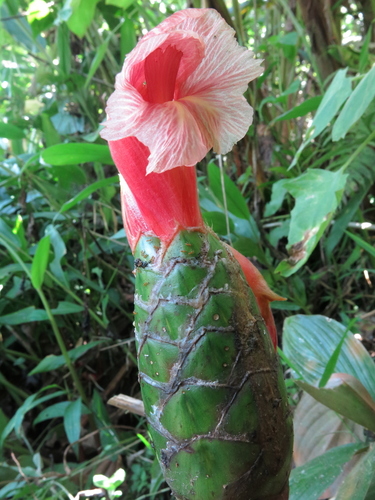
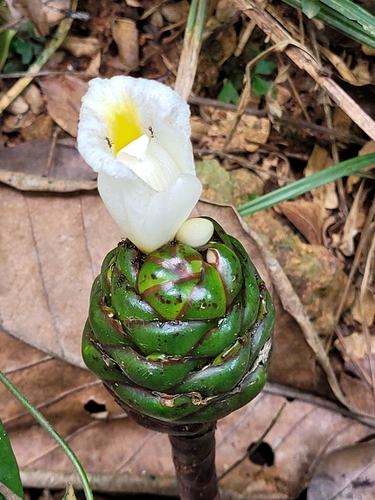
Costus scaber
Ruiz & Pav.
Cana agria, Red congo cane
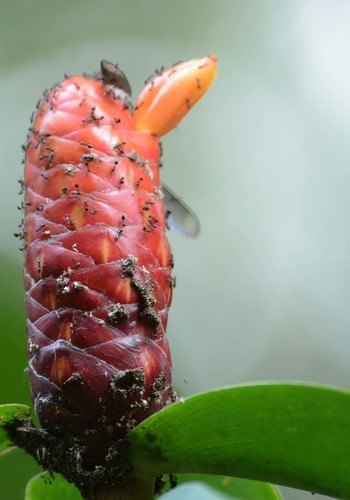
(c) Steve King, some rights reserved (CC BY-NC), uploaded by Steve King
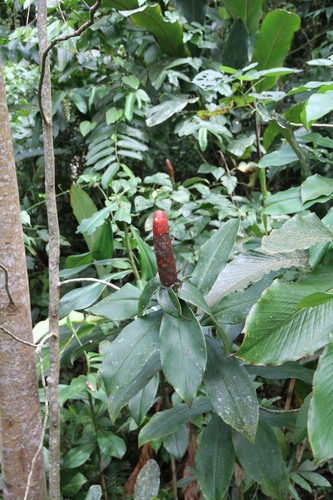
(c) Claus Rasmussen, some rights reserved (CC BY-NC)

(c) Sid Mosdell, some rights reserved (CC BY)
What to Eat
Edible parts: Leaves - flavouring, Stems - drink
The leaves are used as a flavouring; the stems are boiled and made into a fermented drink.
Where to Find It
It is a tropical plant. It grows on the edge of forests and along streams.
Amazon, Australia, Bolivia, Brazil, Central America, Colombia, Costa Rica, Dominican Republic, Ecuador, French Guiana, Guatemala, Guyana, Haiti, Hawaii, Honduras, Leeward Is., Mexico, Nicaragua, Panama, Peru, Puerto Rico, South America, Suriname, Trinidad-Tobago, Venezuela, West Indies,
How to Identify
A herb. It grows 3 m tall. The leaves are arranged in spirals. The leaves are narrowly oval and 32 cm long by 11 cm wide.
Wikipedia
Source ↗Costus scaber is a species of plant in the family Costaceae. Its native range is Mexico to Tropical America. In Costa Rica, Costus scaber is grown in homegardens and used to treat multiple medical conditions. In Trinidad, it is used as an ingredient in treating dogs for snakebite. Costus scaber has been introduced to Hawaii, the Leeward Islands, and Puerto Rico. It has been identified as native or alien to Saint Lucia. Costus scaber is very similar in appearance to other species of Costus, especially Costus spicatus and Costus spiralis.
Names & Synonyms
Auru iru, Canagre, Daavinchi remedyu ku'la, Eseyundu, Haisayundi, Kkilum, ilum Mauby, Orelha-da-onca, Shinachi
References (7)
- Kermath, B. M., et al, 2014, Food Plants in the Americas: A survey of the domesticated, cultivated and wild plants used for Human food in North, Central and South America and the Caribbean. On line draft. p 268
- Kew Plants of the World Online
- Maas, P.J. M., Non-timber forest products of the North-West District of Guyana. Part 1. Nationaal Herbarium Nederland, Universiteit Utrecht. p 100
- Maas, P.J. M., Non-Timber Forest Products of the North-West District of Guyana Part 2. The 85 most important NTFP species. p 70
- Torre, de la, L., et al, 2008, Enciclopedia de las Plantas Útiles del Ecuador. Herbario QCA. Pontificia Universidad Católica del Ecuador. p 296
- Useful plants of Guyana. Non-Timber Forest Products of the North-West District of Guyana Part 1. p 103
- Van den Eynden, V., et al, 2003, Wild Foods from South Ecuador. Economic Botany 57(4): 576-603