Cirsium edule
Nutt.
Edible thistle
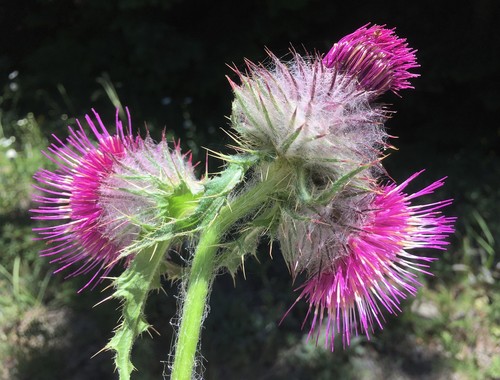
(c) Peter Zika, some rights reserved (CC BY-NC), uploaded by Peter Zika
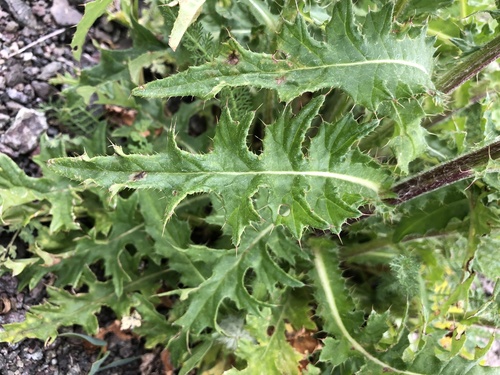
(c) americannaturalist90, some rights reserved (CC BY-NC), uploaded by americannaturalist90

(c) Alex Abair, some rights reserved (CC BY), uploaded by Alex Abair
What to Eat
Edible parts: Root, Stem
The root is edible cooked and is likely rich in inulin, a starch that humans cannot digest. It passes straight through the digestive system unchanged and may ferment in some individuals, producing flatulence. Young stems can be peeled and eaten raw; they are soft and sweet and are considered a luxury food. Young shoots, harvested in spring, can be eaten raw or cooked as greens. Seed oil can also be extracted by expression.
Where to Find It
It is a temperate plant. It grows in wet meadows and moist open woods.
Alaska, Canada, North America, USA,
How to Identify
A herb. It is a thistle. It grows 20-350 cm high. There is usually one stem. It has a tap-root and the plant grows for 2 years or a few years. The leaves are in a ring at the base and are prickly.
How to Grow
An easily grown plant, succeeding in any ordinary garden soil in a sunny position. A monocarpic species, it grows for a number of years without flowering but then dies after flowering.
Propagation: Sow seed in early spring or autumn in situ. Germination usually occurs within 2–8 weeks at 20°C.
Medicinal Uses
None known.
Other Uses
The seeds of all thistle species yield a useful oil by expression, though no details on potential yields are given.
Wikipedia
Source ↗Cirsium edule, the edible thistle or Indian thistle, is a species of thistle in the genus Cirsium, native to western North America from southeastern Alaska south through British Columbia to Washington and Oregon, and locally inland to Idaho. It is a larval host to the mylitta crescent and the painted lady. Cirsium edule is a tall herbaceous perennial plant, reaching 1–2 m (39–79 in) in height. The leaves are very spiny, lobed, 10–30 cm long and 2–5 cm broad (smaller on the upper part of the flower stem). The inflorescence is 3–4 cm diameter, purple, with numerous disc florets but no ray florets. The achenes are 4–5 mm long, with a downy pappus which assists in wind dispersal. It is monocarpic, growing as a low rosette of leaves for a number of years, then sending up the tall flowering stem in spring, with the plant dying after seed maturation. Edible thistle is used by Native Americans for its edible roots and young shoots. The roots are sweet, but contain inulin, which gives some people digestive problems. Varieties Cirsium edule var. edule - Oregon, Washington Cirsium edule var. macounii (Greene) D.J.Keil - Oregon, Washington, British Columbia, Alaska Cirsium edule var. edule wenatchense D.J.Keil - Washington
Notes
There are about 150-250 Cirsium species. They grow in temperate regions.
Names & Synonyms
Hall's thistle
References (8)
- Beckstrom-Sternberg, Stephen M., and James A. Duke. "The Foodplant Database." http://probe.nalusda.gov:8300/cgi-bin/browse/foodplantdb.(ACEDB version 4.0 - data version July 1994)
- Flora of North America. www.eFloras.org
- Kermath, B. M., et al, 2014, Food Plants in the Americas: A survey of the domesticated, cultivated and wild plants used for Human food in North, Central and South America and the Caribbean. On line draft. p 231
- Plants for a Future database, The Field, Penpol, Lostwithiel, Cornwall, PL22 0NG, UK. http://www.scs.leeds.ac.uk/pfaf/
- Saunders, C.F., 1948, Edible and Useful Wild Plants. Dover. New York. p 40
- Tozer, F., 2007, The Uses of Wild Plants. Green Man Publishing. p 69
- Turner, N., 1997, Food Plants of Interior First Peoples. Royal BC Museum Handbook p 95
- Turner, N., et al, 2011, "Up on the Mountain": Ethnobotanical Important of Montane Sites in Pacific Coastal North America. Journal of Ethnobiology 31(1): 4-43