Cirsium eriophorum
(L.) Scop.
Woolly thistle, Woolly-headed thistle
no rights reserved
no rights reserved
no rights reserved
What to Eat
Edible parts: Flowers, Leaves, Stem
Young leaves can be eaten raw. Young stems are edible raw or cooked and can serve as a substitute for asparagus or rhubarb; peeling and soaking the stems in water removes bitterness, after which they are said to be excellent eating. Flower buds can be cooked and used as a globe artichoke substitute, though they are much smaller and more fiddly to prepare. Seed oil can be extracted by expression.
Where to Find It
It is a Mediterranean climate plant. It grows in rough grassland and scrub.
Belgium, Britain, Europe, France, Greece, Italy, Europe, Luxembourg, Mediterranean, Slovenia, Spain, Turkey, Türkiye,
How to Identify
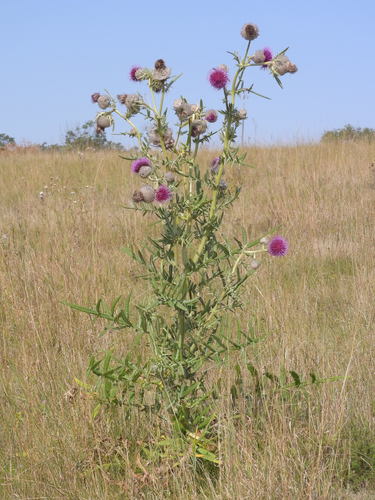
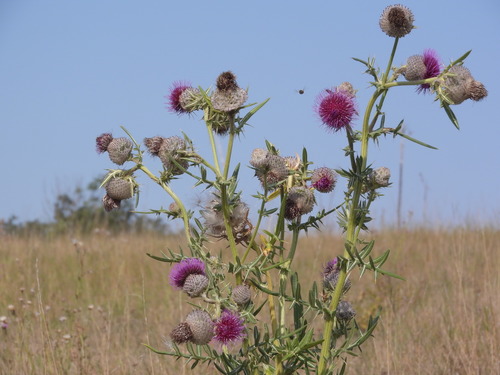
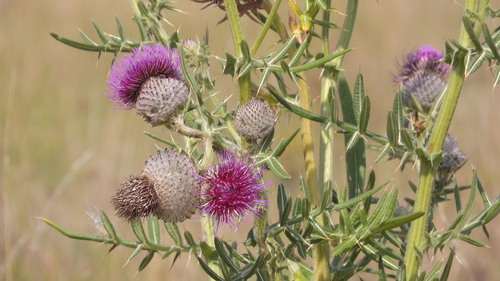
A herb. It is a medium sized thistle. It takes 2 years to complete its life-cycle. It grows 1.5 m high. The stems are unwinged. They are white and cottony. They are branched above. The leaves are divided into leaflets. There are long rigid spines. The leaves are white and cottony underneath. The flower heads are large. They are 25-50 mm across. They are reddish-purple. They usually occur singly. They are erect. The flower bracts have cobwebby hairs between them. The outer bracts curve backwards and have spines at their tips.
How to Grow
Propagation: Sow seed in early spring or autumn in situ. Germination usually occurs within 2–8 weeks at 20°C.
Medicinal Uses
None known.
Other Uses
The seed fluff can be used as tinder. The seeds of all thistle species yield a useful oil by expression, though no details on potential yields are given.
Wikipedia
Source ↗Cirsium eriophorum, the woolly thistle, is a herbaceous biennial species of flowering plant in the genus Cirsium of the family Asteraceae. It is widespread across much of Europe. It is a large biennial plant with sharp spines on the tips of the leaves, and long, woolly hairs on much of the foliage. The flower heads are large and nearly spherical, with spines on the outside and many purple disc florets but no ray florets.
Notes
There are about 150-250 Cirsium species. They grow in temperate regions.
Names & Synonyms
Volnatoglavi osat
References (4)
- Blamey, M and Grey-Wilson, C., 2005, Wild flowers of the Mediterranean. A & C Black London. p 451
- Facciola, S., 1998, Cornucopia 2: a Source Book of Edible Plants. Kampong Publications, p 36
- Hedrick, U.P., 1919, (Ed.), Sturtevant's edible plants of the world. p 205 (As Cnicus eriophorus)
- Plants for a Future database, The Field, Penpol, Lostwithiel, Cornwall, PL22 0NG, UK. http://www.scs.leeds.ac.uk/pfaf/