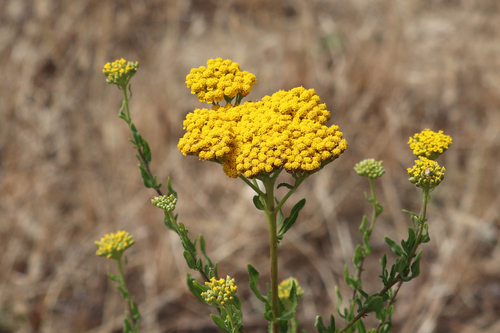
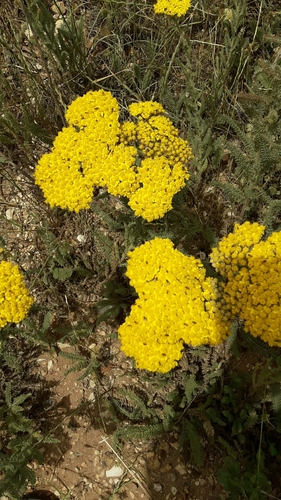
Cirsium oleraceum
(L.) Scop.
Cabbage thistle, Meadow cabbage, Vegetable thistle

(c) Marion Zöller, some rights reserved (CC BY-NC), uploaded by Marion Zöller

(c) ggalitz, some rights reserved (CC BY-NC)
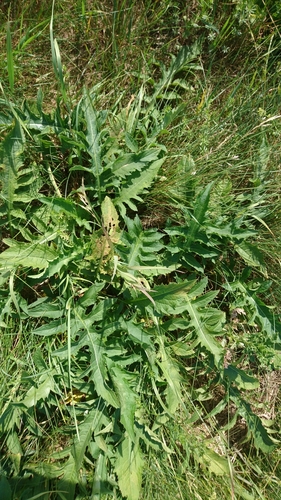
(c) Grzegorz Grzejszczak, some rights reserved (CC BY-SA), uploaded by Grzegorz Grzejszczak
What to Eat
Edible parts: Leaves, Root
Young leaves are cooked and used as a vegetable. The root is cooked and was formerly used as a table vegetable, harvested before the plant flowers. The root is likely rich in inulin, a starch the human body cannot digest, which passes straight through the digestive system and may ferment in some people, causing flatulence.
Where to Find It
It is a temperate plant. It grows in wet lowland soils.
Asia, Balkans, Bosnia, Britain, Estonia, Europe, France, Hungary, Italy, Lithuania, Luxembourg, Mediterranean, Poland, Russia, Siberia, Slovenia,
How to Identify
A herb. It is a thistle. It grows 1.5 m tall. The stems is usually unbranched and with few side branches. The leaves are oval with weakly spiny edges. The flowers are in dense flower heads 2.5-4 cm across. They are pale yellow.
How to Grow
Propagation: Sow seed in early spring or autumn directly in situ. Germination typically occurs within 2–8 weeks at 20°C. Can also be propagated by division in spring or autumn.
Medicinal Uses
None known.
Other Uses
The seed fluff can be used as a tinder. The seeds of all thistle species also yield a useful oil by expression. No details on potential yields are available.
Wikipedia
Source ↗Cirsium oleraceum, the cabbage thistle or Siberian thistle, is a species of thistle in the genus Cirsium within the family Asteraceae, native to central and eastern Europe and Asia, where it grows in wet lowland soils. Cirsium oleraceum is a herbaceous perennial plant growing to 1.5 m tall, the stems unbranched or with only a very few branches. The leaves are broad and ovoid, with a weakly spiny margin, being pinnatipartite. The flowers are produced in dense flower heads which are 2.5–4 cm diameter, pale yellow, but sometimes tinged pink. Its specific epithet oleraceum means "vegetable/herbal" in Latin and is a form of holeraceus (oleraceus).
Other Information
It is cultivated for food in India and Japan.
Notes
There are about 150-250 Cirsium species. They grow in temperate regions.
Names & Synonyms
Kaposztas acat, Mehki osat, Siberian thistle
References (12)
- Cerne, M., 1992, Wild Plants from Slovenia used as Vegetables. Acta Horticulturae 318
- Denes, A., et al, 2012, Wild plants used for food by Hungarian ethnic groups living in the Carpathian Basin. Acta Societatis Botanicorum Poloniae 81 (4): 381-396
- Facciola, S., 1998, Cornucopia 2: a Source Book of Edible Plants. Kampong Publications, p 37
- Hammer, K. & Spahillari, M., 1999, Crops of European origin. in Report of a networking group on minor crops. IPGRI p 44
- Hedrick, U.P., 1919, (Ed.), Sturtevant's edible plants of the world. p 205 (As Cnicus oleraceus)
- Lim, T. K., 2015, Edible Medicinal and Non Medicinal Plants. Volume 9, Modified Stems, Roots, Bulbs. Springer p 24
- Łukasz Łuczaj and Wojciech M Szymański, 2007, Wild vascular plants gathered for consumption in the Polish countryside: a review. J Ethnobiol Ethnomedicine. 3: 17
- Luczaj, L. et al, 2012, Wild food plant use in 21st century Europe: the disappearance of old traditions and the search for new cuisines involving wild edibles. Acta Soc Bot Pol 81(4):359–370
- Paoletti, M.G., Dreon, A.L., and Lorenzoni, G.G., 1995, Pistic, Traditional Food from Western Friuli, NE Italy. Economic Botany 49(1) pp 26-30
- Plants for a Future database, The Field, Penpol, Lostwithiel, Cornwall, PL22 0NG, UK. http://www.scs.leeds.ac.uk/pfaf/
- Prakofjewa, J., et al, 2023, Boundaries Are Blurred: Wild Food Plant Knowledge Circulation across the Polish-Lithuanian-Belarusian Borderland. Biology 2023, 12, 571.
- Redzic, S. J., 2006, Wild Edible Plants and their Traditional Use in the Human Nutrition in Bosnia-Herzegovina. Ecology of Food and Nutrition, 45:189-232