Cirsium segetum
Bunge
Lesser thistle
(c) Yurii Basov, some rights reserved (CC BY)
(c) Yurii Basov, some rights reserved (CC BY)
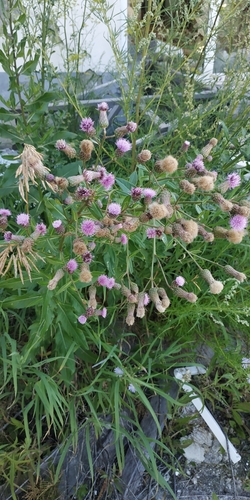
(c) Yurii Basov, some rights reserved (CC BY)
What to Eat
Edible parts: Leaves
Young leaves are eaten as a vegetable, typically boiled, washed, drained and seasoned for salads, or cooked with cracked cereals as a famine food.
Where to Find It
It is a temperate plant. It is common in northern China.
Asia, China, Japan, Korea, Manchuria, Mongolia,
How to Identify
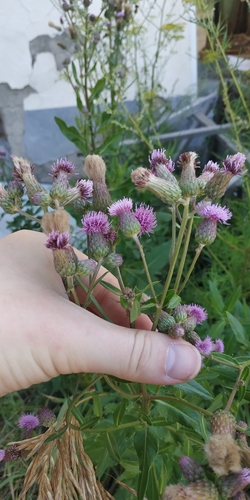
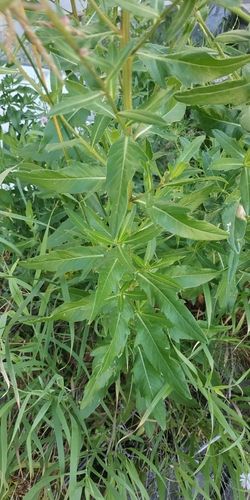
A spiny herb. It is a thistle. It keeps growing from year to year. It grows 10-60 cm high. There are wire like underground stems or rhizomes. The buds at the end develop into aerial shoots. The leaves on young plants are in a ring. The leaves on the stems are alternate. They are sword shaped and 2-10 cm long by 1-3 cm wide. They do not have leaf stalks. The flowers are purple-red.
Notes
There are about 150-250 Cirsium species. They grow in temperate regions.
Names & Synonyms
Chonun haltar
References (6)
- Enum. pl. China bor. 36. 1833 (Mem. Acad. Imp. Sci. St.-Petersbourg Divers Savans 2:110. 1835)
- Hu, Shiu-ying, 2005, Food Plants of China. The Chinese University Press. p 726
- Kang, Y., et al, 2012, Wild food plants and wild edible fungi in two valleys on the Qinling Mountains (Shaanxi, central China) Journal of Ethnobiology and Ethnomedicine; 9:26
- Khasbagan, Hu-Yin Huai, and Sheng-Ji pei, 2000, Wild Plants in the Diet of Athorchin Mongol Herdsmen in Inner Mongolia. Economic Botany 54(4): 528-536
- Plants for a Future database, The Field, Penpol, Lostwithiel, Cornwall, PL22 0NG, UK. http://www.scs.leeds.ac.uk/pfaf/
- Wujisguleng, W., & Khasbagen. K., 2010, An integrated assessment of wild vegetable resources in Inner Mongolian Autonomous Region, China. Journal of Ethnobiology and Ethnomedicine 6:34