Cirsium undulatum
(Nutt.) Spreng.
Wavy-leaved thistle
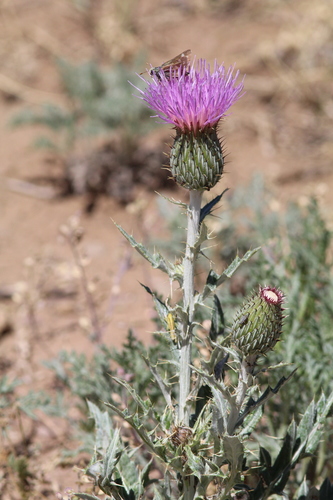
(c) adriscoll, some rights reserved (CC BY-NC), uploaded by adriscoll

(c) Matt Lavin, some rights reserved (CC BY-SA)

(c) Steven Mlodinow, some rights reserved (CC BY-NC), uploaded by Steven Mlodinow
What to Eat
Edible parts: Root, Stem, Flowers, Seeds, Leaves
The taproot and young peeled stems are the most useful edible parts. Roots are best harvested before flowering and can be eaten raw or cooked — one of the more palatable thistles, usable as a vegetable or added to soups and stews. They can also be dried and stored for winter use. The root is likely rich in inulin, a starch the human body cannot digest, which passes straight through the digestive system and may ferment in some people, causing flatulence. Peeled stems can be eaten raw or cooked and are also considered among the more palatable parts of this thistle. Seeds of all thistle species yield a useful oil by expression.
Where to Find It
It is a temperate plant. It grows in dry, well drained open places.
Canada, North America, USA,
How to Identify
A herb. It is a thistle. It has a tap root and usually takes 2 years to complete its life cycle but can grow from a few years. The leaves are in a ring near the base and have prickles.
How to Grow
Propagation: Sow seed in early spring or autumn in situ. Germination typically occurs within 2–8 weeks at 20°C.
Medicinal Uses
A decoction of the root has been used in the treatment of gonorrhoea. A cold infusion of the root has been used as a wash for eye diseases.
Other Uses
The seeds yield a good oil by expression, though no details on potential yields are given.
Wikipedia
Source ↗Cirsium undulatum is a species of thistle known by the common names wavyleaf thistle and gray thistle. It is native to much of central and western North America from British Columbia east to Manitoba and south as far as the State of Durango in Mexico. It has also been found outside of its native range as an introduced species. Cirsium undulatum is widespread and found in many habitat types. It is a perennial herb exceeding 200 cm (79 in) in height. The stem branches a few times toward the top of the plant if at all. The leaves are very wavy along the edges and usually cut into shallow toothed lobes. The longest near the base of the plant are up to 30 centimetres (12 inches) long. The inflorescence holds one or more flower heads each up to 5 centimetres (2.0 inches) long and wide. The head is lined with spiny phyllaries of different shapes. The flowers in the head are white to lavender to pink and up to 5 centimetres (2.0 inches) long. The fruit is an achene a few millimeters long with a pappus which may be up to 4 centimeters in length. Cirsium undulatum has been shown to have its seed production reduced by an exotic weevil Larinus planus which was released to control Canada thistle.
Notes
There are about 150-250 Cirsium species. They grow in temperate regions.
References (7)
- Beckstrom-Sternberg, Stephen M., and James A. Duke. "The Foodplant Database." http://probe.nalusda.gov:8300/cgi-bin/browse/foodplantdb.(ACEDB version 4.0 - data version July 1994)
- Kermath, B. M., et al, 2014, Food Plants in the Americas: A survey of the domesticated, cultivated and wild plants used for Human food in North, Central and South America and the Caribbean. On line draft. p 230
- Plants for a Future database, The Field, Penpol, Lostwithiel, Cornwall, PL22 0NG, UK. http://www.scs.leeds.ac.uk/pfaf/
- Syst. veg. 3:374. 1826
- Tozer, F., 2007, The Uses of Wild Plants. Green Man Publishing. p 69
- Turner, N., 1995, Food Plants of Coastal First Peoples. Royal BC Museum Handbook p 60
- Turner, N., 1997, Food Plants of Interior First Peoples. Royal BC Museum Handbook p 95