Saussurea costus
(Falc.) Lipsch.
Costus
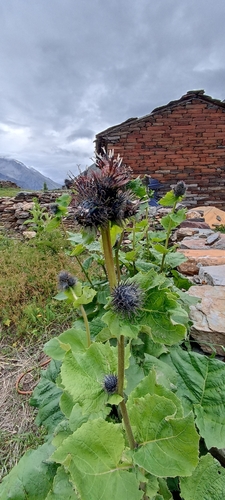
(c) Rajendra Koranga, some rights reserved (CC BY-NC)
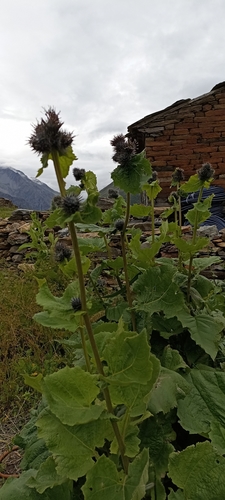
(c) Rajendra Koranga, some rights reserved (CC BY-NC)
(c) Rajendra Koranga, some rights reserved (CC BY-NC)
What to Eat
Edible parts: Herb, Root - spice
The aromatic root is sometimes used as a spice. It has a characteristic penetrating odour reminiscent of violet, orris, and vetiver.
Known Hazards
Where to Find It
It is a temperate plant. It grows between 2,500-3,000 m above sea level. It suits hardiness zone 6-9.
Asia, China, Himalayas, India, Indochina, Pakistan, South Asia, Tibet,
How to Identify
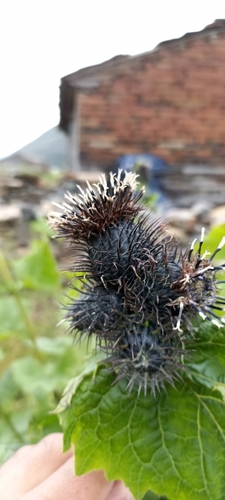
Perennial reaching 3 m tall and 1 m wide with hermaphrodite flowers pollinated by insects. Flowers July to August with seeds ripening August to September. Hardy to UK zone 7. Tolerates light sandy, medium loamy, and heavy clay soils across mildly acid to basic pH. Grows in semi-shade or full sun and prefers moist soil.
How to Grow
Propagation: No specific information is available for this species. It is suggested to surface-sow seed, or just barely cover it, in a cold frame in spring, keeping the compost moist throughout. Prick seedlings into individual pots when large enough to handle and grow on in a greenhouse or cold frame through their first winter, then plant out in late spring after the last expected frosts. Division in spring may also be possible.
Medicinal Uses
Costus is a widely used medicinal herb in China and is counted among the 50 fundamental herbs of Chinese medicine. It is also used in Ayurvedic medicine, where it is valued chiefly for its tonic, stimulant, and antiseptic properties, and is said to be aphrodisiac and capable of preventing the hair from turning grey. The root is anodyne, antibacterial, antispasmodic, aphrodisiac, carminative, stimulant, stomachic, tonic, and vermifuge. Internally it is used to treat abdominal distension and pain, chest pains due to liver problems and jaundice, gall bladder pain, constipation associated with energy stagnation, and asthma. The root is harvested in autumn or spring and either dried for later use or decocted for its essential oil; it is normally used in combination with other herbs. In Tibetan medicine the root is considered to have an acrid, sweet, and bitter taste with a neutral potency, and is used for swelling and fullness of the stomach, blockage and irregular menses, pulmonary disorders, difficulty in swallowing, and rotting or wasting of muscle tissues. An oil from the root is considered very beneficial in the treatment of rheumatism.
Other Uses
An essential oil obtained from the roots is used medicinally, in perfumery, in incenses, and as a hair rinse said to darken grey hair. The oil has a strong, lingering scent — initially like violets, though with age it can become more fur-like or eventually unpleasantly goat-like. Roots are cut into lengths of about 8cm and dried before export. Smaller pieces are ground into powder for making incense sticks, while longer, clean pieces are sliced very thin and burnt at shrines or added to hot baths as a tonic.
Wikipedia
Source ↗Perennial reaching 3 m tall and 1 m wide with hermaphrodite flowers pollinated by insects. Flowers July to August with seeds ripening August to September. Hardy to UK zone 7. Tolerates light sandy, medium loamy, and heavy clay soils across mildly acid to basic pH. Grows in semi-shade or full sun and prefers moist soil.
Other Information
It is cultivated.
Notes
Oils from the root are used in medicine.
Names & Synonyms
Changala, Gostham, Koshet, Kostha, Kostum, Kur, Kust, Kustha, Kut, Kuth, Mu xiang, Oachak, Potchuk, Qust, Sepuddy, Upaleta
References (3)
- Encyclopedia of Life.
- Plants for a Future.
- Wiersema, J. H. & Leon, B., 2013, World Economic Plants. A Standard Reference CRC Press. 2nd Ed. p 616