Aloe affinis
A. Berger
XanthorrhoeaceaeLeaves

iNaturalist · cc-by-nc
(c) Simon Attwood, some rights reserved (CC BY-NC), uploaded by Simon Attwood
(c) Simon Attwood, some rights reserved (CC BY-NC), uploaded by Simon Attwood
iNaturalist · cc-by-nc
(c) Dawie, some rights reserved (CC BY-NC), uploaded by Dawie
(c) Dawie, some rights reserved (CC BY-NC), uploaded by Dawie

iNaturalist · cc-by-nc
(c) Simon Attwood, some rights reserved (CC BY-NC), uploaded by Simon Attwood
(c) Simon Attwood, some rights reserved (CC BY-NC), uploaded by Simon Attwood
What to Eat
Edible parts: Leaves - potash
The leaves are processed to produce potash.
Where to Find It
It is a subtropical plant.
Africa, Southern Africa,
Countries: Angola, Burkina Faso, Burundi, Benin, Botswana, Congo (DRC), Central African Republic, Congo (Republic), Cote d'Ivoire, Cameroon, Cape Verde, Djibouti, Algeria, Egypt, Eritrea, Ethiopia, Gabon, Ghana, Gambia, Guinea, Equatorial Guinea, Guinea-Bissau, Kenya, Comoros, Liberia, Lesotho, Libya, Morocco, Madagascar, Mali, Mauritania, Mauritius, Malawi, Mozambique, Namibia, Niger, Nigeria, Rwanda, Seychelles, Sudan, Sierra Leone, Senegal, Somalia, South Sudan, Sao Tome & Principe, Eswatini, Chad, Togo, Tunisia, Tanzania, Uganda, South Africa, Zambia, Zimbabwe
How to Identify
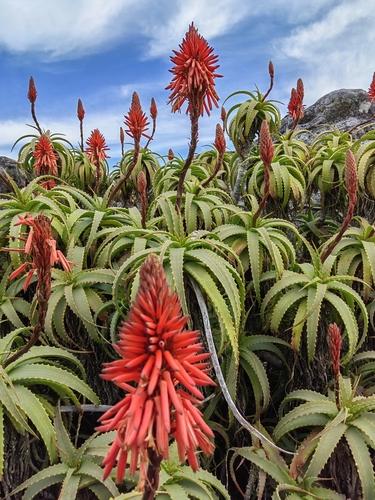
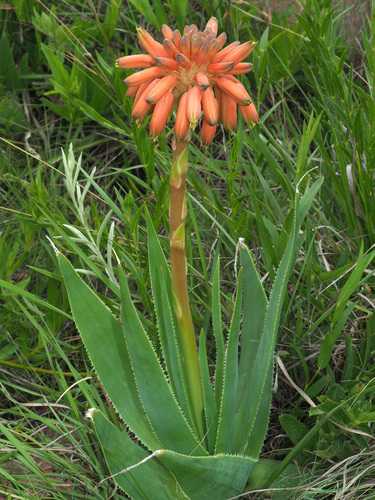
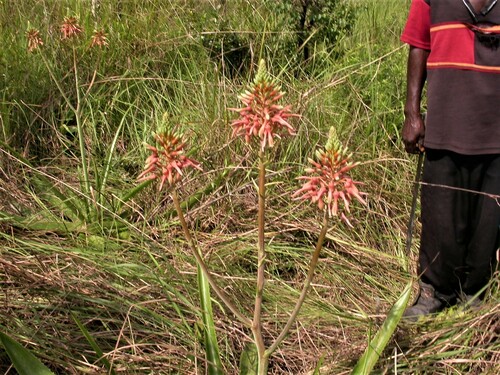
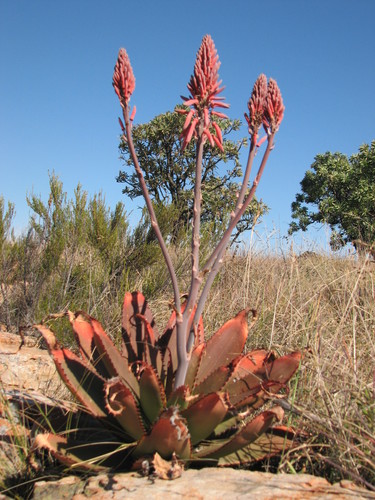
A plant that grows singly and does not have a stem. It grows 20-30 cm tall. There are 16-20 leaves in rings. These are 20-40 cm long by 5-10 cm wide. They are D shaped and point upwards. There are 3-8 flowering shoots on the upper branches. The flowers are dull red.
Wikipedia
Source ↗Aloe affinis is a species of flowering plant in the Asphodelaceae family. It is endemic to Limpopo, Gauteng, and Mpumalanga, of South Africa. It grows 200–300 mm tall excluding inflorescence, with 16-20 leaves per plant, each leaf being roughly 200 mm long x 50–100 mm wide.
Notes
Also put in the family Asphodelaceae.
References (2)
- Ruiters-Welcome, A. K., 2019, Food plants of southern Africa. Ph.D. thesis. Univ. of Johannesburg p 30
- Welcome, A. K. & Van Wyk, B.-E., 2019, An inventory and analysis of the food plants of southern Africa. South African Journal of Botany 122 (2019) 136–179