Eremiolirion amboense
(Schinz.)J. C. Manning & Mannheimer
Desert snowdrop
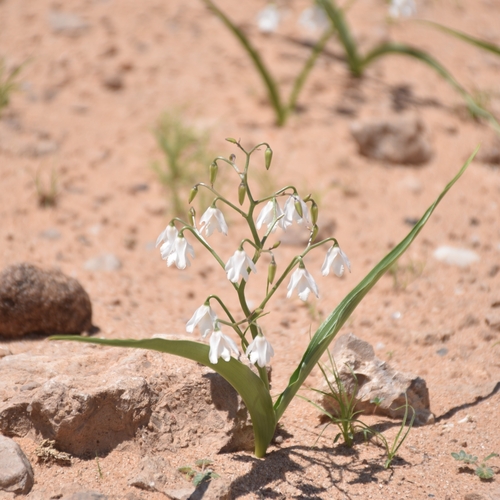
(c) Nathan Van Cooten, some rights reserved (CC BY), uploaded by Nathan Van Cooten
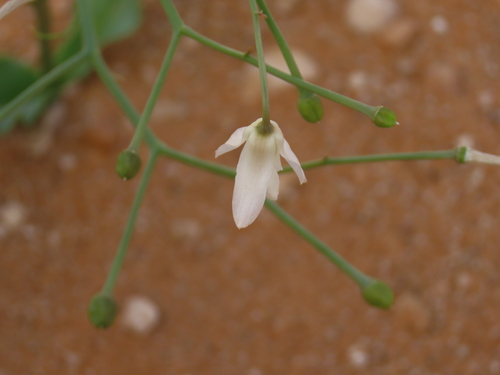
no rights reserved
What to Eat
Edible parts: Root, Bulb, Corm
The corms and roots are eaten as part of the traditional bushmen diet.
Where to Find It
It is a subtropical plant. It grows in hot arid regions with a marked dry season. It grows in well drained soils. It grows between 50-800 m above sea level. It can grow in arid places.
Africa, Namibia, South Africa, Southern Africa,
How to Identify
A herb. It keeps growing from year to year but loses its leaves during the year. It grows 25 cm high. The corms are about 3 cm across. They have a covering of netted fibres. There are 2 leaves at the base. These are narrow and sword shaped and 10 cm long by 1-2 cm wide. The flowers are nodding and white with pink. They close at night and open again in the morning. There are about 30 flowers in a group.
Other Information
The corms are part of the traditional bushmen diet.
Names & Synonyms
Uias
References (5)
- Plants for a Future database, The Field, Penpol, Lostwithiel, Cornwall, PL22 0NG, UK. http://www.scs.leeds.ac.uk/pfaf/ (As Cyanella amboensis)
- Royal Botanic Gardens, Kew (1999). Survey of Economic Plants for Arid and Semi-Arid Lands (SEPASAL) database. Published on the Internet; http://www.rbgkew.org.uk/ceb/sepasal/internet [Accessed 11th June 2011] (As Cyanella amboensis)
- Ruiters-Welcome, A. K., 2019, Food plants of southern Africa. Ph.D. thesis. Univ. of Johannesburg p 105
- Welcome, A. K. & Van Wyk, B.-E., 2019, An inventory and analysis of the food plants of southern Africa. South African Journal of Botany 122 (2019) 136–179
- World Checklist of Useful Plant Species 2020. Royal Botanic Gardens, Kew


