Dioon spinulosum
Dyer
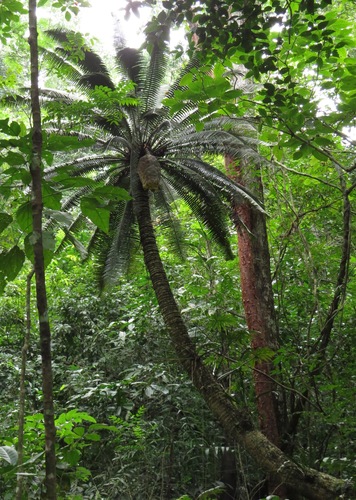
(c) Rich Hoyer, some rights reserved (CC BY-NC-SA), uploaded by Rich Hoyer

(c) olany, some rights reserved (CC BY-NC), uploaded by olany
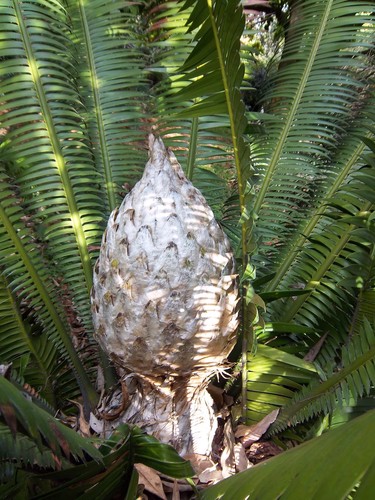
(c) Pablo Galán, some rights reserved (CC BY-NC), uploaded by Pablo Galán
What to Eat
Edible parts: Fruit
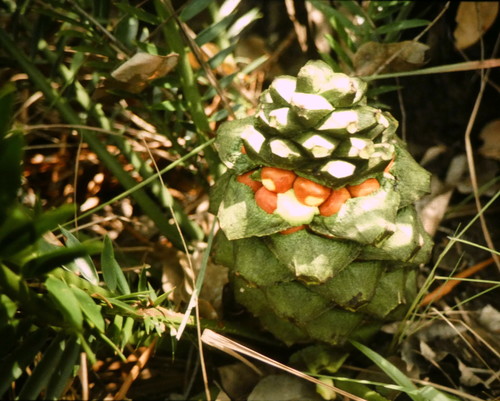
The kernels of the large seeds contain much starch and are said to be roasted or boiled and then eaten. The kernels are also used as a source of meal or starch. The ovoid seeds are 40 - 50mm long, 30 - 35mm wide. In order to remove any toxins, the seeds are shelled, ground to a powder, then washed several times in running water. The end product is a flour-like substance that is almost pure starch, it used to make tortillas. The fleshy testa of the seeds can be used as food. The stems are rich in starch and can be used to make a sago. The pitch-like sap is chewed as a gum.
Known Hazards
How to Identify
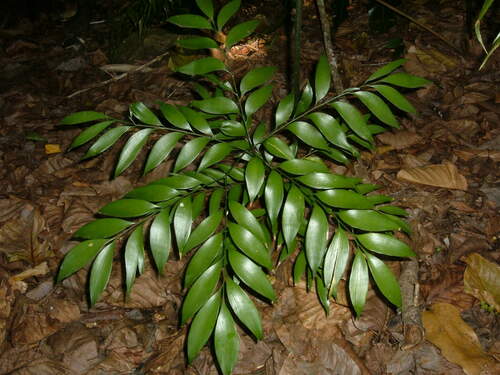
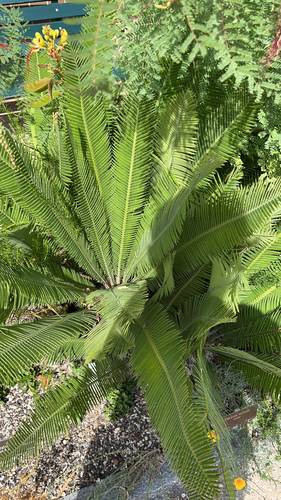
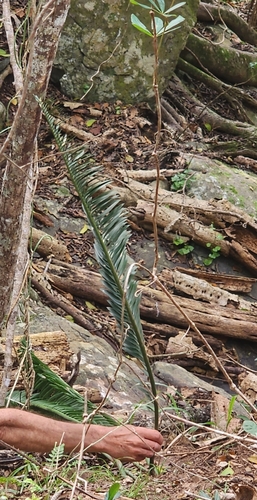
A tropical cycad with edible fruit.
How to Grow
Dioon spinulosum is native to the tropical climate of southern Mexico. Annual rainfall averages more than 2,000 mm, falling mainly in the summer. Summers are hot and humid with frequent rains, whilst winters are warm and generally dry. The plant is somewhat frost tolerant, surviving occasional periods of several degrees below freezing, but lower temperatures will cause foliar damage or complete defoliation. High temperatures and full sun do not usually cause damage, even to forest-dwelling species. Most species of Dioon are easily cultivated and grow with minimal care. Plants are able to grow in low light intensities and on poor soils. Plants in the wild commonly grow out of cracks and pockets in solid rock. Seeds can germinate in small fissures in the cliffs, and growth can be painfully slow until the roots find their way to a pocket of soil. Large plants have been observed growing out of a small hole or fissure in a limestone cliff with one large root connecting them to a patch of soil some 10 metres distant The stems of Dioon species are clothed in a thick armour of old leaf bases that protect them from the frequent fires that pass through their habitat. Their trunks are also clothed in a thick layer of dense, wooly hairs which persist and give protection until burned off. The tops of plants are often cut down in order to obtain the seeds or sell the tops for decorations. Unlike many other cycads, this species does not often sucker from the remaining rootstock after the upper portion of the plant has been removed. The portion of the trunk that is left slowly rots away, and a cycad that has taken hundreds of years to develop is just a memory. Species in this genus form structures known as coralloid roots. These roots branch off from the taproot or secondary roots and are distinctive in that they grow laterally or upward, forming a nodular mass at the apex. These coralloid roots occur slightly below or slightly above the soil surface and generally contain cyanobacteria, also known as blue-green algae. These are able to fix atmospheric nitrogen and make it available as a nutrient to the plant. The ability to extract this important nutrient from the air explains how many cycad species are able to survive on almost sterile soils. A dioecious species, with individual plants producing either all male or all female cones. Therefore both male and female forms of the plant need to be grown if seed is required. Female plants only produce one seed cone at each reproductive cycle, which generally occurs once every three to four years. This cone can take more than one year to mature. The ovoid cones of this species are 35 - 50cm long and 20 - 27cm in diameter, covered with a dense layer of short woolly hairs. They can weigh up to 18 kilos.
Propagation: Seed - surface sow on damp sand at a temperature of 24 - 32°c. On emergence of the radicle, pot the seedling into its own pot of a sandy compost and grow on in shaded warm conditions. Avoid any damage to the taproot and coralloid roots when repotting. Repot and feed frequently to encourage development and plant out when whorls of leaves are being produced, which can be 4 - 8 years.
Other Uses
The dry, stony seedcoats are sometimes used as playthings or whistles.
Wikipedia
Source ↗Dioon spinulosum, giant dioon or spiny dioon, is a cycad endemic to limestone cliffs and rocky hillsides in the tropical rainforests of Veracruz and Oaxaca, Mexico. It is one of the tallest cycads in the world, growing to 16 meters in height. The tree is found at low elevations to 300 meters above sea level. Dioon spinulosum prefers well-drained soil with regular water. It will grow in soils containing few nutrients, in soils rich in limestone, and on slopes.
Notes
The name is ambiguous.
Names & Synonyms
Chicalito, Cica, Maiz de palma, Palma de chicalite
References (2)
- Piedra-Malagón, E. M., et al, 2022, Edible native plants of the Gulf of Mexico Province. Biodiversity Data Journal 10: e80565 p 32
- Segura, S., et al, 2018, The edible fruit species in Mexico. Genet Resour Crop Evol (2018) 65:1767–1793
More from Zamiaceae