Cycas circinalis
(L.) Laut. & Sch.
Queen sago, Sago cycad
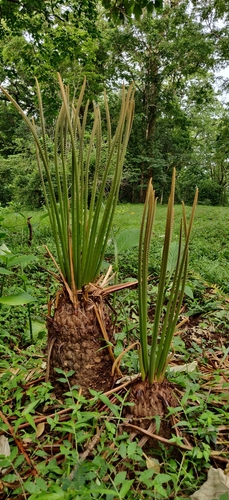
(c) T R Shankar Raman, some rights reserved (CC BY), uploaded by T R Shankar Raman

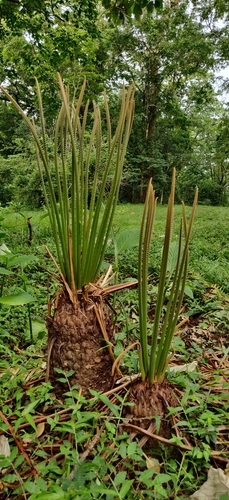
(c) Madhushri Mudke, some rights reserved (CC BY-NC), uploaded by Madhushri Mudke
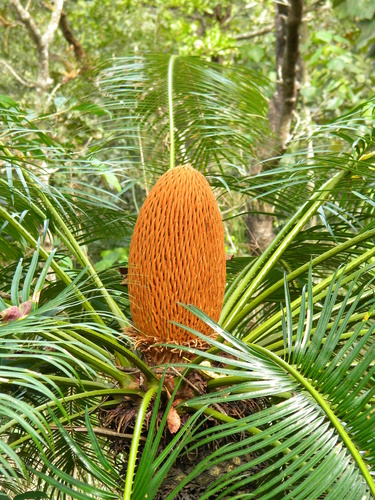
(c) Ansil B.R., some rights reserved (CC BY), uploaded by Ansil B.R.
What to Eat
Edible parts: Seeds, Caution, Leaves, Pith, Shoots
The pith of Cycas circinalis is rich in carbohydrate and can be processed into sago, though doing so kills the plant. The raw seed is poisonous, but can be made edible by slicing it thinly, drying it, steeping it in water for a few minutes, and drying it again — it can then be used as a sago. Using the seed for food is not recommended given its toxicity. The very young leaves are also edible. The plant yields a gum, though no further details are given.
Known Hazards
Where to Find It
A tropical plant. It occurs locally and near the sea. It is widely distributed in the Philippines. They occur in lowland areas in grassland and forest. They grow from sea level to 700 m altitude. They are more common in places with a dry seasonal climate. In India they grow up to 1000 m altitude. It suits hardiness zones 10-12.
Africa, Asia, Australia, Caribbean, East Africa, Fiji, Guam, India, Indochina, Indonesia, Kiribati, Madagascar, Malaysia, Mariana Islands, Marquesas, Marshall Islands, Micronesia, Myanmar, Nauru, New Caledonia, Niue, Pacific, Palau, Papua New Guinea, PNG, Philippines, SE Asia, Singapore, Sri Lanka, Thailand, Tonga, Vanuatu, Vietnam, Yap,
How to Identify
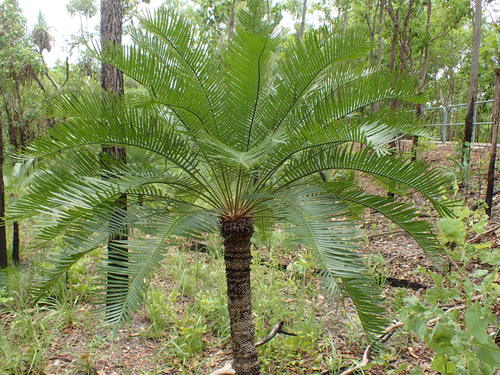
A palm like plant. The trunk is covered with the bases of the old leaves. The leaves have leathery leaflets with a distinct midrib. The leaves are something like feathers with a series of leaflets on each side of the leaf stalk. The leaves are in a cluster at the top of the trunk. A cone of thick leaves with large seeds is produced at the top. There are separate male and female plants. The seeds are 3-4 cm across with a thin fleshy covering and a starchy centre.
How to Grow
Requires a strong loam with sharp sand and good drainage. Succeeds in dry soils. Requires a sunny position. This species is not fully hardy in Britain and requires greenhouse or conservatory protection over the winter, but it can be grown outdoors in the summer. Plants are slow-growing. This plant is often used as a food source in its native range but recent research has shown that it can cause chronic nervous disorders if it is not treated properly. Overall its use is not to be recommended, especially since it is becoming rare in the wild. The plants produce special upward growing roots where nitrogen is produced in symbiosis with algae. Dioecious, male and female plants must be grown if seed is required.
Propagation: Sow seed in a greenhouse as soon as it is ripe, 2cm deep in individual pots sealed in plastic bags to maintain moisture until germination. Germination takes 1–3 months at 25°C. Pre-soak stored seed for 24 hours in warm water before sowing the same way. The plant can also be propagated by dividing suckers in spring.
Medicinal Uses
The pollen is narcotic. The bark and seeds can be ground into a paste with oil and applied as a poultice on sores and swellings. The juice of tender leaves is useful in treating flatulence and vomiting.
Other Uses
The plant yields a gum. It is also a nitrogen fixer.
Wikipedia
Source ↗Cycas circinalis, also known as the queen sago, is a species of cycad known in the wild only from southern India. Cycas circinalis is the only gymnosperm species found among native Sri Lankan flora.
Production
It is a slow growing plant. Plants for sago need to be 7 years old and not to have flowered.
Notes
There are about 20-40 Cycas species. Some of these in Papua New Guinea are now classified as Cycas apoa.
Names & Synonyms
Bitogo, Canningay, Chin-mondaing, Enthu, Fadang, Faho, Indapana, Intalappana, Jangli-madan-mast-ka-phul, Kamkshi, Limel, Logologo, Madanagama, Madu, Mundicalu, Mwel, Mwele, Mol, Ni-baam, Oruguna, Pakis haji, Pakis raja, Pitogo, Te bam, Varaguna
References (46)
- Ambasta, S.P. (Ed.), 2000, The Useful Plants of India. CSIR India. p 153
- Arinathan, V., et al, 2007, Wild edibles used by Palliyars of the western Ghats, Tamil Nadu. Indian Journal of Traditional Knowledge. 6(1) pp 163-168
- Ashton, M. S., et al 1997, A Field Guide to the Common Trees and Shrubs of Sri Lanka. WHT Publications Ltd. pdf p 63 Barrau, J., 1976, Subsistence Agriculture in Melanesia. Bernice P. Bishop Museu, Bulletin 219 Honolulu Hawaii. Kraus reprint. p 50
- Bole, P.V., & Yaghani, Y., 1985, Field Guide to the Common Trees of India. OUP p 33
- Borrell, O.W., 1989, An Annotated Checklist of the Flora of Kairiru Island, New Guinea. Marcellin College, Victoria Australia. p 11
- Bourret, D., 1981, Bonnes-Plantes de Nouvelle-Caledonie et des Loyaute. ORSTOM. p 73
- Brickell, C. (Ed.), 1999, The Royal Horticultural Society A-Z Encyclopedia of Garden Plants. Convent Garden Books. p 326
- Brouk, B., 1975, Plants Consumed by Man. Academic Press, London. p 227
- Brown, W.H., 1920, Wild Food Plants of the Philippines. Bureau of Forestry Bulletin No. 21 Manila. p 19
- Burkill, I.H., 1966, A Dictionary of the Economic Products of the Malay Peninsula. Ministry of Agriculture and Cooperatives, Kuala Lumpur, Malaysia. Vol 1 (A-H) p 729
- Cabalion, P. and Morat, P., 1983, Introduction le vegetation, la flore et aux noms vernaculaires de l'ile de Pentcoste (Vanuatu), In: Journal d'agriculture traditionnelle et de botanique appliquee JATBA Vol. 30, 3-4
- Clarke, W.C. & Thaman, R.R., 1993, Agroforestry in the Pacific Islands: Systems for sustainability. United Nations University Press. New York. p 235
- Cundall, P., (ed.), 2004, Gardening Australia: flora: the gardener's bible. ABC Books. p 449
- Etherington, K., & Imwold, D., (Eds), 2001, Botanica's Trees & Shrubs. The illustrated A-Z of over 8500 trees and shrubs. Random House, Australia. p 248
- Facciola, S., 1998, Cornucopia 2: a Source Book of Edible Plants. Kampong Publications, p 90
- French, B.R., 1986, Food Plants of Papua New Guinea, A Compendium. Asia Pacific Science Foundation p 339
- Garcia, G. S. C., 2006, The mother-child nexus. Knowledge and valuation of wild food plants in Wayanad, Western Ghats, India. Journal of Ethnobiology and Ethnomedicine, 2:39
- Hedrick, U.P., 1919, (Ed.), Sturtevant's edible plants of the world. p 256
- Henty, E.E., & Pritchard, G.S., 1973, Weeds of New Guinea and their control. Botany Bulletin No 7, Division of Botany, Lae, PNG. p 27
- Henty, E.E., 1980, Harmful Plants in Papua New Guinea. Botany Bulletin No 12. Division Botany, Lae, Papua New Guinea. p 44, 46
- Hibbert, M., 2002, The Aussie Plant Finder 2002, Florilegium. p 79
- Johns, R.J., 1976, Common Forest Trees of Papua New Guinea. Part 1 Gymnospermae, Forestry College Bulolo, PNG p 4
- Jones, D.L., 2000, Cycads of the world. Reed New Holland. p 137
- Lacuna-Richman, C., 2006, The use of non-wood forest products by migrants in a new settlement: experiences of a Visayan community in Palawan, Philippines. Journal of Ethnobiology and Ethnomedicine. 2:36
- Lugod, G.C. and de Padua L.S., 1979, Wild Food Plants in the Philippines. Vol. 1. Univ. of Philippines Los Banos. p 32
- Macmillan, H.F. (Revised Barlow, H.S., et al), 1991, Tropical Planting and Gardening. Sixth edition. Malayan Nature Society. Kuala Lumpur. p 356
- Martin, F.W. & Ruberte, R.M., 1979, Edible Leaves of the Tropics. Antillian College Press, Mayaguez, Puerto Rico. p 190
- Martin, F. W., et al, 1987, Perennial Edible Fruits of the Tropics. USDA Handbook 642 p 25
- McClatchey, W. C., 2012, Wild food plants of Remote Oceania. Acta Societatis Botanicorum Poloniae 81(4) 371-380
- Menninger, E.A., 1977, Edible Nuts of the World. Horticultural Books. Florida p 162
- Nurfadilah, S., et al, 2017, Species richness, conservation status, and potential uses of plants in Segara Anakan Area of Sempu Island, East Java, Indonesia. BIODIVERSITAS. Volume 18, Number 4,
- Parham, H. B. R, 1940, Supplement to the Journal of the Polynesian Society No. 16. Fiji Plants: Their Name and Uses.
- Pham-Hoang Ho, 1999, An Illustrated Flora of Vietnam. Nha Xuat Ban Tre. p 213
- Plants for a Future database, The Field, Penpol, Lostwithiel, Cornwall, PL22 0NG, UK. http://www.scs.leeds.ac.uk/pfaf/
- Prasad, P.N., & Abraham, Z., 1984, Ethnobotany of the Nayads of North kerala. J. Econ. Tax. Bot. Vol. 5 No. 1 pp 41-
- Rajapaksha, U., 1998, Traditional Food Plants in Sri Lanka. HARTI, Sri Lanka. p 175
- Rasingam, L., 2012, Ethnobotanical studies on the wild edible plants of Irula tribes of Pillur Valley, Coimbatore district, Tamil Nadu, India. Asian Pacific Journal of Tropical Biomedicine. (2012) S1493-S1497
- Sahni, K.C., 2000, The Book of Indian Trees. Bombay Natural History Society. Oxford. p 192
- Sp. pl. 2:1188. 1753
- Staples, G.W. and Herbst, D.R., 2005, A tropical Garden Flora. Bishop Museum Press, Honolulu, Hawaii. p 68
- Stone, B. C., 1970, The Flora of Guam. A Manual for the Identification of the Vascular Plants of the Island. Micronesica. Journal of the University of Guam. p 65
- Thaman, R.R., 1976, The Tongan Agricultural System, University of the South Pacific, Suva, Fiji. p 394
- Thaman, R. R., 1987, Plants of Kiribati: A listing and analysis of vernacular names. Atoll Research Bulletin No. 296
- Thaman, R. R., et al, 1994, The Flora of Nauru. Atoll Research Bulletin No. 392. Smithsonian Institute p 37
- Vander Velde, N, 2003, The Vascular Plants of Majuro Atoll, Republic of the Marshall Islands. Atoll research Bulletin. No. 503. Smithsonian Institute. p 16
- Yuncker, T.G., 1959, Plants of Tonga, Bernice P. Bishop Museum, Hawaii, Bulletin 220. p 45