Cycas media
R. Br.
Nut Palm, Fern palm, False sago palm, Zamia palm

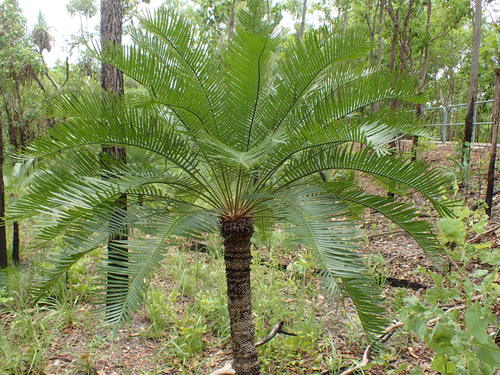
(c) Ian Cowan, some rights reserved (CC BY-NC), uploaded by Ian Cowan

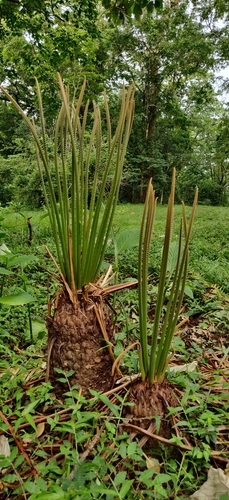
(c) Donald Davesne, some rights reserved (CC BY)

(c) Davide Diana, some rights reserved (CC BY-NC), uploaded by Davide Diana
What to Eat
Edible parts: Kernels, Leaves, Nuts
The trunk can be processed to extract starch for eating. Aboriginal peoples have traditionally processed the seeds for consumption, and the kernels, leaves, and nuts are edible portions.
Known Hazards
Where to Find It
A tropical plant. It prefers light to medium well-drained soil. It needs a protected sunny position. They are drought tender and frost hardy to light frosts. They need a temperature above 13°C. Trunks can resist fire and will regrow new leaves. It cannot tolerate bad drainage or deep shade. In the Cairns Botanical Gardens. It suits hardiness zones 10-12.
Australia*, Pacific, Papua New Guinea, PNG,
How to Identify
An evergreen tree like plant. It grows to 3-5 m high and spreads to 2 m across. The stem is erect and stout and has leaf scars. It rarely has branches. The leaves are 0.5-1.5 m long and palm like with side leaflets along the stalk. The leaflets are deep green and stiff and taper towards the tip. The leaflets are 10-13 cm long and 1 cm wide. The flower is like a cone and brown. The male cones are 30-45 cm long while the female cones are 40 cm long. The female cones produce 4-6 broad oval, orange-red fruit. These are 2-4 cm long.
Nutrition Score: 40/100
| Part | Moisture | kJ | kcal | Protein | Vit A | Vit C | Iron | Zinc |
|---|---|---|---|---|---|---|---|---|
| Nut processed | 67.7 | 511 | 122 | 5.1 | — | — | — | — |
How to Grow
Plants are grown from seed. Seed are slow to germinate. They can be transplanted. If large plants are transplanted they take a year or more to re-establish.
Propagation: Seed - best sown in containers as soon as it is ripe. Stored seed should be pre-soaked for 24 hours in warm water prior to sowing. The seed should be sown 2cm deep in individual pots, which are then sealed in plastic bags to keep them moist until germination takes place. Germinates in 1 - 3 months at 25°c. Division of suckers.
Medicinal Uses
Used in medicine.
Other Uses
A starch obtained from the stems can be used as a laundry starch, to make adhesives etc.
Wikipedia
Source ↗Cycas media is a palm-like cone-bearing plant widespread in seasonally dry tropical sclerophyll woodlands close to the east coast of Queensland, with scattered occurrences also in northern Northern Territory and Western Australia, Australia. The dark green leathery, thick leaves are pinnately divided and grow in annual flushes from a massive apical bud. It is tolerant of bushfire and often re-foliates immediately following a dry season fire, before the beginning of the next rainy season. All plant parts are considered highly toxic. However, the seeds were eaten by Aboriginal Australians after careful and extensive preparation to remove the toxins. The 1889 book 'The Useful Native Plants of Australia records that common names included "Nut Palm" while Central Queensland Indigenous people referred to the plant as "Baveu" and that "An excellent farina is obtained from it. The nuts are deprived of their outer succulent cover (sarcocarp) and are then broken; and the kernels, having been roughly pounded, are dried three or four hours in the sun, then brought in a dilly-bag to a stream or pond, where they remain in the running water four or five days, and in stagnant water three or four days. By a touch of the fingers the proper degree of softness produced by maceration is ascertained. They are afterwards placed between the two stones mentioned under Colocasia macrorrhizon, reduced to a fine paste, and then baked under the ashes in the same way that our bush people bake their damper. (Thozet.)"
Production
Plants grow slowly.
Notes
There are about 20-40 Cycas species.
Names & Synonyms
Baveu, Mayi badil
References (28)
- Anon., 2003, Native Plants for the Fitzroy basin. Society for Growing Australian Plants Inc. (Rockhampton Branch)
- Beck, W., 1992, Aboriginal Preparation of Cycas Seeds in Australia. Economic Botany, Vol. 46, No. 2, pp. 133-147
- Blomberry, A.M., 1979, Australian Native Plants. Angus and Robertson p 110
- Bodkin, F., 1991, Encyclopedia Botanica. Cornstalk publishing, p 311
- Brickell, C. (Ed.), 1999, The Royal Horticultural Society A-Z Encyclopedia of Garden Plants. Convent Garden Books. p 326
- Cooper, W. and Cooper, W., 2004, Fruits of the Australian Tropical Rainforest. Nokomis Editions, Victoria, Australia. p 1
- Cribb, A.B. & J.W., 1976, Wild Food in Australia, Fontana. p 83, 105
- Cronin, L., 1989, The Concise Australian Flora. Reed. p 257
- Cundall, P., (ed.), 2004, Gardening Australia: flora: the gardener's bible. ABC Books. p 449
- Djunbunji Newsletter Edition 2 2011. p 5
- Elliot, W.R., & Jones, D.L., 1984, Encyclopedia of Australian Plants suitable for cultivation. Vol 3. Lothian. p 149
- Hibbert, M., 2002, The Aussie Plant Finder 2002, Florilegium. p 79 (Also as Cycas kennedyana)
- Hinton, B & B., 1982, A Wilderness in Bloom. Wildflowers of tropical Australia. p 20
- Jackes, B.R., 2001, Plants of the Tropics. Rainforest to Heath. An Identification Guide. James Cook University. p 49
- Jones D, L, 1986, Ornamental Rainforest Plants in Australia, Reed Books, p 331
- Jones, D.L., 2000, Cycads of the world. Reed New Holland. p 145
- Lazarides, M. & Hince, B., 1993, Handbook of Economic Plants of Australia, CSIRO. p 71
- Leiper, G & Houser, J., Mutooroo. Plant Use by Australian Aboriginal People. Assembly press, Queensland. (As Cycas kennedyana)
- Lord, E.E., & Willis, J.H., 1999, Shrubs and Trees for Australian gardens. Lothian. p 95
- Low, T., 1991, Wild Food Plants of Australia. Australian Nature FieldGuide, Angus & Robertson. p 139
- Low, T., 1992, Bush Tucker. Australia’s Wild Food Harvest. Angus & Robertson. p 82
- Menninger, E.A., 1977, Edible Nuts of the World. Horticultural Books. Florida p 162
- Molyneux, B & Forrester, S., 1997, The Austraflora A-Z of Australian Plants. Reed. p 71
- Pearson, S. & A., 1992, Rainforest Plants of Eastern Australia. Kangaroo Press p 76
- Prodr. 348. 1810
- Ratcliffe D & P., 1987, Australian Native Plants for Indoors. Little Hills press. p 76
- Townsend, K., 1994, Across the Top. Gardening with Australian Plants in the tropics. Society for Growing Australian Plants, Townsville Branch Inc. p 153 (Also as Cycas kennedyana)
- Wickens, G.E., 1995, Edible Nuts. FAO Non-wood forest products. FAO, Rome. p173