Pinus patula
Scheide ex Schlydl. & Cham.
Mexican weeping pine, Patula pine
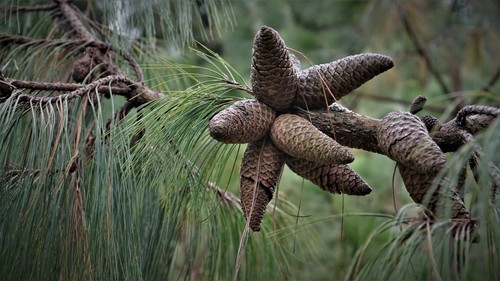
(c) Hermann Jesús Cortés Blobaum, some rights reserved (CC BY-NC), uploaded by Hermann Jesús Cortés Blobaum
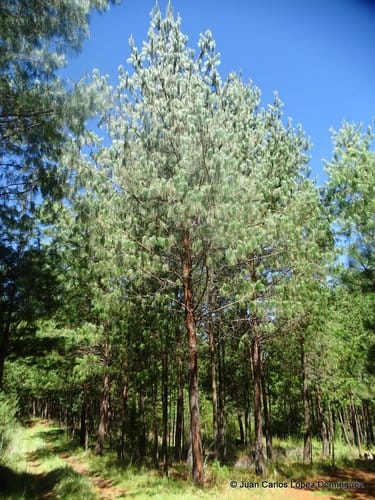
(c) Juan Carlos López Domínguez, some rights reserved (CC BY-NC)
What to Eat
Edible parts: Gum - flavouring, Seeds
A vanillin flavouring is obtained as a by-product of other resins that are released from the pulpwood. The seeds of all Pinus species are more or less edible, and some are of good size and make very tasty and nutritious foods, often eaten in quantitiy. Others can be less desireable, either having a strongly resinous flavour, being bitter or, more commonly, rather too small and fiddly to make it very worthwhle even trying to eat them, We have no specific information of the desireability of this species, though they are rather small (the size given includes the shell). The ovoid seeds are 4 - 6mm long and 2 - 4mm wide.
Known Hazards
Where to Find It
It is a tropical plant. Arboretum Tasmania.
Africa, Argentina, Australia, Bolivia, Brazil, Central America, Colombia, Costa Rica, Ethiopia, Kenya, Madagascar, Mexico*, New Zealand, SE Asia, South Africa, Southern Africa, South America, Tanzania, Tasmania, Uganda,
How to Identify
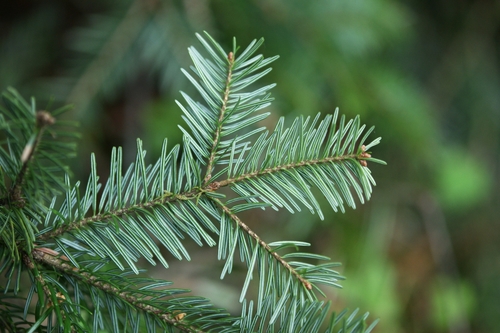
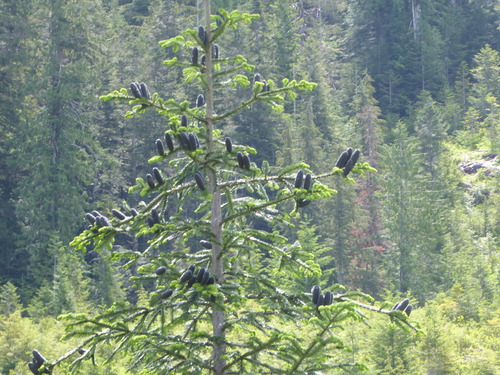
A tree. It grows 35-40 m tall. The leaves are 19-25 cm long by 0.7-0.9 mm wide.
How to Grow
Thrives in a light well-drained sandy or gravelly loam. Dislikes poorly drained moorland soils. Established plants tolerate drought. This species is not hardy in the colder areas of the country, it tolerates temperatures down to between -5 and -10°c. Plants usually form multi-stemmed trees in Britain due to frost damage. Early growth is quite rapid but, in England, once trees reach a good size they blow down or die. This species is cultivated for its timber in warm temperate areas but is not very suitable for Britain. Plants grow well in Cornwall (where there are specimens more than 15 metres tall) and in other areas with similar climates. The cones open and shed their seed whilst still attached to the tree. Plants are strongly outbreeding, self-fertilized seed usually grows poorly. They hybridize freely with other members of this genus. Leaf secretions inhibit the germination of seeds, thereby reducing the amount of plants that can grow under the trees. This species is notably resistant to honey fungus.
Propagation: Sow seed in individual pots in a cold frame as soon as it is ripe, or in late winter if not. Stored seed benefits from 6 weeks of cold stratification at 4°c to improve germination. Move seedlings to their permanent positions as soon as possible and protect them for the first winter or two. The root system is very sparse, so early planting is critical for good establishment. Plant trees when small — between 30 and 90cm, ideally around 5–10cm tall — with a thorough weed-excluding mulch. Larger transplants check badly, barely growing for several years, with poor root development and wind resistance. Cuttings are only viable from trees under 10 years old, using single leaf fascicles with the base of the short shoot. Disbudding a few weeks before taking cuttings can help, though cuttings are generally slow to establish.
Medicinal Uses
Turpentine from pine resin is antiseptic, diuretic, rubefacient, and vermifuge. Taken internally, it treats kidney and bladder complaints, and is used both internally and as a rub or steam bath for rheumatic conditions. It benefits the respiratory system and is useful for mucous membrane diseases, coughs, colds, influenza, and TB. Externally it treats skin complaints, wounds, sores, burns, and boils, applied as liniment plasters, poultices, herbal steam baths, and inhalers.
Other Uses
A tan or green dye comes from the needles. The needles release terpene when rained on, which negatively affects germination of some plants including wheat. Oleo-resins are extracted by tapping the trunk or by destructive distillation of the wood; warmer-region trees tend to yield more. Turpentine makes up around 20% of the oleo-resin, separated by distillation, and used as a solvent for waxes, in varnish-making, and medicinally. Rosin, the residue after turpentine removal, is used on violin bows and in sealing wax and varnish. Pitch from the resin is used for waterproofing and as a wood preservative. The wood is an important timber in warm temperate regions.
Wikipedia
Source ↗Pinus patula, commonly known as patula pine, spreading-leaved pine, or Mexican weeping pine, and in Spanish as pino patula or pino llorón, (patula Latin = "spreading") is a tree native to the highlands of Mexico. It grows from 24° to 18° North latitude and 1,800–2,700 m (5,900–8,900 ft) above sea level. The tree grows up to 30 m (98 ft) tall. It can only withstand short periods of temperatures as low as −10 °C (14 °F), but resists well occasional dips below 0 °C (32 °F). It is moderately drought-tolerant, and in this respect is superior to Pinus taeda. The average annual rainfall in its native habitat is from 750 to 2000 mm. This falls mostly in summer, but in a little area of the State of Veracruz on the Sierra Madre Oriental its habitat is rainy the year round. It is planted at high altitudes in Ecuador (3500 m), Bolivia, Colombia (3300 m), Kenya, Tanzania, Angola, Zimbabwe, Papua New Guinea, and Hawaii (3000 m). In Hawaii it is replacing the native alpine grassland. At lower altitudes than in its origin country it is cultivated in Southern Brazil, South Africa, India, and in the Argentine provinces of Córdoba and San Luis. it is planted for forestation purposes in lands originally covered by bushland. It has been introduced near sea level in New South Wales, Australia, where it spreads naturally by wind and is very favored because rainfalls are more abundant in summer. It was also introduced in New Zealand for commercial purposes and is fully naturalized there. It is cultivated in the United Kingdom as an ornamental tree for parks and gardens, and has gained the Royal Horticultural Society's Award of Garden Merit. The timber is pale-pink to salmon, moderately soft, brittle and smelling strongly of aniseed when freshly cut.
References (3)
- Kew Plants of the World Online
- Roa, J. A. G. & Boada, D. S. G., 2018, Fundación para el Fortalecimiento de la Fruticultura y Plantas Alimenticias no Convencionales en Colombia.
- World Checklist of Useful Plant Species 2020. Royal Botanic Gardens, Kew