Eclipta prostrata
(L.) L.
White Eclipta, False daisy
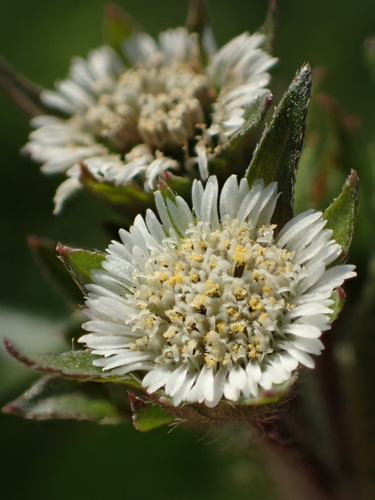
no rights reserved, uploaded by 葉子
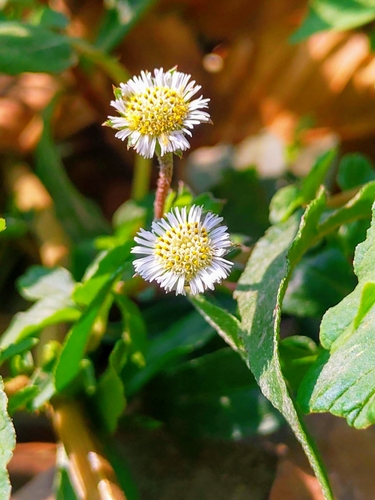
(c) Mitul and Vijul Singh, some rights reserved (CC BY), uploaded by Mitul and Vijul Singh

(c) Douglas Goldman, some rights reserved (CC BY-SA), uploaded by Douglas Goldman
What to Eat
Edible parts: Herb, Leaves, Roots, Vegetable
Tender leaves and young shoots are edible when cooked and used as a vegetable.
Where to Find It
A tropical and subtropical plant. It occurs in humid places. It grows in damp locations such as river banks. It is a common self sown plant. It is common in rice paddy fields. It grows in wetland. It occurs in all tropical regions. In Nepal it grows to about 1500 m altitude. It needs a temperature above 10°C. In Argentina it grows from sea level to 2,000 m above sea level. It can grow in arid places.
Africa, American Samoa, Argentina, Asia, Australia, Bangladesh, Benin, Bhutan, Bolivia, Botswana, Brazil, British Indian Ocean Terr., BIOT, Burkina Faso, Cambodia, Canada, Caribbean, Chile, China, Central Africa, Central African Republic, CAR, Central America*, China, Congo, Côte d'Ivoire, Dominica, Dominican Republic, East Africa, East Timor, Eswatini, Europe, Fiji, France, Gabon, Ghana, Guiana, Guianas, Guinea, Guinée, Guinea-Bissau, Guyana, Haiti, Hawaii, Himalayas, India, Indochina, Indonesia, Ivory Coast, Japan, Kenya, Korea, Laos, Lesser Antilles, Madagascar, Malaysia, Maldives, Mali, Marquesas, Mozambique, Myanmar, Nepal, Nigeria, North America, Northeastern India, Pacific, Papua New Guinea, PNG, Paraguay, Philippines, Puerto Rico, Rotuma, Russia, Sao Tome and Principe, SE Asia, Senegal, Sierra Leone, Singapore, South Africa, Southern Africa, South America, Sri Lanka, Suriname, Swaziland, Taiwan, Tanzania, Timor-Leste, Thailand, Tibet, Tuvalu, Uruguay, USA, Venezuela, West Africa, West Indies, Zambia, Zimbabwe,
How to Identify
A small straggling herb which keeps growing from year to year. It curves upwards along the ground and forms roots at the nodes. It is 30-60 cm tall. The leaves are sword shaped and hairy. They occur opposite each other and do not have a leaf stalk. They are 1-5 cm long by 0.4-1 cm wide. The leaves have large teeth along the edge near the tip. The flower is produced in the axils of the leaves. The flower heads are a dirty white. There are a group of seeds in the head. The flower stalk is 2-4 cm long.
Nutrition Score: 30/100
| Part | Moisture | kJ | kcal | Protein | Vit A | Vit C | Iron | Zinc |
|---|---|---|---|---|---|---|---|---|
| Leaves | — | — | — | 36 | — | — | — | — |
How to Grow
Requires a damp to wet soil and a position in some shade. This is a tropical species and it might need more summer heat and a longer growing season than is normally available in British summers.
Propagation: Sow seed in spring in a greenhouse, barely covering it. Once seedlings are large enough to handle, prick them out into individual pots and plant out into permanent positions in early summer, after the last expected frosts. Provide extra protection such as a cloche until the plants are well established.
Medicinal Uses
This species is widely used in traditional Chinese herbal medicine and in Ayurveda, where it is regarded as one of the best remedies for the hair and is also used as a rejuvenative and liver tonic. The whole plant contains the alkaloids nicotine and ecliptine, as well as coumarin. It is astringent, deobstruent, depurative, emetic, febrifuge, ophthalmic, purgative, styptic, and tonic. Internally, it is used to treat dropsy, liver complaints, anaemia, diphtheria, tinnitus, tooth loss, and premature greying of the hair. Externally, it is applied as an oil to treat hair loss, and is also used on athlete's foot, eczema, dermatitis, and wounds. Plant juice mixed with an aromatic is used for catarrhal problems and jaundice. The leaves are applied in the treatment of scorpion stings and are used as an antidote for snake bites in Korea. The plant is harvested as it comes into flower and dried for later use. The roots are emetic and purgative, and are applied externally as an antiseptic to ulcers and wounds, particularly in cattle.
Other Uses
A black dye obtained from the plant is used as a hair dye and for tattooing.
Wikipedia
Source ↗Eclipta prostrata, the false daisy, is a species of plant in the family Asteraceae. It is widespread across much of the world. This plant has cylindrical, grayish roots. Solid, circular, purplish stems with white fine hairs 0.8m. Leaves arranged in opposite pairs, hairy in two-sided, lanceolate, serrated 2–12.5 cm long, 5–35 mm wide. The solitary flower heads are 6–8 mm (0.24–0.31 in) in diameter, with white florets. The bumpy achenes are compressed and narrowly winged. This species is native to North and South America. It also grows commonly in moist places in warm temperate to tropical areas worldwide. It can be found in habitats such as on marsh edges, along lake shores and river banks, and in brackish marshes and cypress depression swamps.
Other Information
It is only occasionally used. It is sold in local markets in China.
Notes
It is used in medicine.
Names & Synonyms
Aali jhar, A ge wo chi, Agriao-do-brejo, A ji mei, Bhagra, Bhangrii, Bhirangrazshak, Bhringraj, Bhrungaraj, Boton blanco, Botoncillo, Coacica, Coatia, Curichera, Eclipta, Ekaraja, Erva-botao, Erva-lanceta, Goman, Grobidia, Huangjiu, Ink plant, Kaiyunni, Kalhu kandhili, Kameng, Karippan, Karisalankanni, Keharaj, Kehraj, Keshut, Kesut, Kpawu, Kyeik-hman, Lenguilla, Maka, Mo han lian, Mossofing, Nhanvua, Ntum, Quebra-pedra, Sucurima, Surucuina, Tandala, Tangara caa, Tangarac, Uchi-sumban, Urang-aring, White twin-heads
References (66)
- Achigan-Dako, E, et al (Eds), 2009, Catalogue of Traditional Vegetables in Benin. International Foundation for Science.
- Bandyopadhyay, S. et al, 2009, Wild edible plants of Koch Bihar district, West Bengal. Natural Products Radiance 8(1) 64-72
- Banerjee, A., et al, 2013, Ethnobotanical Documentation of Some Wild Edible Plants in Bankura District, West Bengal, India. The Journal of Ethnobiology and Traditional Medicine. Photon 120 (2013) 585-590
- Barua, U., et al, 2007, Wild edible plants of Majuli island and Darrang districts of Assam. Indian Journal of Traditional Knowledge 6(1) pp 191-194
- Bodkin, F., 1991, Encyclopedia Botanica. Cornstalk publishing, p 375
- Borrell, O.W., 1989, An Annotated Checklist of the Flora of Kairiru Island, New Guinea. Marcellin College, Victoria Australia. p 63, 181
- Brown, D., 2002, The Royal Horticultural Society encyclopedia of Herbs and their uses. DK Books. p 200
- Burkill, H. M., 1985, The useful plants of west tropical Africa, Vol. 2. Kew.
- Burkill, I.H., 1966, A Dictionary of the Economic Products of the Malay Peninsula. Ministry of Agriculture and Cooperatives, Kuala Lumpur, Malaysia. Vol 1 (A-H) p 904 (As Eclipta alba)
- Calvert, G. & Liessman, L., 2014, Wetland Plants of the Townsville - Burdekin Flood Plain. LBLCA Ayr, Queensland, p 73
- Chowdery, T., et al, 2014, Wild edible plants of Uttar Dinajpur District, West Bengal. Life Science Leaflets. 47:pp 20-36 http://lifesciencesleaflets.ning.com
- Cooper, W. and Cooper, W., 2004, Fruits of the Australian Tropical Rainforest. Nokomis Editions, Victoria, Australia. p 80
- Dangol, D. R., 2002, Economic uses of forest plant resources in western Chitwan, Nepal. Banko Janakari, 12(2): 56-64
- Dansi, A., et al, 2008, Traditional leafy vegetables and their use in the Benin Republic. Genet Resour Crop Evol (2008) 55:1239–1256
- Dansi, A., et al, 2009, Traditional leafy vegetables in Benin: folk nomenclature, species under threat and domestication. Acta Bot. Gallica 156(2), 183-199
- Devarkar, V. D., et al, 2011, Dietary and Medicinal Significance of Wild Vegetables from Osmanabad Region, Maharashtra (India). Life sciences Leaflets 11:317-332. (As Eclipta alba)
- Diarra, N. et al, 2016, Etude ethnobotanique des plantes alimentaires utilisées en période de soudure dans les régions Sud du Mali. Int. J. Biol. Chem. Sci. 10(1): 184-197
- Fowler, D. G., 2007, Zambian Plants: Their Vernacular Names and Uses. Kew. p 12
- GAMMIE (As Eclipta alba)
- Gautam, R. S., et al, 2022, Ethnobotanical Review of Wild Edible Plants of Nepal. Journal of Natural History Museum Volume 32, 2021-22 p 106
- Grubben, G. J. H. and Denton, O. A. (eds), 2004, Plant Resources of Tropical Africa 2. Vegetables. PROTA, Wageningen, Netherlands. p 561
- Henty, E.E., & Pritchard, G.S., 1973, Weeds of New Guinea and their control. Botany Bulletin No 7, Division of Botany, Lae, PNG. p 72
- Hossain, U. & Rahman, A., 2018, Study and quantitative analysis of wild vegetable floral diversity available in Barisal district, Bangladesh. Asian J. Med. Biol. Res. 2018, 4 (4), 362-371 (As Eclipta alba)
- Jackes, B.R., 2001, Plants of the Tropics. Rainforest to Heath. An Identification Guide. James Cook University. p 43
- Jain et al, 2011, Dietary Use and Conservation Concern of Edible Wetland Plants at Indo-Burma Hotspot: A Case Study from Northeast India. Journal of Ethnobiology and Ethnomedicine 7:29 p 6 (As Eclipta alba)
- Jardin, C., 1970, List of Foods Used In Africa, FAO Nutrition Information Document Series No 2.p 76
- Joshi, N., et al, 2007, Traditional neglected vegetables of Nepal: Their sustainable utilization for meeting human needs. Tropentag 2007. Conference on International Agricultural Research for Development.
- Joshi, N. & Siwakoti, M., 2012, Wild Vegetables Used by Local Community of Makawanpur District and Their Contribution to Food Security and Income Generation. Nepal Journal of Science and Technology Vol. 13, No. 1 (2012) 59-66
- Kinupp, V. F., 2007, Plantas alimenticias nao-convencionais da regiao metropolitana de Porto Alegre, RS, Brazil p 66
- Kumar, S. A., Manus, D. & Mallika, M., 2018, Impact of non-timber forest products on Forest and in Livelihood Economy of the People of Adjoining Areas of Jalpaiguri Forest Division, West Bengal, India. Int. J. of Life Sciences, 2018; 6 (2):365-385
- Lazarides, M. & Hince, B., 1993, Handbook of Economic Plants of Australia, CSIRO. p 87
- Li, D. et al, 2017, Ethnobotanical survey of herbal tea plants from the traditional markets in Chaoshan, China. Journal of Ethnopharmacology. 205 (2017) 195-206
- Luo, B., et al, 2019, Wild edible plants collected by Hani from terraced rice paddy agroecosystem in Honghe Prefecture, Yunnan, China. Journal of Ethnobiology and Ethnomedicine 15:56
- Malezas Comestibles del Cono Sur, INTA, 2009, Buernos Aires
- Manandhar, N.P., 2002, Plants and People of Nepal. Timber Press. Portland, Oregon. p 211
- Mant. pl. 2:286. 1771
- Martin, F.W. & Ruberte, R.M., 1979, Edible Leaves of the Tropics. Antillian College Press, Mayaguez, Puerto Rico. p 184 (As Eclipta alba)
- McMakin, P.D., 2000, Flowering Plants of Thailand. A Field Guide. White Lotus. p 89
- Mishra, N., et al, 2016, Indigenous knowledge in utilization of wetland plants in Bhadrak district, Odisha, India. Indian Journal of Natural Products and Resources. Vol. 7(1) pp. 82-89 (As Eclipta alba)
- Negi, K.S., 1988, Some little known wild edible plants of U.P. Hills. J. Econ. Tax. Bot. Vol. 12 No. 2 pp 345-360
- Paczkowska, G. & Chapman, A.R., 2000, The Western Australian Flora. A Descriptive Catalogue. Western Australian Herbarium. p 161
- Pagag, K. & Borthakur, S.K., 2012, Wild edible wetland plants from Lakhimpur district of Assam, India. Pleione 6(2): 322 - 327
- Patiri, B. & Borah, A., 2007, Wild Edible Plants of Assam. Geethaki Publishers. p 72
- Peekel, P.G., 1984, (Translation E.E.Henty), Flora of the Bismarck Archipelago for Naturalists, Division of Botany, Lae, PNG. p 561, 560
- Peters, C. R., O'Brien, E. M., and Drummond, R.B., 1992, Edible Wild plants of Sub-saharan Africa. Kew. p 90
- Plants of Haiti Smithsonian Institute http://botany.si.edu
- Plants for a Future database, The Field, Penpol, Lostwithiel, Cornwall, PL22 0NG, UK. http://www.scs.leeds.ac.uk/pfaf/
- Price, L. L., 1997, Wild Plant Food in Agricultural Environments: A Study of Occurrence, management and gathering Rights in Northeast Thailand. Human Organization. 56(2)
- READ (As Eclipta alba)
- Rodriguez-Amaya, D. B., 1999, Carotenoides y Prepracion de Alimentos. University Estadual de Campinas, Brasil, Ph.D. thesis. p 22
- Royal Botanic Gardens, Kew (1999). Survey of Economic Plants for Arid and Semi-Arid Lands (SEPASAL) database. Published on the Internet; http://www.rbgkew.org.uk/ceb/sepasal/internet [Accessed 11th April 2011]
- Sainty, G.R. & Jacobs, S.W.L., 1981, Waterplants of New South Wales. Water Resources Commission. NSW p 97
- Samy, J., Sugumaran, M., Lee, K. L. W., 2009, Herbs of Malaysia, Marshall Cavendish. p 96
- Samydurai, P., et al, 2012, Wild habits of Kolli Hills being staple food of inhabitant tribes of eastern Ghats, Tamil Nadu, India. Indian Journal of Natural Products and Resources. 3(3) September 2012 pp 432-437
- Sarma, H., et al, 2010, Updated Estimates of Wild Edible and Threatened Plants of Assam: A Meta-analysis. International Journal of Botany 6(4): 414-423
- Smith, A.C., 1991, Flora Vitiensis Nova, Lawaii, Kuai, Hawaii, Volume 5 p 275
- Stephens, K.M., & Dowling, R.M., 2002, Wetland Plants of Queensland. A field guide. CSIRO p 10
- Sivakumar, A. & Murugesan, M., 2005, Ethnobotanical Studies of the wild edible plants used by the tribals of the Anaimalai Hills, the Western Ghats. Ancient Science of Life. XXV(2) Oct-Dec.
- Sujanapal, P., & Sankaran, K. V., 2016, Common Plants of Maldives. FAO & Kerala FRI, p 116
- Swapna, M. M. et al, 2011, A review on the medicinal and edible aspects of aquatic and wetland plants of India. J. Med. Plants Res. 5 (33) pp. 7163-7176
- Swaziland's Flora Database http://www.sntc.org.sz/flora
- Thaman, R. R, 2016, The flora of Tuvalu. Atoll Research Bulletin No. 611. Smithsonian Institute p 67
- Topp, J. M. W., 1988, An Annotated Check List of the Flora of Diego Garcia, British Ocean Territory. Atoll Research Bulletin No. 313
- Wild edible plants of Himachal Pradesh (As Eclipta alba)
- World Checklist of Useful Plant Species 2020. Royal Botanic Gardens, Kew
- Zon, A.P.M. van der, Grubben, G.J.H., 1976, Les legumes-feuilles spontanes et cultives du Sud-Dahomey, Communication 65, Royal Tropical Institute, Amsterdam, p 58