Elephantopus scaber
L.
Elephant's foot
no rights reserved, uploaded by 葉子
no rights reserved, uploaded by 葉子
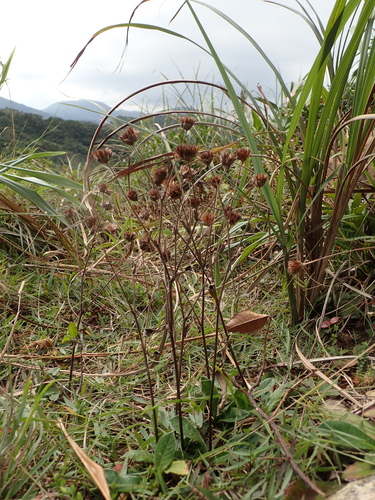
no rights reserved, uploaded by 葉子
What to Eat
Edible parts: Leaves, Root - tea
The leaves are eaten with oil and salt. The rootstock is sliced, dried, and powdered for use in fermented drinks. The plant is powdered and used as a cake and fermenting agent for preparing beers and alcoholic drinks.
Known Hazards
Where to Find It
It is a tropical plant. It prefers rich, moist, well-drained soils. It needs an open sunny position. It is drought and frost tender. In southern China it grows at about 1,400 m above sea level. In Yunnan.
Africa, Asia, Australia, Bangladesh, Cambodia, China, East Africa, East Timor, Himalayas, India, Indochina, Indonesia, Laos, Madagascar, Malaysia, Mozambique, Myanmar, Nepal, Pacific, Papua New Guinea, PNG, SE Asia, Taiwan, Thailand, Timor-Leste, West Timor, Zambia, Zimbabwe,
How to Identify
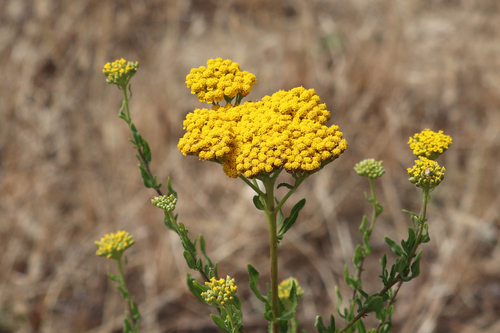
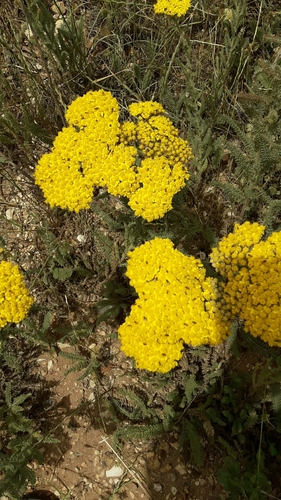
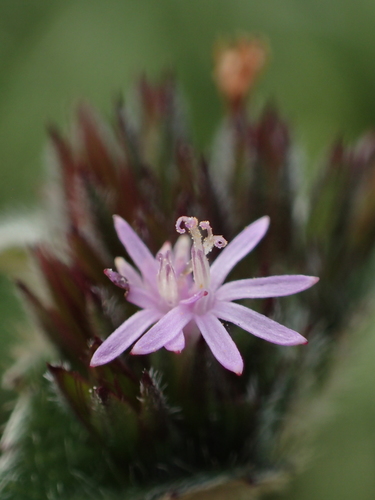
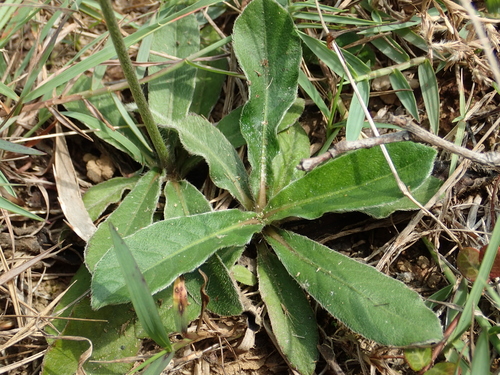
A small herb plant which keeps growing from year to year. It is 30-100 cm high and spreads to 30-60 cm across. It has a creeping rootstock. The stem is stiff and erect. 1-3 stems arise from the base. The stem is densely hairy and warty and is white. The leaves are 10-40 cm long by 1-6 cm wide and oblong. The leaves have a notched edge. The leaves are arranged in a circle near the base. They do not have leaf stalks. There are also some leaves along the stem. These are smaller. The flowers are in compound heads and are yellow or blue. They have leaf like bracts around them. The heads are 2.5 cm across with 20-50 flowers.
How to Grow
Plants are grown from seed.
Medicinal Uses
Elephantopus scaber is used as a traditional medicine. Different parts of the plant are used in traditional medicine of India as an astringent agent, cardiac tonic, and diuretic, and is used for eczema, rheumatism, fever, and bladder stones. E. scaber modulates inflammatory responses by inhibiting the production of TNFα and IL-1β.
Wikipedia
Source ↗Elephantopus scaber is a tropical species of flowering plant in the family Asteraceae. It is native to tropical Africa, Eastern Asia, Indian subcontinent, Southeast Asia, and northern Australia. It has become naturalized in tropical Africa and Latin America. Its natural habitat is subtropical or tropical moist montane forests.
Other Information
It is sold in local markets in China.
Notes
It can become a troublesome weed in some tropical places. There are about 32 Elephantopus species. The leaves are boiled and used in medicine in Asia.
Names & Synonyms
Anashovadi, Bhopathari, Bobhi, Bo ga ga sa, Chen veal, Di dan tou, Geji shak, Gojialata, Gojihva, Hakkarike, Hastikasaka, Hastipata, Jad dabai, Karipadam, Ka-tu-pin, Kitambakombako, Ma die min, Mao-ti-tan-ts'ao, Ma-tu-pin, Mayur jhanti, Pathari, Sahasra buti, Samudulan, Shamdalan, Shamdulum, Sin che, Tapak liman, Tapak limna, Thinko, Tinko jhangi, Ya din dian, Yah-fai-nok-khum
References (23)
- Ambasta, S.P. (Ed.), 2000, The Useful Plants of India. CSIR India. p 193
- Ara, R. I. T., 2015, Leafy Vegetables in Bangladesh. Photon eBooks. p 37
- Bodkin, F., 1991, Encyclopedia Botanica. Cornstalk publishing, p 378
- Burkill, I.H., 1966, A Dictionary of the Economic Products of the Malay Peninsula. Ministry of Agriculture and Cooperatives, Kuala Lumpur, Malaysia. Vol 1 (A-H) p 924
- Cao, Y., et al, 2020, Ethnobotanical study on wild edible plants used by three trans-boundary ethnic groups in Jiangcheng County, Pu’er, Southwest China. Journal of Ethnobiology and Ethnomedicine (2020) 16:66
- Cooper, W. and Cooper, W., 2004, Fruits of the Australian Tropical Rainforest. Nokomis Editions, Victoria, Australia. p 81
- Cowie, I, 2006, A Survey of Flora and vegetation of the proposed Jaco-Tutuala-Lore National Park. Timor-Lests (East Timor) www.territorystories.nt/gov.au p 45
- Dangol, D. R., 2002, Economic uses of forest plant resources in western Chitwan, Nepal. Banko Janakari, 12(2): 56-64
- Dangol, D. R. et al, 2017, Wild Edible Plants in Nepal. Proceedings of 2nd National Workshop on CUAOGR, 2017.
- Elliot, W.R., & Jones, D.L., 1984, Encyclopedia of Australian Plants suitable for cultivation. Vol 3. Lothian. p 396
- Facciola, S., 1998, Cornucopia 2: a Source Book of Edible Plants. Kampong Publications, p 38
- Fowler, D. G., 2007, Zambian Plants: Their Vernacular Names and Uses. Kew. p 77
- Kumar, R. & Saikia, P., 2020, Wild edible plants of Jharkhand and their utilitarian perspectives. Indian Journal of Traditional Knowledge Vol 19 (2), April 2020, pp 237-250
- Li, D. et al, 2017, Ethnobotanical survey of herbal tea plants from the traditional markets in Chaoshan, China. Journal of Ethnopharmacology. 205 (2017) 195-206
- McMakin, P.D., 2000, Flowering Plants of Thailand. A Field Guide. White Lotus. p 89
- Misra, R. C., et al, 2013, Genetic resources of wild tuberous food plants traditionally used in Similipal Biosphere Reserve, Odisha, India. Genetic Resources and Crop Evolution. Vol. 60 No. 2. Springer
- Pandy, R. K. & Saini, S. K., 2007, Edible plants of tropical forests among tribal communities of Madhya Pradesh. Indian Journal of Traditional Knowledge. 6(1), pp 185-190
- Peekel, P.G., 1984, (Translation E.E.Henty), Flora of the Bismarck Archipelago for Naturalists, Division of Botany, Lae, PNG. p 555, 554
- READ
- Tanaka, Y. & Van Ke, N., 2007, Edible Wild Plants of Vietnam: The bountiful garden. Orchid books. p 42 (NB different synonmys)
- Thapa, L. B., et al, 2014, Wild Edible Plants used by endangered and Indigenous Raji Tribe in Western Nepal. International Journal of Applied Sciences and Biotechnology. Vol 2(3):243-252
- Turreira Garcia, N., et al, 2017, Ethnobotanical knowledgeof the Kuy and Khmer people in Prey Lang, Cambodia. Cambodian Journal of Natural History 2017 (1): 76-101
- Xu, You-Kai, et al, 2004, Wild Vegetable Resources and Market Survey in Xishuangbanna, Southwest China. Economic Botany. 58(4): 647-667.