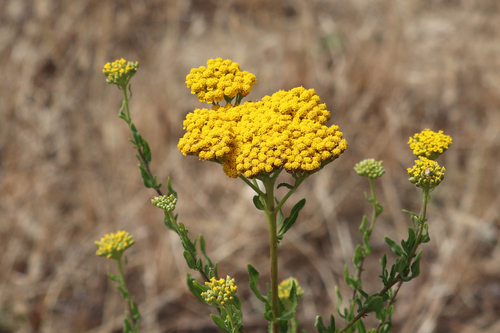
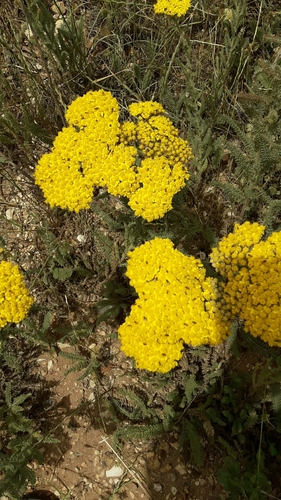
Inula helenium
L.
Elecampane, Elecampane inula

(c) Susan Elliott, some rights reserved (CC BY-NC), uploaded by Susan Elliott

(c) Douglas Goldman, some rights reserved (CC BY-SA), uploaded by Douglas Goldman

(c) Tom Norton, some rights reserved (CC BY), uploaded by Tom Norton
What to Eat
Edible parts: Leaves, Root
Leaves - cooked. Rather bitter and aromatic, they were used as a potherb by the ancient Romans but are rarely used at present. Root - candied and eaten as a sweetmeat. It contains up to 44% inulin. Inulin is a starch that cannot be digested by humans. It usually passes straight through the digestive system, though it can ferment and cause wind problems for some people. Inulin can be converted into a sugar that is suitable for diabetics to eat. The Council of Europe list Inula helenium as a natural food flavouring.
Known Hazards
Where to Find It
S.E. Europe. Naturalized in Britain.
TEMPERATE ASIA: Iran, Iraq, Turkey, Russian Federation-Ciscaucasia (Ciscaucasia), Armenia, Azerbaijan, Georgia, Russian Federation (Dagestan), Kazakhstan, Kyrgyzstan, Tajikistan, Uzbekistan EUROPE: Ukraine (incl. Krym), Albania, Bulgaria, Bosnia and Herzegovina, Greece, Italy (Sardegna), North Macedonia, Montenegro, Serbia
How to Identify
Inula helenium is a PERENNIAL growing to 1.5 m (5ft) by 1 m (3ft 3in). See above for USDA hardiness. It is hardy to UK zone 5. It is in flower from July to August, and the seeds ripen from August to September. The species is hermaphrodite (has both male and female organs) and is pollinated by Bees, Lepidoptera (Moths & Butterflies). The plant is self-fertile. Suitable for: light (sandy), medium (loamy) and heavy (clay) soils. Suitable pH: mildly acid, neutral and basic (mildly alkaline) soils. It can grow in semi-shade (light woodland) or no shade. It prefers moist soil. The plant can tolerates strong winds but not maritime exposure.
How to Grow
An easily grown plant, it grows well in moist shady positions in ordinary garden soil, though it grows best in a good loamy soil. Succeeds in an ordinary garden soil in a sunny position. Plants are also tolerant of considerable neglect, succeeding on our Cornwall trial ground even when left unweeded for four years. Elecampane has a long history of cultivation as a medicinal herb, though it is not commonly grown nowadays. When first dug up, the roots smell like ripe bananas, but as they dry they take on the scent of violets. In garden design, as well as the above-ground architecture of a plant, root structure considerations help in choosing plants that work together for their optimal soil requirements including nutrients and water. The predictable growth behaviour makes it easier to maintain without having to apply containment methods.
Propagation: Seed - sow in spring or autumn in a cold frame. When they are large enough to handle, prick the seedlings out into individual pots and plant them out in the summer. If you have sufficient seed, it could be worthwhile trying an outdoor sowing in situ in the spring. Division in spring or autumn. Fairly small pieces of root can be used, so long as each piece has a growth bud on it. Very easy, larger clumps can be replanted direct into their permanent positions, though it is best to pot up smaller clumps and grow them on in a cold frame until they are rooting well. Plant them out in the spring. Root cuttings in winter. Cut sections of root about 5cm long, place them in a warm greenhouse over the winter and they should grow away vigorously.
Medicinal Uses
Alterative Anthelmintic Antiseptic Antitussive Astringent Bitter Cholagogue Demulcent Diaphoretic Diuretic Expectorant Stimulant Stomachic Tonic. Elecampane has a long history of use as a medicinal herb. A gently warming and tonic herb, it is especially effective in treating coughs, consumption, bronchitis and many other complaints of the chest as well as disorders of the digestive system. A very safe herb to use, it is suitable for the old and the young and especially useful when the patient is debilitated. It cleanses toxins from the body, stimulating the immune and digestive systems and treating bacterial and fungal infections. The root is alterative, anthelmintic, antiseptic, astringent, bitter, cholagogue, demulcent, diaphoretic, diuretic, mildly expectorant, gently stimulant, stomachic, tonic[4, 7, 9, 21, 46. 165, 200, 218, 222]. It is best harvested in the autumn from plants that are two years old, and it can be dried for later use. The roots should be at least 3 years old according to another report. This remedy should not be prescribed for pregnant women. An extract of the plant is a powerful antiseptic and bactericide, particularly effective against the organism that causes TB. The root contains alantolactone, which is strongly anthelmintic. In a 1:1000 dilution it kills the parasitic worm Ascaris in 16 hours. Alantolactone has an anti-inflammatory action, it also reduces mucous secretions and stimulates the immune system. The plant is sometimes recommended as an external wash for skin inflammations and varicose ulcers, but has been known to cause allergic reactions.
Other Uses
Dye EssentialA blue dye is obtained from the bruised and macerated root mixed with ashes and whortleberries (Vaccinium myrtillus). The root yields up to 2% of a camphor-scented essential oil, this is used as a flavouring and medicinally.