Erigeron acer
L.
Blue Fleabane
(c) Ryan Sealy, some rights reserved (CC BY-NC)
(c) Ryan Sealy, some rights reserved (CC BY-NC)
(c) Ryan Sealy, some rights reserved (CC BY-NC)
What to Eat
Edible parts: Leaves
The leaves can be eaten boiled. This is considered a famine food, used only when no other options are available.
Where to Find It
It is a Mediterranean climate plant. It grows in dry grassy habitats.
Africa, Asia, China, Europe, France, Greece, Italy, Japan, Luxembourg, Mediterranean, North Africa, Portugal, Spain, Turkey, Türkiye,
How to Identify
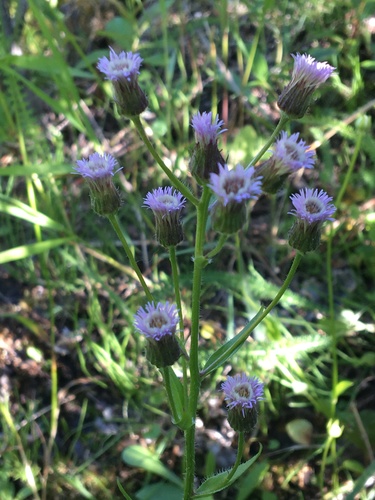
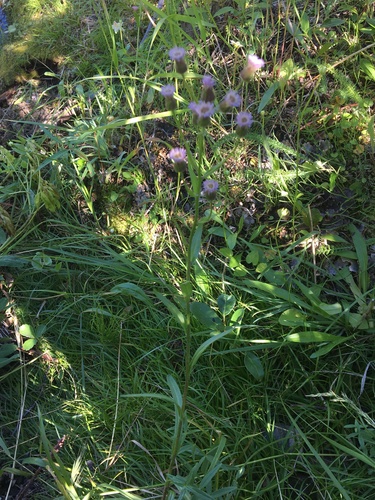
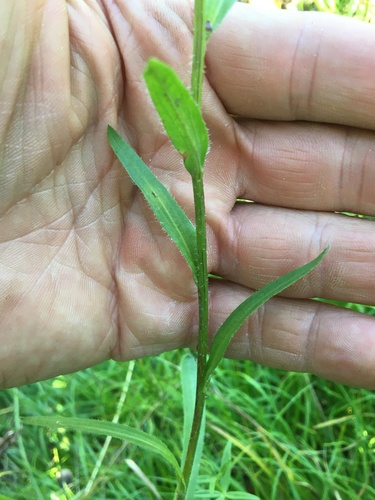
A densely hairy grey green herb. It can grow for one or two years. The stems are erect. The leaves near the base are narrow or oval and may or may not have teeth. They have stalks. The upper leaves are not stalked and are sword shaped. The flower heads are 10-15 mm across. The rays are purple or lilac. The disk is yellow. They are in panicles which are often flat at the top. The rays are in 2 rows scarcely longer than the disk florets.
How to Grow
Prefers a moderately fertile well-drained soil in a sunny position. Grows well in dry situations. Succeeds in maritime gardens. There is some doubt over the correct name of this species. E. acris is said to be a synonym of E. acer, the report of edibility refers to the sub-species E. acris kamtschaticus. The entry is included under E. acer but this needs further investigation. Very few members of this genus will hybridise with other members of the genus.
Propagation: Sow seed in spring in situ. Germination usually occurs within four weeks.
Medicinal Uses
None known.
Other Uses
None known.
Wikipedia
Biennial or perennial growing to 0.5 m tall. Hermaphroditic flowers attract butterflies, moths, and bees. Prefers light sandy, medium loamy, and heavy clay soils with good drainage. Grows across mildly acidic to mildly alkaline pH ranges. Requires full sun and cannot tolerate shade. Prefers moist soil and withstands maritime exposure.
Notes
There are about 200 Erigeron species. They are temperate plants.
Names & Synonyms
Guangguangcao
References (3)
- Blamey, M and Grey-Wilson, C., 2005, Wild flowers of the Mediterranean. A & C Black London. p 433
- Kang, Y., et al, 2012, Wild food plants and wild edible fungi in two valleys on the Qinling Mountains (Shaanxi, central China) Journal of Ethnobiology and Ethnomedicine; 9:26
- Plants for a Future database, The Field, Penpol, Lostwithiel, Cornwall, PL22 0NG, UK. http://www.scs.leeds.ac.uk/pfaf/