Erigeron annuus
(L.) Pers.
Annual fleabane, Daisy fleabane

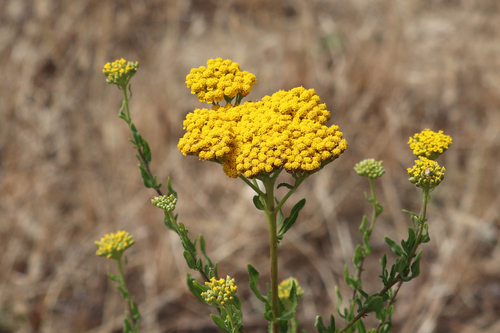
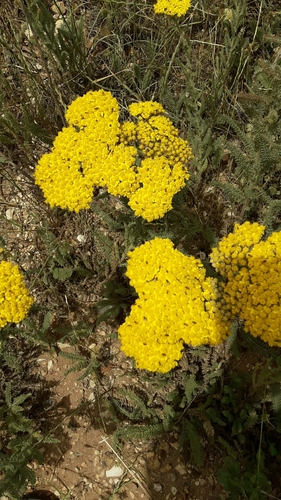
(c) Jeff Skrentny, some rights reserved (CC BY-NC), uploaded by Jeff Skrentny

(c) esther_stroh, some rights reserved (CC BY-NC)

(c) Steve, some rights reserved (CC BY-NC), uploaded by Steve
What to Eat
Edible parts: Leaves, Stem
Young plants can be eaten boiled.
Where to Find It
It is a temperate plant. It grows in disturbed sites throughout Canada. In China it grows from sea level to 1,100 m above sea level.
Asia, Canada, China, Korea, Europe, India, Italy, Japan, Korea, Luxembourg, Mediterranean, North America*, Slovenia, Tibet, USA,
How to Identify
A herb. It grows 30 cm to 1.5 m tall. The stems are erect and hairy. The lower leaves are oblong and in rings. The leaves are hairy and have teeth. They are 10 cm long. The flower heads have about 80 tightly packed white flowers. These have yellow diskes around them.
How to Grow
Propagation: Sow seed in spring in situ. Germination usually occurs within four weeks.
Medicinal Uses
None known.
Other Uses
None known.
Wikipedia
Source ↗Erigeron annuus (formerly Aster annuus), the annual fleabane, daisy fleabane, or eastern daisy fleabane, is a species of herbaceous flowering plant, annual or biennial, in the family Asteraceae.
Notes
There are about 200 Erigeron species.
Names & Synonyms
Enoletna suholetnica, Gaemangcho, Kaemangcho'o
References (11)
- Arora, R. K., 2014, Diversity in Underutilized Plant Species - An Asia-Pacific Perspective. Bioversity International. p 40
- Chen, B. & Qiu, Z., Consumer's Attitudes towards Edible Wild Plants, Ishikawa Prefecture, Japan. p 23 www.hindawi.com/journals/ijfr/aip/872413.pdf
- Hwang, H., et al, 2013, A Study on the Flora of 15 Islands in the Western Sea of Jeollanamdo Province, Korea. Journal of Asia-Pacific Biodiversity Vol. 6, No. 2 281-310
- Hwang, HS, et al, 2014, Distribution characteristics of plant in the Ungseokbong Mountain, Gyeongsangnam-do, Korea. Journal of Asia-Pacific Biodiversity. 7(2014) e164-e178
- Kim, H. & Song, M., 2013, Ethnobotanical analysis for traditional knowledge of wild edible plants in North Jeolla Province (Korea). Genetic. Resour. Crop Evol. (2013) 60:1571-1585
- MacKinnon, A., et al, 2009, Edible & Medicinal Plants of Canada. Lone Pine. p 347
- Paoletti, M.G., Dreon, A.L., and Lorenzoni, G.G., 1995, Pistic, Traditional Food from Western Friuli, NE Italy. Economic Botany 49(1) pp 26-30
- Pemberton, R. W. & Lee, N. S., 1996, Wild Food Plants in South Korea: Market Presence, New Crops, and Exports to the United States. Economic Botany, Vol. 50, No. 1, pp. 57-70
- Plants for a Future database, The Field, Penpol, Lostwithiel, Cornwall, PL22 0NG, UK. http://www.scs.leeds.ac.uk/pfaf/
- Syn. pl. 2(2):431. 1807
- www.ediblewildfood.com