Ageratum conyzoides
(L.) L.
Billygoat Plant, Goatweed
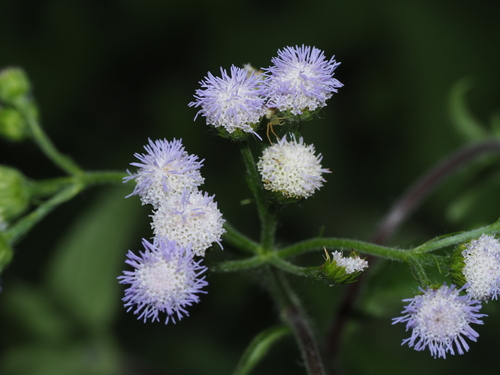
(c) 小铖/Smalltown, some rights reserved (CC BY-NC), uploaded by 小铖/Smalltown
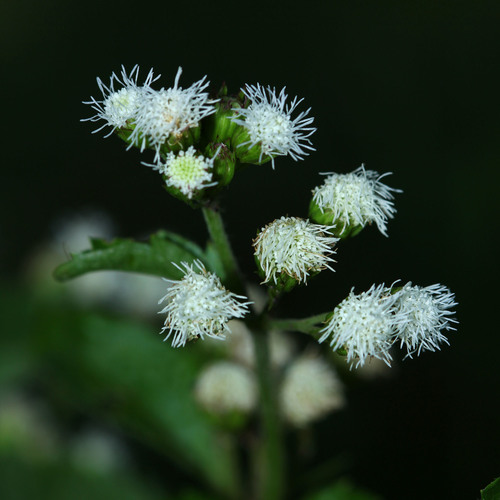
(c) Franz Anthony, some rights reserved (CC BY), uploaded by Franz Anthony

(c) Ken Janes, some rights reserved (CC BY-NC), uploaded by Ken Janes
What to Eat
Edible parts: Leaves - oil, Flowers - oil, Seeds - oil, Leaves, Vegetable, Salt, Leaves - tea
There are records that the fresh leaves have been eaten, combined with Abelmoschus esculentus. It only happens rarely and it is probably eaten mainly for its supposed medicinal benefits by nursing mothers who believe it helps to increase their milk flow.
Known Hazards
Where to Find It
A tropical plant. It does best in well composted well drained soils. It suits a sunny position. It is drought and frost tender. It can grow in arid places. In Sikkim it grows between 200-2,000 m above sea level.
Africa, American Samoa, Andamans, Angola, Argentina, Asia, Australia, Bahamas, Bangladesh, Benin, Bhutan, Bolivia, Botswana, Bougainville, Brazil, British Indian Ocean Terr., BIOT, Burkina Faso, Burundi, Cambodia, Cameroon, Cape Verde, Caribbean, Central Africa, Central African Republic, CAR, Central America, Chile, China, Colombia, Comoros, Congo DR, Côte d'Ivoire, Cuba, Dominica, Dominican Republic, East Africa, East Timor, Easter Island, Ecuador, Egypt, Equatorial Guinea, Eswatini, Ethiopia, Europe, Fiji, France, French Guiana, Gabon, Gambia, Ghana, Guadeloupe, Guatemala, Guiana, Guianas, Guinea, Guinée, Guinea-Bissau, Guyana, Haiti*, Hawaii, Himalayas, Honduras, India, Indochina, Indonesia, Ivory Coast, Jamaica, Japan, Kenya, Korea, Laos, Lebanon, Liberia, Madagascar, Malawi, Malaysia, Mali, Marquesas, Mauritius, Mediterranean, Mexico, Middle East, Mozambique, Myanmar, Nepal, New Caledonia, Nicaragua, Nigeria, Niue, Norfolk Island, North Africa, Northeastern India, North America, Pacific, Panama, Papua New Guinea, PNG, Paraguay, Peru, Philippines, Puerto Rico, Rotuma, Rwanda, Samoa, Sao Tome and Principe, Saudi Arabia, SE Asia, Seychelles, Socotra, Senegal, Sierra Leone, Sikkim, Solomon Islands, South Africa, Southern Africa, South America, Sri Lanka, St Helena, St Lucia, Sudan, Suriname, Swaziland, Taiwan, Tanzania, Thailand, Timor-Leste, Togo, Tonga, Trinidad-Tobago, Uganda, Uruguay, USA, Vanuatu, Venezuela, Vietnam, West Africa, West Indies*, West Timor, Zambia, Zimbabwe,
How to Identify
A small annual under shrub. It grows to 0.6 m tall and spreads to 1 m across. The stem is erect and branching. The leaves are oval and opposite. They are 6 cm long by 4 cm wide. They taper towards the tip and are hairy. The edges have teeth. The flowers are white and insignificant. They occur in small clusters at the ends of branches. The fruit are dry, black hairy capsules.
Nutrition Score: 34/100
| Part | Moisture | kJ | kcal | Protein | Vit A | Vit C | Iron | Zinc |
|---|---|---|---|---|---|---|---|---|
| Leaves | 90.4 | 130 | 31 | 3.5 | — | 29 | — | — |
How to Grow
Succeeds in full sun in a sheltered position in any reasonably fertile moisture-retentive soil that does not dry out in the summer. Plant vigour and flowering periods are much reduced on dry soils. This species is not frost hardy, though it can be grown as a summer annual in Britain. The fresh plant is malodorous.
Propagation: Sow seed in late winter or early spring in a warm greenhouse, barely covering it. Prick out seedlings when large enough to handle and plant out after the last expected frosts. Seed can also be sown in situ in spring, or in late summer or early autumn for earlier blooms, though autumn-sown plants will need to be overwintered in a warm greenhouse.
Medicinal Uses
The plant contains 0.7–2.0% essential oil, along with alkaloids and saponins. The whole plant is antiinflammatory and antiallergic. Juice of the fresh plant, or an extract of the dried plant, is used to treat allergic rhinitis and sinusitis. Fresh plant juice is also useful for post-partum uterine haemorrhage. Root juice is antilithic. A paste of the root mixed with the bark of Schinus wallichii is applied to set dislocated bones. The leaves are styptic — dried and powdered, they are applied to cuts, sores, and ruptures caused by leprosy. The powder absorbs moisture and forms a layer that is removed after 1–2 days, offering an effective cure for most cuts and sores, though not a complete cure for leprosy. Leaves are also used externally for ague. Plant juice treats cuts, wounds, and bruises. A paste of the leaves draws thorns from the skin. A paste combining equal amounts of the leaves with Bidens pilosa, Drymaria cordata, Galinsoga parviflora, and the rhizome of Zingiber officinale is used for snakebites. Juice of the flowerheads treats scabies externally, and a paste of them is used for rheumatism. A tea made from flowerheads combined with Ocimum tenuifolium is used for coughs and colds.
Other Uses
The leaves and flowers yield 0.2% essential oil with a powerful nauseating odour. The oil contains 5% eugenol, which has a pleasant scent. Oil from plants grown in Africa has an agreeable odour and consists almost entirely of eugenol. A decoction of the fresh plant is used as a hair wash, leaving hair soft, fragrant, and dandruff free.
Wikipedia
Source ↗Ageratum conyzoides (billygoat-weed, chick weed, goatweed, whiteweed, mentrasto) is native to Tropical America, especially Brazil, and is an invasive weed in many other regions. It is an herb that is 0.5–1 m. high, with ovate leaves 2–6 cm long, and flowers are white to mauve. In Vietnamese, the plant is called cứt lợn (meaning "pig feces") due to its growth in dirty areas.
Other Information
It is not known if it is used for food in Papua New Guinea. It is sold in local markets in China.
Notes
It is used for medicine in Nepal. The leaves are used externally and the flower heads are taken in small doses. It has anti-bacterial properties. There are about 40 Ageratum species.
Names & Synonyms
Adwowakuro, Ahimaimbo, Ajagandha, Anatsiataolana, Bái huā chòu dì wén, Bakariabish, Balquiama, Balquiana, Bandotan, Barba de chivo, Baume, Berokan, Bhusuripata, Blue floss flower, Blue top, Boksunga, Bolbol, Boroboro-menchena, Botebotekoro, Bulak-manok, Dholi sadodee, Elame, Elamey, Gandhe, Gandhari, Gane, Ghaneraosadi, Gua kubo, Gumdrya, Gunyato, Hapon-hapon, Hierba de chivo, Ilamejhar, Jukut bau, Kadu-hpo, Kaziraruguma, Kondre, Koobhi, Laboel, Luboel, Lulubye, Matamocemoce, Mentrasto, Mpata kasakula, Nayitulasi, Ngonamshu, Ntongola, Osari, Poksunga, Pumpillu, Puru, Quicala-pure, Rumput sekedok, Sahadevi, Selaseh dandi, Sesumpate, Seto ghandhe, Sinnapo-ompillu, Tekote tea, Teteco, Timimbo, Uchanti, Uchunti, Uru ute, Yima
References (50)
- Alegado, A. M. & De Guzman, R. B., 2014, Indigenous food crops of the Aetas tribe in the Philippines and their traditional methods of food preparation. in Promotion of Underutilized Indigenous Food Resources for Food Security and Nutrition in Asia and Pacific. FAO. Bangkok p 160
- Ambasta S.P. (Ed.), 2000, The Useful Plants of India. CSIR India. p 20
- Aryal, K. P., et al, 2018, Diversity and use of wild and non-cultivated edible plants in the Western Himalaya. Journal of Ethnobiology and Ethnomedicine (2018) 14:10
- Bodkin, F., 1991, Encyclopedia Botanica. Cornstalk publishing, p 57
- Borrell, O.W., 1989, An Annotated Checklist of the Flora of Kairiru Island, New Guinea. Marcellin College, Victoria Australia. p 62
- Bourret, D., 1981, Bonnes-Plantes de Nouvelle-Caledonie et des Loyaute. ORSTOM. p 61
- Burkill, H. M., 1985, The useful plants of west tropical Africa, Vol. 1. Kew.
- Burkill, I.H., 1966, A Dictionary of the Economic Products of the Malay Peninsula. Ministry of Agriculture and Cooperatives, Kuala Lumpur, Malaysia. Vol 1 (A-H) p 72
- Cabalion, P. and Morat, P., 1983, Introduction le vegetation, la flore et aux noms vernaculaires de l'ile de Pentcoste (Vanuatu), In: Journal d'agriculture traditionnelle et de botanique appliquee JATBA Vol. 30, 3-4
- Cooper, W. and Cooper, W., 2004, Fruits of the Australian Tropical Rainforest. Nokomis Editions, Victoria, Australia. p 79
- Cowie, I, 2006, A Survey of Flora and vegetation of the proposed Jaco-Tutuala-Lore National Park. Timor-Lests (East Timor) www.territorystories.nt/gov.au p 43
- Dangol, D. R. et al, 2017, Wild Edible Plants in Nepal. Proceedings of 2nd National Workshop on CUAOGR, 2017.
- Dansi, A., et al, 2008, Traditional leafy vegetables and their use in the Benin Republic. Genet Resour Crop Evol (2008) 55:1239–1256
- Devarkar, V. D., et al, 2011, Dietary and Medicinal Significance of Wild Vegetables from Osmanabad Region, Maharashtra (India). Life sciences Leaflets 11:317-332.
- Fowler, D. G., 2007, Zambian Plants: Their Vernacular Names and Uses. Kew. p 12
- Franklin, J., Keppel, G., & Whistler, W., 2008, The vegetation and flora of Lakeba, Nayau and Aiwa Islands, Central Lau Group, Fiji. Micronesica 40(1/2): 169–225, 2008
- Grubben, G. J. H. and Denton, O. A. (eds), 2004, Plant Resources of Tropical Africa 2. Vegetables. PROTA, Wageningen, Netherlands. p 559
- Henty, E.E., & Pritchard, G.S., 1973, Weeds of New Guinea and their control. Botany Bulletin No 7, Division of Botany, Lae, PNG. p 66
- Joshi, N., et al, 2007, Traditional neglected vegetables of Nepal: Their sustainable utilization for meeting human needs. Tropentag 2007. Conference on International Agricultural Research for Development.
- Kinupp, V. F., 2007, Plantas alimenticias nao-convencionais da regiao metropolitana de Porto Alegre, RS, Brazil p 64
- Kumar, R. & Saikia, P., 2020, Wild edible plants of Jharkhand and their utilitarian perspectives. Indian Journal of Traditional Knowledge Vol 19 (2), April 2020, pp 237-250
- Kumar, S. A., Manus, D. & Mallika, M., 2018, Impact of non-timber forest products on Forest and in Livelihood Economy of the People of Adjoining Areas of Jalpaiguri Forest Division, West Bengal, India. Int. J. of Life Sciences, 2018; 6 (2):365-385
- Latham, P. & Mbuta, A. K., 2017, Plants of Kongo Central Province, Democratic Republic of Congo. Volume 1. 3rd ed p 30
- Lazarides, M. & Hince, B., 1993, Handbook of Economic Plants of Australia, CSIRO. p 10
- Li, D. et al, 2017, Ethnobotanical survey of herbal tea plants from the traditional markets in Chaoshan, China. Journal of Ethnopharmacology. 205 (2017) 195-206
- Maghirang, R. G., et al, 2018. Ethnobotanical Studies of Some Plants Commonly Used as Vegetables in Selected Provinces of the Philippines. Journal of Nature Studies. 17(2), 30-43.
- Manandhar, N.P., 2002, Plants and People of Nepal. Timber Press. Portland, Oregon. p 76
- Malezas Comestibles del Cono Sur, INTA, 2009, Buernos Aires
- Molla, A., Ethiopian Plant Names. http://www.ethiopic.com/aplants.htm
- Mot So Rau Dai an Duoc O Vietnam. Wild edible Vegetables. Ha Noi 1994, p 74
- Namsa, N. D., 2011, Ethnobotany of the Monpa ethnic group at Arunachal Pradesh, India. Journal of Ethnobiology and Ethnomedicine 2011, 7:31
- Ogle, B. M., et al, 2003, Food, Feed or Medicine: The Multiple Functions of Edible Wild Plants in Vietnam. Economic Botany 57(1): 103-117
- Peekel, P.G., 1984, (Translation E.E.Henty), Flora of the Bismarck Archipelago for Naturalists, Division of Botany, Lae, PNG. p 557, 556
- Paczkowska, G. & Chapman, A.R., 2000, The Western Australian Flora. A Descriptive Catalogue. Western Australian Herbarium. p 154
- Peters, C. R., O'Brien, E. M., and Drummond, R.B., 1992, Edible Wild plants of Sub-saharan Africa. Kew. p 87
- Pickering, H., & Roe, E., 2009, Wild Flowers of the Victoria Falls Area. Helen Pickering, London. p 32
- Plants of Haiti Smithsonian Institute http://botany.si.edu
- Razanameharizaka, J., et al, 2022, Catalogue Legumes Traditionnels de Madagascar. Université d’Antananarivo, Antananarivo (101), Madagascar. Vol. 1. p 22
- Recher, P, 2001, Fruit Spirit Botanical Gardens Plant Index. www.nrg.com.au/~recher/ seedlist.html p 4
- Royal Botanic Gardens, Kew (1999). Survey of Economic Plants for Arid and Semi-Arid Lands (SEPASAL) database. Published on the Internet; http://www.rbgkew.org.uk/ceb/sepasal/internet [Accessed 10th April 2011]
- Sarma, H., et al, 2010, Updated Estimates of Wild Edible and Threatened Plants of Assam: A Meta-analysis. International Journal of Botany 6(4): 414-423
- Sp. pl. 2:839. 1753
- Terashima, H., et al, 1992, Ethnobotany of the Lega in the Tropical Rainforest of Eastern Zaire (Congo): Part Two, Zone de Walikale, African Study Monographs, Suppl. 19:1-60
- Thoa, P. T. K., et al, 2013, Biodiversity indices and utilization of edible wild plants a case study of the Cham Island in Quang Nam Province, Vietnam. Journal of research in Environmental Science and Toxicology Vol. 2(9): 167-174
- Topp, J. M. W., 1988, An Annotated Check List of the Flora of Diego Garcia, British Ocean Territory. Atoll Research Bulletin No. 313
- Vernon, R., 1983, Field Guide to Important Arable Weeds of Zambia. Dept of Agriculture, Chilanga, Zambia. p 80
- von Katja Rembold, 2011, Conservation status of the vascular plants in East African rain forests. Dissertation Universitat Koblenz-Landau
- World Checklist of Useful Plant Species 2020. Royal Botanic Gardens, Kew
- Yuncker, T.G., 1959, Plants of Tonga, Bernice P. Bishop Museum, Hawaii, Bulletin 220. p 266
- Zizka, G., 1991, Flowering Plants of Easter Island. Palmarum Hortus Francofurtensis