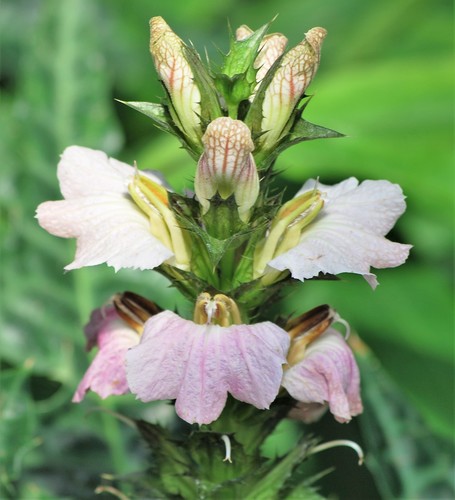
Justicia procumbens
L.

(c) Himanshu Pandav, some rights reserved (CC BY-NC), uploaded by Himanshu Pandav

(c) 106611639464075912591, some rights reserved (CC BY-NC-SA), uploaded by 106611639464075912591
What to Eat
Edible parts: Leaves, Seed
Young leaves - boiled. Seed - cooked. It is usually made into a flour.
Where to Find It
E. Asia - Himalayas to China, Japan and Korea.
TEMPERATE ASIA: China (Anhui Sheng, Fujian Sheng, Guangdong Sheng, Guangxi Zhuangzu Zizhiqu, Guizhou Sheng, Hainan Sheng, Hebei Sheng, Henan Sheng, Hubei Sheng, Hunan Sheng, Jiangsu Sheng, Jiangxi Sheng, Shaanxi Sheng, Sichuan Sheng, Xizang Zizhiqu, Yunnan Sheng, Zhejiang Sheng), Japan (Honshu, Kyushu, Ryukyu Islands, Shikoku), Taiwan TROPICAL ASIA: Bangladesh, India, Sri Lanka, Pakistan, Cambodia, Laos, Myanmar, Thailand, Vietnam, Indonesia, Malaysia, Philippines
How to Identify
Justicia procumbens is a ANNUAL growing to 0.3 m (1ft). The species is hermaphrodite (has both male and female organs). Suitable for: light (sandy), medium (loamy) and heavy (clay) soils. Suitable pH: mildly acid, neutral and basic (mildly alkaline) soils. It can grow in semi-shade (light woodland) or no shade. It prefers moist soil.
How to Grow
We have almost no information on this species and do not know if it will be successful in Britain, though it should succeed if grown as a half-hardy annual.
Propagation: Seed - sow spring in a greenhouse. When they are large enough to handle, prick the seedlings out into individual pots and plant them out after the last expected frosts.
Medicinal Uses
Antiphlogistic Depurative Diaphoretic Diuretic Febrifuge Laxative Ophthalmic Skin. The plant is alterative, anthelmintic, antiphlogistic, depurative, diaphoretic, diuretic, expectorant, febrifuge and laxative. A decoction or an infusion is used in the treatment of asthma, cough, backache, flatulence and many skin conditions. The juice of the leaves is used in ophthalmia. A decoction of the leaves is used in the treatment of curvature and diseases of the bone. The juice of the root is used in the treatment of coughs where blood is being coughed up.