Grindelia robusta
Nutt., nom. ambig.
Great valley gumweed, Gum plant, Gumweed

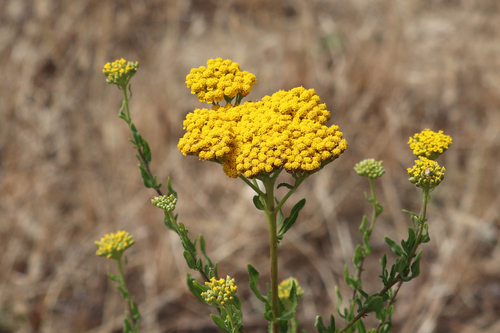
(c) Michael Nettles, some rights reserved (CC BY-NC)

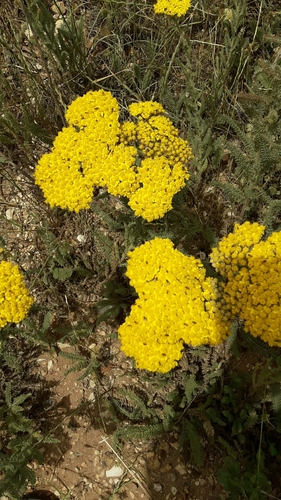
(c) Tom Lebsack, some rights reserved (CC BY-NC)

(c) Tom Lebsack, some rights reserved (CC BY-NC)
What to Eat
Edible parts: Leaves, Leaves - tea
The leaves can be eaten raw.
Where to Find It
It is a temperate plant.
Britain, Europe, France, Germany, Netherlands, North America, USA,
How to Identify
A herb. It grows about 40 cm high. The plant is covered with a resinous substance.
How to Grow
Succeeds in any well-drained soil in full sun. Does well on dry sandy banks and in poor soils. Plants tend to concentrate selenium in the leaves and stems, this is especially noticeable on soils that are relatively rich in that element. Some authorities class this species as a synonym of G. camporum.
Propagation: Sow seed in autumn or spring in a cool greenhouse, barely covering it. Prick plants out into individual pots when large enough to handle and plant out into permanent positions in early summer.
Medicinal Uses
The leaves and flowering tops are antiphlogistic, antispasmodic, balsamic, demulcent, expectorant, sedative, stomachic, and a vascular tonic, and are used as a blood purifier. The plant is applied externally as a compress on inflamed or irritated skin. Taken internally, it slows the heartbeat and reduces stimulation of the nerve endings in the air passages that causes coughing, making it effective for treating asthma. A fluid extract is prepared by placing freshly gathered leaves and flowers in a small quantity of simmering water for about 15 minutes. The plant is also used to treat people affected by poison ivy.
Other Uses
Yellow and green dyes are obtained from the flowering heads and pods. The plant is aromatic. A decoction of the roots has been used as a hair shampoo to kill lice.
Wikipedia
Source ↗Grindelia robusta is a perennial shrub reaching 0.6 m (2 ft) tall. Hardy to UK zone 7, it flowers from May to September with hermaphrodite blooms pollinated by insects. The plant grows in light sandy to medium loamy soils, preferring well-drained conditions and tolerating nutritionally poor, mildly acid to mildly alkaline, and saline soils. It requires full sun, adapts to dry or moist soil, and can withstand drought.
Notes
There are 60 Grindelia species. They grow in dry regions in the Americas.
References (4)
- Kiple, K.F. & Ornelas, K.C., (eds), 2000, The Cambridge World History of Food. CUP p 1783
- Moerman, D. F., 2010, Native American Ethnobotany. Timber Press. p 252
- Plants for a Future database, The Field, Penpol, Lostwithiel, Cornwall, PL22 0NG, UK. http://www.scs.leeds.ac.uk/pfaf/
- Trans. Amer. Philos. Soc. ser. 2, 7:314. 1840 - in part = G. camporum and G. stricta