Grindelia squarrosa
(Pursh) Dunal
Resinweed, Gum plant
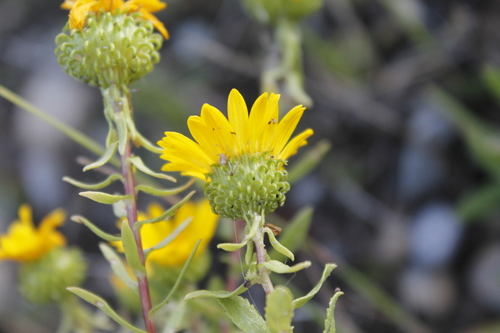
(c) Lena Dietz Chiasson, some rights reserved (CC BY-NC), uploaded by Lena Dietz Chiasson

(c) Remington Jackson, some rights reserved (CC BY-NC), uploaded by Remington Jackson
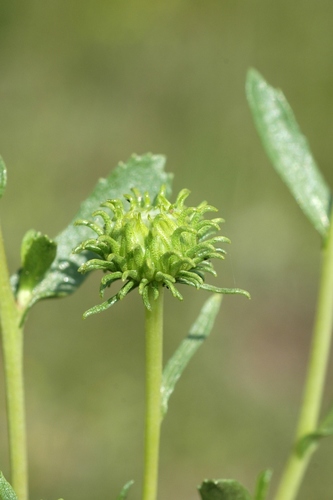
(c) vladimir_epiktetov, some rights reserved (CC BY-NC), uploaded by vladimir_epiktetov
What to Eat
Edible parts: Leaves - tea, Flowers - gum
Fresh or dried leaves can be used to make an aromatic, slightly bitter but pleasing tea. A sticky resinous sap that covers the leaves can be used as a chewing gum substitute.
Known Hazards
Where to Find It
It is a temperate plant. It grows in dry open sites.
Canada, North America, Slovenia, USA,
How to Identify
A herb. It can grow for a few years. It has taproots. The stems are 20-80 cm tall. The leaves are oblong and have lobes or teeth. The leaves often clasp the stem. The flower heads are yellow and 2-3 cm across. They are 25-40 flowers around a yellow disk. The fruit are 4-5 ribbed dry seed heads or achenes.
How to Grow
Propagation: Sow seed in autumn or spring in a cool greenhouse, barely covering it. Prick plants out into individual pots when large enough to handle and plant out into permanent positions in early summer. Divide clumps as new growth commences in spring; larger clumps can be replanted directly into permanent positions, though smaller clumps are best potted up and grown on in a cold frame until rooting well before planting out in spring. Can also be propagated from cuttings.
Medicinal Uses
Rosin weed was used by native North American Indians to treat bronchial problems and skin afflictions such as reactions to poison ivy. It remains valued in modern herbalism, particularly for treating bronchial asthma and conditions where phlegm in the airways impedes breathing. It is believed to desensitize nerve endings in the bronchial tree and slow the heart rate, leading to easier breathing. The herb is contraindicated for patients with kidney or heart complaints. The dried leaves and flowering tops are antiasthmatic, anti-inflammatory, antispasmodic, expectorant, and sedative. The principal use is in treating bronchial catarrh, especially with an asthmatic tendency, as well as whooping cough and cystitis. The active principle is excreted via the kidneys, which can sometimes produce signs of renal irritation. Externally, the plant is used as a poultice for burns, poison ivy rash, dermatitis, eczema, and skin eruptions. The plant is harvested when in full bloom and can be used fresh as a poultice or dried for infusions. A fluid extract is prepared by placing freshly gathered leaves and flowers in a small quantity of simmering water for about 15 minutes. A homeopathic remedy is prepared from the leaves and flowering stems.
Other Uses
Yellow and green dyes are obtained from the flowering heads and pods. The plant is aromatic.
Wikipedia
Source ↗Grindelia squarrosa, also known as a curly-top gumweed or curlycup gumweed, is a small North American biennial or short-lived perennial plant.
References (4)
- Beckstrom-Sternberg, Stephen M., and James A. Duke. "The Foodplant Database." http://probe.nalusda.gov:8300/cgi-bin/browse/foodplantdb.(ACEDB version 4.0 - data version July 1994)
- Facciola, S., 1998, Cornucopia 2: a Source Book of Edible Plants. Kampong Publications, p 38
- MacKinnon, A., et al, 2009, Edible & Medicinal Plants of Canada. Lone Pine. p 340
- Mem. Mus. Hist. Nat. 5:50. 1819