Heuchera micrantha
Douglas ex Lindl.
Small-flowered alum root

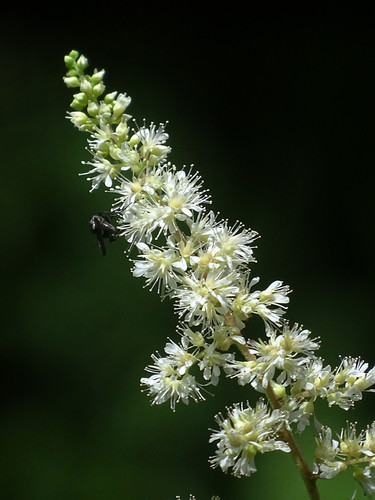
(c) Stefan, some rights reserved (CC BY-NC), uploaded by Stefan
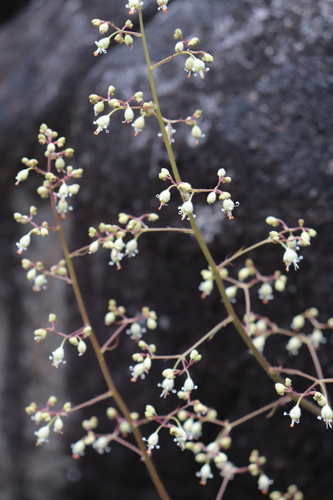
(c) Nicola Rammell, some rights reserved (CC BY-NC), uploaded by Nicola Rammell

(c) Todd Ramsden, some rights reserved (CC BY-NC), uploaded by Todd Ramsden
What to Eat
Edible parts: Leaves, Roots
Young leaves can be eaten cooked, though they are not considered very palatable.
Where to Find It
It is a temperate plant. It grows in gravelly banks and rock crevices. In Canada it grows from low altitudes to sub-alpine regions. It is frost hardy. It suits hardiness zones 5-9.
Australia, Canada, North America, Tasmania, USA,
How to Identify
A perennial plant. It grows 45-60 cm high. It spreads 30-40 cm wide. The leaves are hairy with grey marbling. They are broad with shallow lobes. They are heart shaped and 8 cm long. The flowers are cream or white in open sprays.
How to Grow
Succeeds in any good sweet garden soil that does not dry out in spring. Prefers full sun but tolerates partial shade. Prefers a well-drained fairly rich and not too heavy soil. Plants are hardy to about -15°c. Apt to hybridize with other members of this genus. This species is probably best treated as a sub-species of H. micrantha.
Propagation: Sow seed in early spring in a warm greenhouse, barely covering it. Germination is usually fairly rapid. Prick seedlings into individual pots when large enough and plant out into permanent positions in late spring or early summer. Seed can also be sown in an outdoor seedbed in mid-spring for early summer planting, or in mid-summer for planting out the following spring. Divide plants in March or October, though August or early September is preferred. Plant the woody roots deeply, leaving only the foliage crown above ground.
Medicinal Uses
The root is antiphlogistic, antiseptic, astringent, febrifuge, and ophthalmic.
Other Uses
The root can be used as an alum substitute mordant in dyeing. Its high tannin content is thought to be the active mordanting component. The plant makes a good ground cover for the woodland garden, with plants spaced about 30cm apart in each direction.
Wikipedia
Source ↗Heuchera micrantha is a species of flowering plant in the saxifrage family known by the common name crevice alumroot, or small-flowered alumroot.
Notes
There are 55 Heucheria species.
Names & Synonyms
References (7)
- Cundall, P., (ed.), 2004, Gardening Australia: flora: the gardener's bible. ABC Books. p 698
- Edward's Bot. Reg. 15: t. 1302. 1829
- Joyce, D., 1998, The Garden Plant Selector. Ryland, Peters and Small. p 236
- Lim, T. K., 2015, Edible Medicinal and Non Medicinal Plants. Volume 9, Modified Stems, Roots, Bulbs. Springer p 46
- MacKinnon, A., et al, 2009, Edible & Medicinal Plants of Canada. Lone Pine. p 219
- Moerman, D. F., 2010, Native American Ethnobotany. Timber Press. p 264
- Plants for a Future database, The Field, Penpol, Lostwithiel, Cornwall, PL22 0NG, UK. http://www.scs.leeds.ac.uk/pfaf/