Ammannia multiflora
Roxb.
Jerry-jerry
no rights reserved, uploaded by 葉子
(c) Martin Bennett, some rights reserved (CC BY-NC), uploaded by Martin Bennett

(c) Dinesh Valke, some rights reserved (CC BY-SA)
What to Eat
Edible parts: Seeds
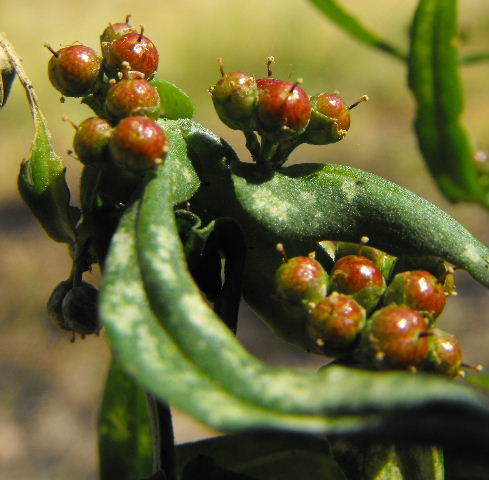
Seed - cooked. It is usually ground into a powder and used in making a cake. The tiny seeds are around 0.2mm long, contained in a red-brown or red-wine coloured capsule that is around 1.5mm in diameter.
Where to Find It
It is a tropical plant. It grows in warmer places. It grows in sandy and alluvial soil. It is often along watercourses and near lakes. In Pakistan it grows up to 1,800 m altitude.
Africa, Asia, Australia, China, Himalayas, India, Korea, Madagascar, Nepal, Pakistan, Taiwan,
How to Identify
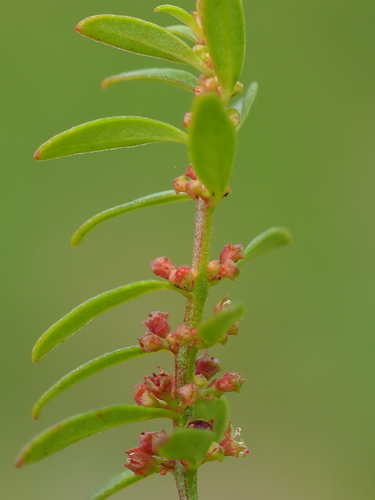
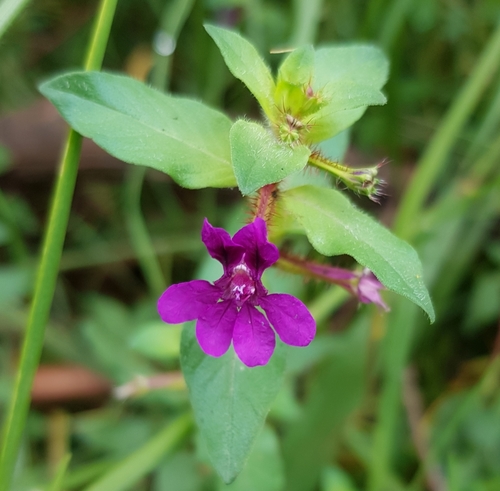
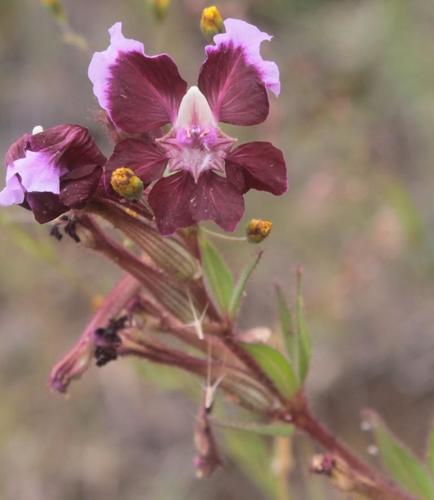
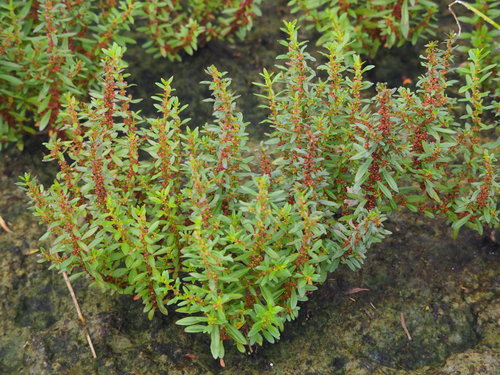
A herb. It is erect and grows each year from seed. It grows 10-60 cm high. The leaves are narrowly sword shaped. They are 3-40 mm long by 1-6 mm wide. The flowers are in groups of 3 or more. The flowers are red, pink and white.
How to Grow
Ammannia multiflora is native of tropical and subtropical regions in Africa, Asia and Australia, where it is often found as a weed of cultivated land, especially ricefields. It has spread as a weed of rice into warm temperate regions of Asia. The plant is a weed of cultivated land, especially rice fields.
Medicinal Uses
None known.
Other Uses
None known.
Wikipedia
Source ↗Ammannia multiflora, commonly known as many-flower ammannia and jerry-jerry in Victoria, is a species in the family Lythraceae. It is widespread in Asia, tropical and sub-tropical Africa and Australia. It can be found in shallow water and damp heavy soils.
Notes
There are 30 Ammania species. They grow in the tropics and subtropics.
Names & Synonyms
Bongonimbary, Rongombary, Taboronjazalahy
References (12)
- Bailey, F. M., 1913, Comprehensive Catalogue of Queensland Plants. Queensland Government. p 214
- Calvert, G. & Liessman, L., 2014, Wetland Plants of the Townsville - Burdekin Flood Plain. LBLCA Ayr, Queensland, p 69
- Cherikoff V. & Isaacs, J., The Bush Food Handbook. How to gather, grow, process and cook Australian Wild Foods. Ti Tree Press, Australia p 188
- Cribb, A.B. & J.W., 1976, Wild Food in Australia, Fontana. p 96
- Dunlop, C.R., Leach, G.J. & Cowie, I.D., 1995, Flora of the Darwin Region. Vol 2. Northern Territory Botanical Bulletin No 20. p 133
- Jackes, B.R., 2001, Plants of the Tropics. Rainforest to Heath. An Identification Guide. James Cook University. p 62
- Kenneally, K.E., Edinger, D. C., and Willing T., 1996, Broome and Beyond, Plants and People of the Dampier Peninsula, Kimberley, Western Australia. Department of Conservation and Land Management. p 119
- Lazarides, M. & Hince, B., 1993, Handbook of Economic Plants of Australia, CSIRO. p 18
- Morley, B.D., & Toelken, H.R., (Eds), 1983, Flowering Plants in Australia. Rigby. p 170
- Paczkowska, G. & Chapman, A.R., 2000, The Western Australian Flora. A Descriptive Catalogue. Western Australian Herbarium. p 286
- Roth, W.E., 1901,
- Wheeler, J.R.(ed.), 1992, Flora of the Kimberley Region. CALM, Western Australian Herbarium, p 490