Pachira aquatica
Aublet
Guiana Chestnut, Water Chestnut
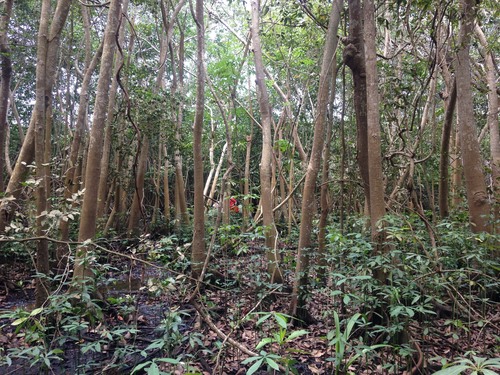
(c) Rafael Paredes Montesinos, some rights reserved (CC BY-NC)
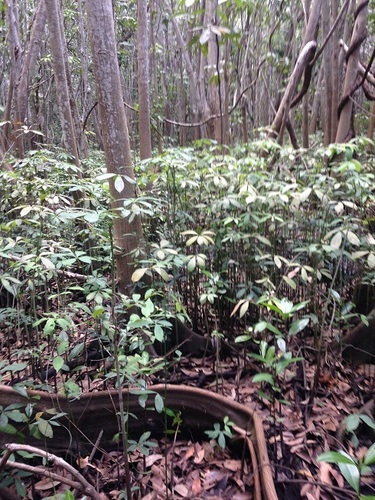
(c) Rafael Paredes Montesinos, some rights reserved (CC BY-NC)
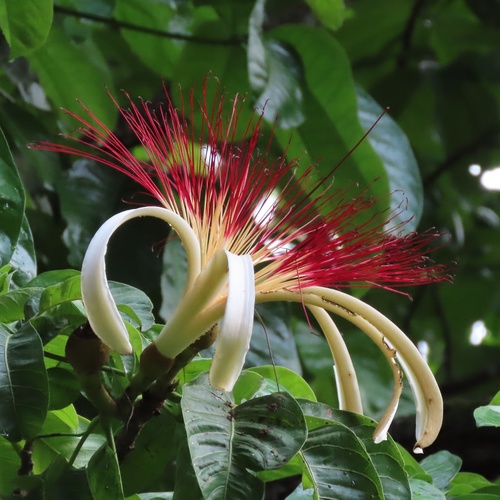
(c) larsonek, some rights reserved (CC BY-NC)
What to Eat
Edible parts: Flowers, Leaves, Seeds
The seeds can be cooked by boiling, roasting, or frying, or eaten raw. The leaves and flowers are eaten as vegetables.
Known Hazards
Where to Find It
A tropical plant. It requires a warm sunny, well protected position. It is drought tolerant. It is sensitive to frost, but the tree can survive light frosts. It can grow in moist or boggy places. It grows on creek and river banks. It originally came from South America and Mexico but has been taken to many tropical countries. It can grow in subtropical places. It suits humid places. It suits hardiness zones 10-12. In Yunnan.
Africa, Amazon, Andes, Angola, Asia, Australia, Belize, Bolivia, Brazil*, Cameroon, Central Africa, Central America, China, Colombia, Cook Islands, Costa Rica, Cuba, Dominican Republic, East Africa, Ecuador*, El Salvador, French Guiana, French Polynesia, FSM, Gabon, Ghana, Guadeloupe, Guam, Guatemala, Guianas, Guyana, Haiti, Hawaii, Honduras, India, Indochina, Marquesas, Mexico, Mozambique, Nicaragua, Nigeria, North America, Pacific, Panama, Peru*, Pohnpei, Puerto Rico, SE Asia, Senegal, Singapore, Solomon Islands, South America, Suriname, Tahiti, Taiwan, Thailand, Venezuela, West Africa, West Indies, Yap,
How to Identify
An evergreen tree. It grows to a height of 7-18 m with a spread of 3 m. The trunk is erect and branches heavily. The leaves are large and compound like the fingers on a hand. There are up to 9 leaflets. The leaflets can be 30 cm long. The leaves are dark green and shiny. The flowers are cream with bright red tips. The petals are long and droop outwards. It is the red tips of the stamens that look like a shaving brush which gives it one of its common names. The flowers occur in long hanging groups. The flowers are short lived opening in the morning and falling by evening. The fruit is like a round pod. It can be 30 long and 15 cm across. The pod bursts open when ripe. The pod opens in about 5 sections. The seeds are round and 1-2 cm across. They are brown. They have a fleshy pulp. It is a good shade tree but other plants will not grow under it.
Nutrition Score: 48/100
| Part | Moisture | kJ | kcal | Protein | Vit A | Vit C | Iron | Zinc |
|---|---|---|---|---|---|---|---|---|
| Seeds | 3.9 | 2 | 559 | 11.9 | — | — | — | — |
| Fruit | 76 | 386 | 94 | 2.2 | — | — | — | — |
How to Grow
It is grown from seed. Seed will only remain viable for a short period so should be sown fresh. Cuttings can also be used to grow trees. Probably aerial layering can be used.
Propagation: Seed - - best sown as soon as it is ripe in a partially shaded position in individual containers. A germination rate of almost 100% can be expected, with the seed sprouting within 5 - 10 days. Seedlings grow away quickly and they should be ready to plant out 3 - 4 months later. The seed has a very short viability of 20 - 30 days in storage. Cuttings Layering
Medicinal Uses
The skin of the immature green fruit is used in the treatment of hepatitis. The seeds are used as an anaesthetic. The bark is used medicinally to treat stomach complaints and headaches while. A tisane from the boiled bark is used as a blood tonic. A cold water infusion of the crushed leaves is used to treat a burning sensation in the skin.
Other Uses
A yellow dye is obtained from the bark. A dark red dye is obtained. A fibre is obtained from the bark. It is used for caulking boats and cordage. The oil from the seed has industrial potential for manufacturing soap. The fruit is spread on the ground in order to repel sand fleas. The white wood is light in weight, fibrous, soft and of low durability. It is used only for low quality purposes such as making boxes and matches and is suitable for manufacturing paper, yielding 36% cellulose paste.
Wikipedia
Source ↗Pachira aquatica is a species of tropical wetland tree in the mallow family Malvaceae, native to Central and South America where it grows in swamps. It is known by its common names Malabar chestnut, French peanut, Guiana chestnut, provision tree, Saba nut, Monguba (Brazil), Pumpo (Guatemala) and Jelinjoche (Costa Rica) and is commercially sold under the names money tree and money plant. This tree is sometimes sold with a braided trunk and is commonly grown as a houseplant, although more commonly what is sold as a "Pachira aquatica" houseplant is in fact a similar species, Pachira glabra.
Production
Trees are slow growing. Flowering can occur throughout the year but seed set is mostly in the late dry season. Seeds can be stored for several months.
Other Information
It is a cultivated food plant.
Notes
There are 20 Pachira species. They are from tropical America. Also put in the family Bombacaceae. In the subfamily Bombacoideae. Presumably in a hot house in Slovenia.
Names & Synonyms
Acamoyote, Apompo, Axilochochitl, Castanon, Castano del choco, Catanho de agua, Ceibo de agua, Coco de agua, Gua li, Guyana chestnut, Jelinjoche, Kanihiri, Malabar-chestnut, Mamorana, Minguba, Momow, Money tree, Monguba, Pacae plano, Pachira, Provision Tree, Pukru, Saba nut, Sabanut, Sacha pandisho, Shaving Brush Tree, Watrakakaw, Zapotolongo
References (59)
- Arora, R. K., 2014, Diversity in Underutilized Plant Species - An Asia-Pacific Perspective. Bioversity International. p 80 (As Pachira macrocarpa)
- Barrau, J., 1976, Subsistence Agriculture in Polynesia and Micronesia. Bernice P. Bishop Museu, Bulletin 223 Honolulu Hawaii. Kraus reprint. p 56
- Barwick, M., 2004, Tropical and Subtropical Trees. A Worldwide Encyclopedic Guide. Thames and Hudson p 306
- Bodkin, F., 1991, Encyclopedia Botanica. Cornstalk publishing, p 755
- Burkill, H. M., 1985, The useful plants of west tropical Africa, Vol. 1. Kew.
- Cheifetz, A., (ed), 1999, 500 popular vegetables, herbs, fruits and nuts for Australian Gardeners. Random House p 212
- Chizmar Fernandez, C., et al, 2009, Plantas comestibles de Centroamerica. Instituto de Biodiversidad, Costa Rica. p 123
- Coe, F.G., and Anderson, G.J., 1996, Ethnobotany of the Garifuna of Eastern Nicaragua. Economic Botany 50(1) pp 71-107
- Coe, F. G. & Anderson, G. J., 1997, Ethnobotany of the Miskitu of Eastern Nicaragua. Journal of Ethnobiology 17(2): 171-214
- Condit, R., et al, 2011, Trees of Panama and Costa Rica. Princeton Field Guides. p 276
- Cundall, P., (ed.), 2004, Gardening Australia: flora: the gardener's bible. ABC Books. p 970
- Etherington, K., & Imwold, D., (Eds), 2001, Botanica's Trees & Shrubs. The illustrated A-Z of over 8500 trees and shrubs. Random House, Australia. p 508
- Facciola, S., 1998, Cornucopia 2: a Source Book of Edible Plants. Kampong Publications, p 50
- French, B.R., 2010, Food Plants of Solomon Islands. A Compendium. Food Plants International Inc. p 178
- Gardner, S., et al, 2000, A Field Guide to Forest Trees of Northern Thailand, Kobfai Publishing Project. p 77
- Grandtner, M. M., 2008, World Dictionary of Trees. Wood and Forest Science Department. Laval University, Quebec, Qc Canada. (Internet database http://www.wdt.qc.ca)
- Grandtner, M. M. & Chevrette, J., 2013, Dictionary of Trees, Volume 2: South America: Nomenclature, Taxonomy and Ecology. Academic Press p 471
- Hearne, D.A., & Rance, S. J., 1975, Trees for Darwin and Northern Australia. AGPS, Canberra p 91, Pl 25
- Hedrick, U.P., 1919, (Ed.), Sturtevant's edible plants of the world. p 459
- Hibbert, M., 2002, The Aussie Plant Finder 2002, Florilegium. p 217
- Hist. pl. Guiane 2:726, t. 291-292. 1775
- http://www.botanic-gardens-ljubljana.com/en/plants
- Hu, Shiu-ying, 2005, Food Plants of China. The Chinese University Press. p 545
- Jardin, C., 1970, List of Foods Used In Africa, FAO Nutrition Information Document Series No 2.p 35
- Kiple, K.F. & Ornelas, K.C., (eds), 2000, The Cambridge World History of Food. CUP p 1807
- Llamas, K.A., 2003, Tropical Flowering Plants. Timber Press. p 264
- Lopez-Diago, D. & Garcia, N., 2021, Wild edible fruits of Colombia. Biota ColomBiana 22 (2) p 41
- Lord, E.E., & Willis, J.H., 1999, Shrubs and Trees for Australian gardens. Lothian. p 63
- Lorenzi, H., Bacher, L., Lacerda, M. & Sartori, S., 2006, Brazilian Fruits & Cultivated Exotics. Sao Paulo, Instituto Plantarum de Estuados da Flora Ltda. p 161
- Lyle, S., 2006, Discovering fruit and nuts. Land Links. p 305
- Martin, F. W., et al, 1987, Perennial Edible Fruits of the Tropics. USDA Handbook 642 p 84 (As Pachira macrocarpa) p 83 (As Bombax aquaticum)
- Massal, E. and Barrau, J., 1973, Food Plants of the South Sea Islands. SPC Technical Paper No 94. Nounea, New Caledonia. p 32
- Menninger, E.A., 1977, Edible Nuts of the World. Horticultural Books. Florida p 65
- Mutchnick, P. A. and McCarthy, B. C., 1997, An Ethnobotanical Analysis of the Tree Species Common to the Subtropical Moist Forests of the Peten, Guatemala. Economic Botany, Vol. 51, No. 2, pp. 158-183
- Omawale, 1973, Guyana's edible plants. Guyana University, Georgetown p 54 (As Bombax aquaticum)
- Paz, F. S., et al, 2021, Edible Fruit Plant Species in the Amazon Forest Rely Mostly on Bees and Beetles as Pollinators. Journal of Economic Entomology, XX(XX), 2021, 1–13
- Piedra-Malagón, E. M., et al, 2022, Edible native plants of the Gulf of Mexico Province. Biodiversity Data Journal 10: e80565 p 24
- Plants of Haiti Smithsonian Institute http://botany.si.edu/antilles/West Indies
- Raponda-Walker, A & Sillans, R., 1961, Les Plantes Utiles du Gabon. Editions Paul Lechevalier, Paris. p 107 (As Pachyra aquatica)
- van Roosmalen, M.G.M., 1985, Fruits of the Guianan Flora. Utrecht Univ. & Wageningen Univ. p 56
- Recher, P, 2001, Fruit Spirit Botanical Gardens Plant Index. www.nrg.com.au/~recher/ seedlist.html p 3
- Roa, J. A. G. & Boada, D. S. G., 2018, Fundación para el Fortalecimiento de la Fruticultura y Plantas Alimenticias no Convencionales en Colombia.
- Segura, S., et al, 2018, The edible fruit species in Mexico. Genet Resour Crop Evol (2018) 65:1767–1793
- Smith, N., Mori, S.A., et al, 2004, Flowering Plants of the Neotropics. Princeton. p 57
- Smith, N., Mori, S.A., et al, 2004, Flowering Plants of the Neotropics. Princeton. Plate 7 (Photo)
- Standley, P. C. & Record, S. J., 1936, The Forests and Flora of British Honduras. (Belize). p 250
- Staples, G.W. and Herbst, D.R., 2005, A tropical Garden Flora. Bishop Museum Press, Honolulu, Hawaii. p 194 (Drawing)
- Tang Ya, BOMBACACEAE [Draft], Flora of China
- Torre, de la L., et al, 2008, Enciclopedia de las Plantas Útiles del Ecuador. Herbario QCA. Pontificia Universidad Católica del Ecuador. p 251
- USDA, ARS, National Genetic Resources Program. Germplasm Resources Information Network - (GRIN). [Online Database] National Germplasm Resources Laboratory, Beltsville, Maryland. Available: www.ars-grin.gov/cgi-bin/npgs/html/econ.pl (10 April 2000)
- Van den Eynden, V., et al, 2003, Wild Foods from South Ecuador. Economic Botany 57(4): 576-603
- van Wyk, B., 2005, Food Plants of the World. An illustrated guide. Timber press. p 272
- Vasquez, R. and Gentry, A. H., 1989, Use and Misuse of Forest-harvested Fruits in the Iquitos Area. Conservation Biology 3(4): 350f
- Vivien, J., & Faure, J.J., 1996, Fruitiers Sauvages d'Afrique. Especes du Cameroun. CTA p 82
- Wickens, G.E., 1995, Edible Nuts. FAO Non-wood forest products. FAO, Rome. p 57, 110
- Wiersema, J. H. & Leon, B., 2013, World Economic Plants. A Standard Reference CRC Press. 2nd Ed. p 486
- World Checklist of Useful Plant Species 2020. Royal Botanic Gardens, Kew
- www.colecionandofrutas.org
- Zuchowski W., 2007, Tropical Plants of Costa Rica. A Zona Tropical Publication, Comstock Publishing. p 252