Petasites hyperboreus
Rydb.
Arctic sweet coltsfoot
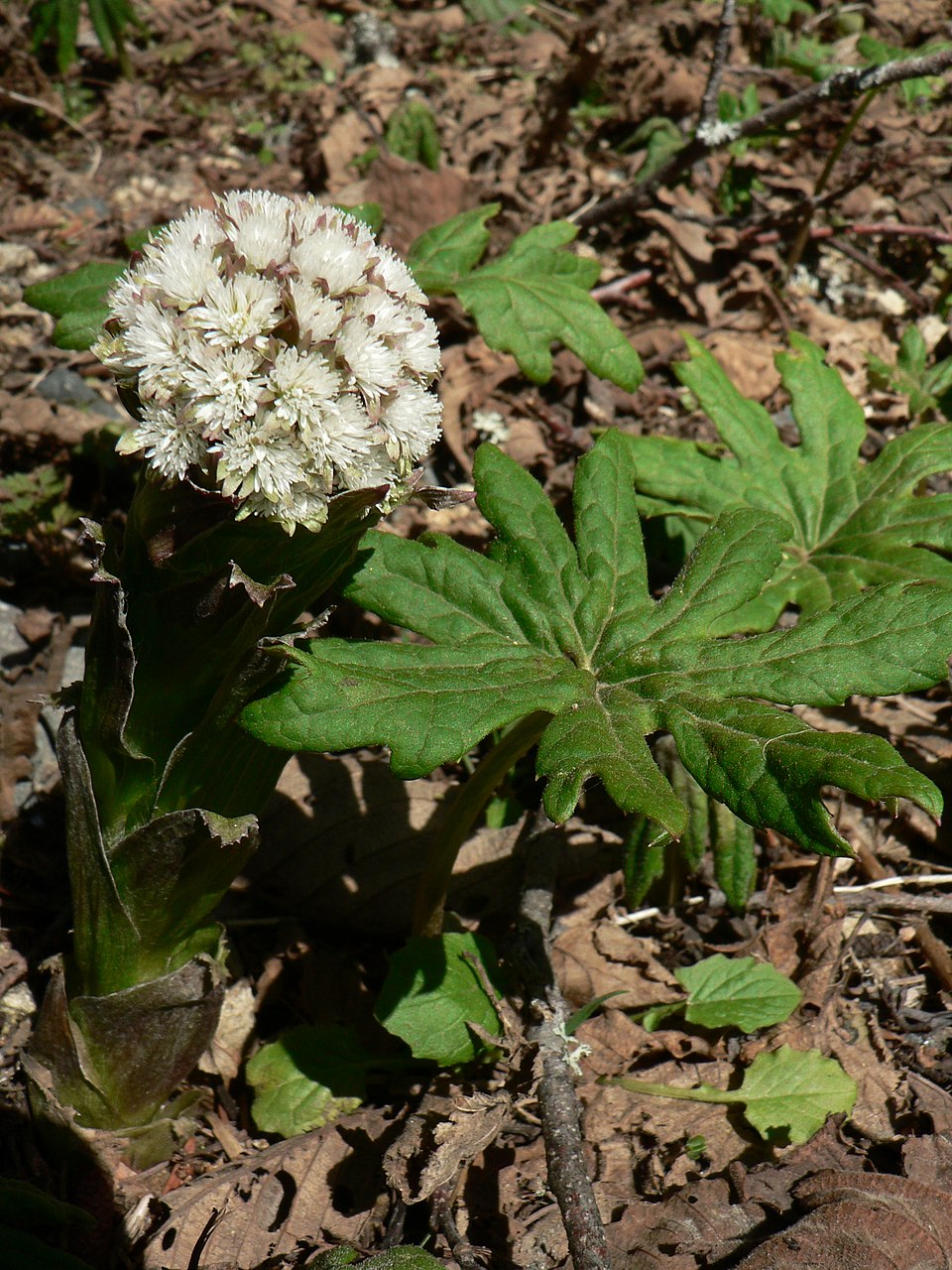
Wikimedia Commons - Walter Siegmund (talk)
What to Eat
Edible parts: Flowers, Leaves, Salt, Stem
Young leaves can be eaten cooked, though they have a felt-like texture. Young stalks and flower heads are also used cooked. The burnt ash of the leaves serves as a salt substitute: the stems and leaves, while still green, are rolled into balls, dried, then burned on top of a very small fire on a rock, producing a very acceptable condiment for piñole.
Where to Find It
It is a temperate plant. It grows in damp alpine meadows and in wet moss near small streams in the Rocky Mountains.
Canada, North America, USA,
How to Identify
A stout herb. It keeps growing from year to year. It has a creeping rootstock. It is somewhat fleshy. The leaves at the base have long leaf stalks. The leaf blades are heat shaped or triangle shaped with irregular lobes. They are deep green above and have a blue covering underneath. The flower stalks are 30-40 cm tall. There can be several heads of flowers in a flat topped cluster.
How to Grow
We have very little information on this species and do not know if it will succeed in Britain, though judging by its native range it should succeed outdoors in most parts of the country. According to one report this species is no more than a synonym of P. frigidus. The following notes are based on the general needs of the genus. Succeeds in ordinary garden soil, but prefers a deep fertile humus-rich soil that is permanently moist but not stagnant, succeeding in shade, semi-shade or full sun. Prefers partial shade. Plants can be grown in quite coarse grass, which can be cut annually in the autumn. A very invasive plant, too rampant for anything other than the wild garden. Dioecious, male and female plants must be grown if seed is required.
Propagation: Sow seed in a cold frame as soon as it is ripe or in early spring, covering only lightly and keeping the compost moist. Prick seedlings into individual pots when large enough to handle and plant out in summer. Division succeeds at almost any time of year. Larger divisions can go directly into permanent positions; smaller ones are better potted up and grown on in light shade in a cold frame until well established, then planted out in late spring or early summer.
Medicinal Uses
The plant is antispasmodic and used as a poultice and salve. An infusion of dried, stored leaves has been used in the treatment of colds and head and chest congestion.
Other Uses
The cotton-like seed heads have been used as stuffing material in mattresses. The leaves have been used to make temporary cone-shaped containers for picking fruit and have occasionally served as makeshift funnels.
Wikipedia
Low perennial reaching 0.2 m tall but spreading to 1 m, growing rapidly. Flowers April to May with seeds ripening May to June. Dioecious requiring both sexes for seed production. Hardy to UK zone 5. Adapts to sandy, loamy, and clay soils with mildly acid to mildly alkaline pH. Grows from full shade to full sun and prefers moist to wet soil.
Names & Synonyms
References (4)
- Lim, T. K., Edible Medicinal and Non-Medicinal Plants Volume 7 Flowers
- Plants for a Future database, The Field, Penpol, Lostwithiel, Cornwall, PL22 0NG, UK. http://www.scs.leeds.ac.uk/pfaf/
- Porsild, A.E., 1974, Rocky Mountain Wild Flowers. Natural History Series No. 2 National Museums of Canada. p 420
- Scotter, G. W., & Flygare, H., 1993, Wildflowers of the Canadian Rockies. Hurtig. p 12