Physalis viscosa
L.
Sticky Cape Gooseberry

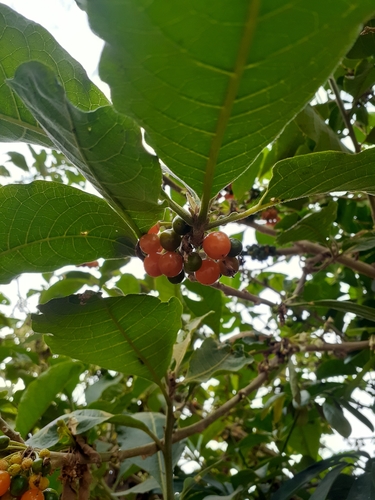
(c) Tony Rebelo, some rights reserved (CC BY-SA), uploaded by Tony Rebelo

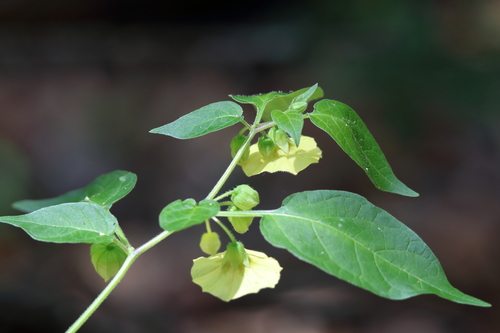
(c) Ricky Taylor, some rights reserved (CC BY-NC), uploaded by Ricky Taylor
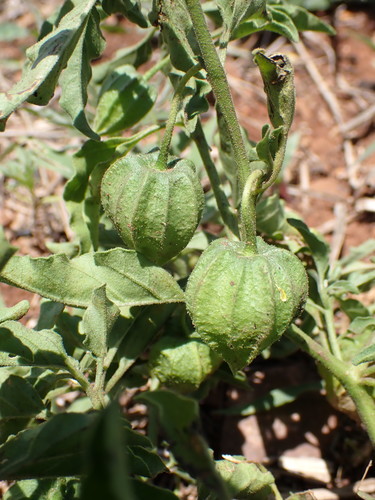
(c) David Hoare, some rights reserved (CC BY-NC-SA), uploaded by David Hoare
What to Eat
Edible parts: Fruit, Leaves
The fruit can be eaten raw or cooked — it is juicy and thin-skinned with a pleasant, sub-acid, cherry-like flavour, and is considered the best North American species of Physalis. Each fruit is naturally enclosed in a papery calyx that protects it from pests and the elements — this calyx is toxic and must not be eaten.
Known Hazards
Where to Find It
It is a warm temperate plant. In Chile it grows from sea level to 2,000 m altitude. It grows in humid areas with constant rain. It grows in full sun. It can tolerate some dry periods and some shade. It can grow in arid places. It suits hardiness zone 9. It can tolerate light frosts.
Africa, Argentina, Australia, Bolivia, Brazil*, Chile, East Africa, Easter Island, Eswatini, Mexico, Mozambique, North America, Paraguay, South Africa, Southern Africa, South America, Swaziland, Uruguay, USA, Zimbabwe,
How to Identify
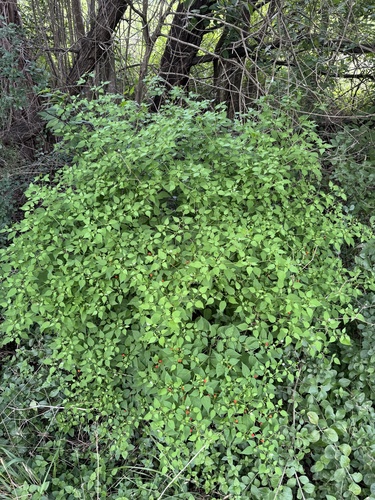
An erect plant. It has a spreading habit. The roots are extensive and creeping. It grows 60-180 cm high. It keeps growing from year to year. The leaves are light green and have leaf stalks. The leaves do not have hairs and have a wavy edge. The flowers are yellow. They grow in the axils of the upper leaves. The flowers are bell shaped and 2.5 cm across. They have dark centres. The fruit is a berry which is orange and sticky. It is covered in a thin outer covering.
Nutrition Score: 45/100
| Part | Moisture | kJ | kcal | Protein | Vit A | Vit C | Iron | Zinc |
|---|---|---|---|---|---|---|---|---|
| Leaves | 82.8 | 226 | 54 | 4.9 | — | — | 21.6 | 1.3 |
How to Grow
We have very little information on this species and do not know if it will be hardy in Britain, though judging by its native range it could succeed outdoors at least in the milder parts of this country. We are not sure if this species is an annual or perennial, but it should be possible to treat it as an annual, sowing the seed in early spring in a warm greenhouse and planting out after the last expected frosts. The following notes are based on the general needs of the genus. Succeeds in any well-drained soil in full sun or light shade.
Propagation: Sow seed in March or April in a greenhouse, barely covering it. Germination is typically quick and prolific. Diurnal temperature fluctuations assist germination. Once large enough to handle, prick seedlings out into individual pots of fairly rich soil and plant out after the last expected frosts, with cloche protection until established. Division in spring is very straightforward — larger divisions can go directly into permanent positions, while smaller ones are better potted up and grown on in light shade in a cold frame until well established before planting out in late spring or early summer. For basal cuttings in early summer, harvest shoots with plenty of underground stem when they reach about 8–10cm above ground, pot into individual pots, and keep in light shade in a cold frame or greenhouse until rooting well before planting out in summer.
Medicinal Uses
The fruit is aperient and diuretic, used in the treatment of gravel and suppression of urine, and is highly recommended for fevers and gout. The leaves and stems are febrifuge and mildly tonic, used to treat the malaise that follows malaria and to support weak or anaemic individuals. The root has been applied as a dressing on wounds.
Other Uses
None known Special Uses
Wikipedia
Source ↗Physalis viscosa is a species of flowering plant in the nightshade family known by many common names, including starhair groundcherry, stellate ground-cherry and grape groundcherry in English, and arrebenta-cavalo, balãozinho, and camambú in Portuguese and Spanish (from Guaraní akamambu, «blister»). It is native to South America, and it is known on other continents as an introduced species and sometimes a weed. It can grow in many types of habitat, including disturbed areas. This is a rhizomatous perennial herb producing hairy stem up to about 40 centimeters in maximum height. The oval leaves are 3 to 5 centimeters long and have smooth or toothed edges. The flowers blooming from the leaf axils are bell-shaped and about 1.5 centimeters wide. They are yellow with darker centers, and have five stamens tipped with yellow anthers. The calyx of sepals at the base of the flower enlarges as the fruit develops, becoming an inflated, ribbed, lanternlike structure 2 to 3 centimeters long which contains the berry.
Other Information
The fruit are enjoyed by children.
Notes
There are about 75-100 Physalis species.
Names & Synonyms
Camambu, Camapu, Cerezo ratrero, Huevo de gallo, Kamambu, Prairie ground cherry, Sticky ground cherry, Tomatito, Uchuva, Uvilla del campo
References (34)
- Arenas, P. and Scarpa, G. F., 2006, Edible wild plants of the Chorote Indians, Gran Chaco, Argentina. Botanical Journal of the Linnean Society. Vol. 153 (1): pp 73-85
- Beckstrom-Sternberg, Stephen M., and James A. Duke. "The Foodplant Database." http://probe.nalusda.gov:8300/cgi-bin/browse/foodplantdb.(ACEDB version 4.0 - data version July 1994)
- Brack, P., et al, 2020, Frutas nativas do Rio Grande do Sul, Brasil: riqueza e potencial alimentício. Native fruits of Rio Grande do Sul, Brazil: richness and potential as food. Rodriguésia 71: e03102018
- Cordero, S. E., Abello, L. A., & Galvez, F. L., 2017, Plantas silvestres comestibles y medicinales de Chile y otras partes del mundo. CORMA p 218
- Ferns, Useful Tropical Plants
- Fox, F. W. & Young, M. E. N., 1982, Food from the Veld. Delta Books. p 345
- Hedrick, U.P., 1919, (Ed.), Sturtevant's edible plants of the world. p 493
- Hussey, B.M.J., Keighery, G.J., Cousens, R.D., Dodd, J., Lloyd, S.G., 1997, Western Weeds. A guide to the weeds of Western Australia. Plant Protection Society of Western Australia. p 222
- Kermath, B. M., et al, 2014, Food Plants in the Americas: A survey of the domesticated, cultivated and wild plants used for Human food in North, Central and South America and the Caribbean. On line draft. p 653
- Kinupp, V. F., 2007, Plantas alimenticias nao-convencionais da regiao metropolitana de Porto Alegre, RS, Brazil p 102
- Lamp, C & Collet F., 1989, Field Guide to Weeds in Australia. Inkata Press. p 213
- Lazarides, M. & Hince, B., 1993, Handbook of Economic Plants of Australia, CSIRO. p 189
- Leon-Lobos, P., et al, 2022, Patterns of Traditional and Modern Uses of Wild Edible Native Plants of Chile: Challenges and Future Perspectives. Plants (Basel) v 11 (6) Table S1
- Long, C., 2005, Swaziland's Flora - siSwati names and Uses http://www.sntc.org.sz/flora/
- Low, T., 1991, Wild Herbs of Australia and New Zealand. Angus & Robertson. p 100
- Malezas Comestibles del Cono Sur, INTA, 2009, Buernos Aires
- Paczkowska, G . & Chapman, A.R., 2000, The Western Australian Flora. A Descriptive Calatogue. Western Australian Herbarium. p 537
- Palmieri, V. S., et al, 2018, Aproximaciones etnobotánicas de las especies y prácticas de frutos nativos comestibles de la Actualidad. Aportes para la interpretación del pasado prehispánico de cerro colorado (Córdoba, Argentina). Bol. Soc. Argent. Bot. 53 (1): 115-133
- Palmieri, V. S., et al, 2022, Wild edible plants of the Central Mountains in Argentina. Comparing subregions to understand the complexity of local botanical knowledge. Rodriguésia 73: e01092021. 2022
- Piedra-Malagón, E. M., et al, 2022, Edible native plants of the Gulf of Mexico Province. Biodiversity Data Journal 10: e80565 p 31
- Plants for a Future database, The Field, Penpol, Lostwithiel, Cornwall, PL22 0NG, UK. http://www.scs.leeds.ac.uk/pfaf/
- Polini, G., et al, Useful and edible plants of Paraguay Region of Chaco. p 126
- Royal Botanic Gardens, Kew (1999). Survey of Economic Plants for Arid and Semi-Arid Lands (SEPASAL) database. Published on the Internet; http://www.rbgkew.org.uk/ceb/sepasal/internet [Accessed 11th June 2011]
- Ruiters-Welcome, A. K., 2019, Food plants of southern Africa. Ph.D. thesis. Univ. of Johannesburg p 103
- Samuels, J., 2015, Biodiversity of Food Species of the Solonaceae Family: A Preliminary Taxonomic Inventory of Subfamily Solanoideae. Resources 2015, 4. 277-322
- Saunders, C.F., 1948, Edible and Useful Wild Plants. Dover. New York. p 87
- Scarpa, G. F., 2009, Wild food plants used by the indigenous peoples of South American Gran Chaco: A general synopsis and intercultural comparison. Journal of Applied Botany and Food Quality 83:90-101
- Segura, S., et al, 2018, The edible fruit species in Mexico. Genet Resour Crop Evol (2018) 65:1767–1793
- Smith, F. I. and Eyzaquirre, P., 2007, African leafy vegetables: Their role in the World Health Organization's global Fruit and Vegetables Initiative. AJFAND, Vol. 7 No. 3
- Swaziland's Flora Database http://www.sntc.org.sz/flora
- Wehmeyer, A. S, 1986, Edible Wild Plants of Southern Africa. Data on the Nutrient Contents of over 300 species
- Welcome, A. K. & Van Wyk, B.-E., 2019, An inventory and analysis of the food plants of southern Africa. South African Journal of Botany 122 (2019) 136–179
- www.chileflora.com
- Zizka, G., 1991, Flowering Plants of Easter Island. Palmarum Hortus Francofurtensis