Picea orientalis
(L.) Link
Caucasian spruce, Oriental spruce

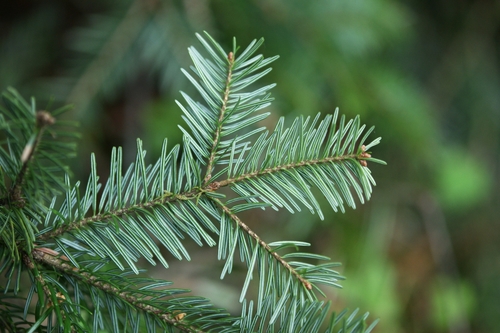
(c) София Р., some rights reserved (CC BY-NC), uploaded by София Р.

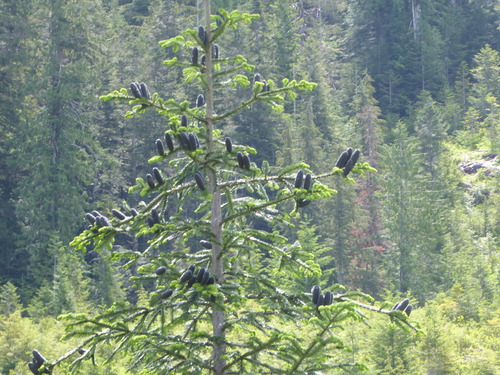
(c) Alexey P. Seregin, some rights reserved (CC BY-NC), uploaded by Alexey P. Seregin
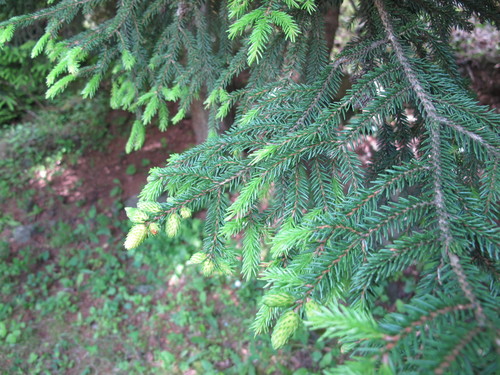
(c) Grzegorz Grzejszczak, some rights reserved (CC BY-SA), uploaded by Grzegorz Grzejszczak
What to Eat
Edible parts: Flowers, Inner bark, Seeds, Tea, Resin
Young male catkins can be eaten raw or cooked and used as a flavouring. Immature female cones are edible when cooked — the central portion becomes sweet and syrupy when roasted. The inner bark can be dried and ground into a powder for use as a soup thickener or bread additive, though it is an emergency food used only when nothing else is available. The seed is raw-edible but too small and fiddly to be worth collecting except in desperate circumstances. Young shoot tips make a refreshing tea that is rich in vitamin C.
Where to Find It
It is a temperate plant. It grows to 2,130 m altitude in the Caucasus. It grows naturally in Turkey. It suits hardiness zones 3-9. Arboretum Tasmania.
Asia, Australia, Britain, Caucasus, Europe, Georgia, Tasmania, Turkey, Türkiye,
How to Identify
A large cone shaped tree. It grows to 40 m high. It has dense branches and foliage. The leaves are glossy, dark green needles. They are small and lie close to the stem. They have rounded ends. Male flowers are dark red at first and then turn yellow. Female flowers are yellow. The cones are narrow and slightly curved. They taper to both ends.
How to Grow
Plants are grown from seed.
Propagation: Sow fresh seed in autumn in a cold frame to benefit from natural stratification, or sow stored seed as early in the year as possible under the same conditions. Light shade is preferable. Keep seed moist and cool during storage. Prick out seedlings into individual pots once large enough to handle and overwinter in a greenhouse or cold frame. Plant out into permanent positions in early summer the following year, or grow on in an outdoor nursery bed for a further season. Spring frost protection may be needed. Semi-ripe terminal shoot cuttings, 5–8cm long, taken in August in a frame, protected from frost, root in spring. Mature terminal shoot cuttings, 5–10cm long, taken September/October in a cold frame, take 12 months to root. Soft to semi-ripe wood cuttings taken in early summer in a frame are slow but reliable.
Medicinal Uses
The young shoot tips provide a tea rich in vitamin C. No other medicinal uses are known.
Other Uses
Tannin is obtained from the bark. Turpentine is obtained from the bark and branches. The wood is soft, white, easily cleaved, light, durable, and has good resonance; it is used for construction, furniture, and paper pulp.
Wikipedia
Source ↗Picea orientalis, commonly known as the Oriental spruce or Caucasian spruce, is a species of spruce native to the Caucasus and adjacent northeast Turkey.
Production
It grows slowly in the establishment phase.
Notes
There are between 30 and 40 species of Picea.
Names & Synonyms
Ladin, Nadzvi
References (11)
- Bussman, R. W., et al, 2016, A comparative ethnobotany of Khevsureti, Samtskhe-Javakheti, Tusheti, Svaneti, and Racha-Lechkhumi, Republic of Georgia (Sakartvelo), Caucasus. Journal of Ethnobiology and Ethnomedicine (2016) 12:4
- Bussman, R. W. et al, 2017, Ethnobotany of Samtskhe-Javakheti, Sakartvelo (Republic of Georgia), Caucasus. Indian Journal of Traditional Knowledge Vol. 16(1) pp 7-24
- Bussman, R. W., et al, 2021, Unity in diversity—food plants and fungi of Sakartvelo (Republic of Georgia), Caucasus. Journal of Ethnobiology and Ethnomedicine (2021) 17:72 p 12
- Coombes, A.J., 2000, Trees. Dorling Kindersley Handbooks. p 64
- Cundall, P., (ed.), 2004, Gardening Australia: flora: the gardener's bible. ABC Books. p 1041
- Ertug, F, Yenen Bitkiler. Resimli Türkiye Florası -I- Flora of Turkey - Ethnobotany supplement
- Harris, E & J., 1983, Field Guide to the Trees and Shrubs of Britain. Reader's Digest. p 239
- Hibbert, M., 2002, The Aussie Plant Finder 2002, Florilegium. p 233
- Linnaea 20:294. 1847
- Lord, E.E., & Willis, J.H., 1999, Shrubs and Trees for Australian gardens. Lothian. p 86
- Plants for a Future database, The Field, Penpol, Lostwithiel, Cornwall, PL22 0NG, UK. http://www.scs.leeds.ac.uk/pfaf/