Picea rubens
Sarg.
Red spruce, Eastern spruce, Yellow spruce, He-balsam

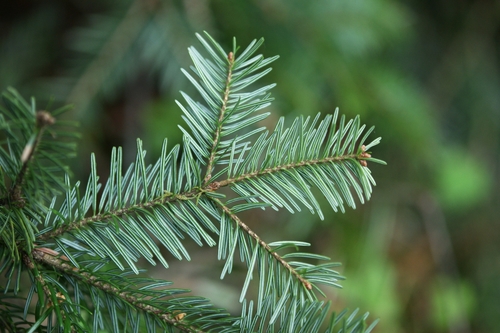
(c) Susan Elliott, some rights reserved (CC BY-NC), uploaded by Susan Elliott

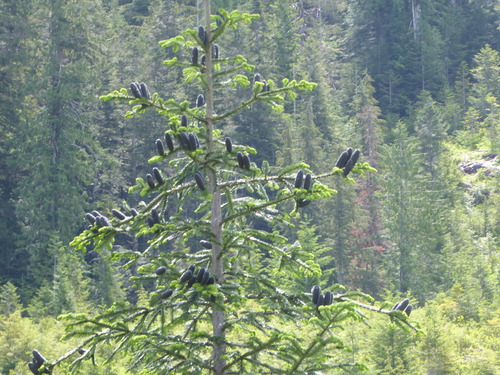
(c) Michael J. Papay, some rights reserved (CC BY)
What to Eat
Edible parts: Flowers, Gum, Inner bark, Leaves, Seeds, Tea
Young shoots are edible and used as an emergency food when all else fails. Young male catkins can be eaten raw or cooked and used as a flavouring. Immature female cones are edible when cooked — the central portion becomes sweet and syrupy when roasted; the cones measure 3–5cm in diameter. The inner bark can be dried and ground into a powder for use as a soup thickener or bread additive, and is likewise an emergency food. The seed is raw-edible, about 2–4mm long, but too small and fiddly to be worthwhile except in desperate circumstances. Young shoot tips make a refreshing tea rich in vitamin C. A gum exuded from the tree as a result of injury to the sapwood is also used for chewing.
Known Hazards
Where to Find It
It is a temperate plant. It grows in moist upland sites in Canada. It is very shade tolerant. It suits hardiness zones 4-8.
Australia, Canada, North America, USA,
How to Identify
A medium sized tree. It grows to 25 m high. The trunk is 60 cm across. The crown is a rather open cone shape. The bark is reddish-brown and separated into darker scales or plates with age. The branches slope downwards with the tips turned upwards. The leaves are single and curved and 10-16 mm long. They are shiny yellowish green. The tip is blunt. The needles point forward often pressed close to the twig. The cones are oval and 3-5 cm long. They are chocolate brown. The taper to a very short stalk. They scales are stiff and have light lines over them. The cones open with widely spread scales. These are easily separated from the axis.
How to Grow
Likes abundant moisture at the roots, if grown in drier areas it must be given a deep moist soil. Tolerates poor peaty soils. Succeeds in wet cold and shallow soils but is not very wind-firm in shallow soils. Resists wind exposure to some degree. A shallow-rooted tree, in the wild it is often blown down by strong winds. Prefers a pH between 4 to 6. Dislikes shade. Intolerant of atmospheric pollution. This species has been planted experimentally as a timber crop in N. Europe. It is slow to get started, but can then grow fairly rapidly when established though it soon slows down and seems to be fairly short-lived in cultivation, around 100 years is probably the limit. Wild trees live about 300 - 400 years. In some upland areas, especially over granitic or other base-poor soils, growth rate and health have been seriously affected by aluminium poisoning induced by acid rain. Seed production commences when the tree is about 15 years old, though reliable crops are not produced for another 5 - 10 years. Heavy crops occur every 4 - 6 years. Plants are strongly outbreeding, self-fertilized seed usually grows poorly. They hybridize freely with other members of this genus. Closely related to and hybridizes in the wild with P. mariana. It is believed by some botanists to be a hybrid between P. mariana and P. glauca. Trees should be planted into their permanent positions when they are quite small, between 30 and 90cm. Larger trees will check badly and hardly put on any growth for several years. This also badly affects root development and wind resistance. The crushed leaves are redolent of apples or camphor.
Propagation: Sow fresh seed in autumn in a cold frame to benefit from natural stratification, or sow stored seed as early in the year as possible under the same conditions. Light shade is preferable. Keep seed moist and cool during storage. Prick out seedlings into individual pots once large enough to handle and overwinter in a greenhouse or cold frame. Plant out into permanent positions in early summer the following year, or grow on in an outdoor nursery bed for a further season. Spring frost protection may be needed. Semi-ripe terminal shoot cuttings, 5–8cm long, taken in August in a frame, protected from frost, root in spring. Mature terminal shoot cuttings, 5–10cm long, taken September/October in a cold frame, take 12 months to root. Soft to semi-ripe wood cuttings taken in early summer in a frame are slow but reliable.
Medicinal Uses
A tea made from the boughs has been used to treat colds and to bring out measles. Pitch from the trunk has been applied as a poultice to rheumatic joints, the chest, and the stomach to relieve congestion and pain. A decoction of the bark has been used for lung complaints and throat problems.
Other Uses
The bark has been used to make baskets. Pitch can be obtained from the trunk. The roots have been used to make thread for sewing baskets and canoe skins. The wood is straight-grained, soft, light, and not strong, weighing 28lb per cubic foot; it is used for boxes, sash frames, and paper pulp, and is commonly used in the production of stringed musical instruments.
Wikipedia
Source ↗Picea rubens, commonly known as red spruce, is a species of spruce native to eastern North America, ranging from Nova Scotia to eastern Quebec and south-eastern Ontario, and south through the Adirondack Mountains and New England along the Appalachians to western North Carolina and eastern Tennessee. This species is also known as yellow spruce, West Virginia spruce, eastern spruce, and he-balsam. Red spruce is the provincial tree of Nova Scotia.
Production
Trees can live for 300 years. There are good seed crops every 2-11 years.
Notes
There are between 30 and 40 species of Picea.
Names & Synonyms
References (10)
- Beckstrom-Sternberg, Stephen M., and James A. Duke. "The Foodplant Database." http://probe.nalusda.gov:8300/cgi-bin/browse/foodplantdb.(ACEDB version 4.0 - data version July 1994)
- Cundall, P., (ed.), 2004, Gardening Australia: flora: the gardener's bible. ABC Books. p 1042
- Farrar, J.L., 1995, Trees of the Northern United States and Canada. Iowa State University press/Ames p 104
- Grandtner, M. M., 2008, World Dictionary of Trees. Wood and Forest Science Department. Laval University, Quebec, Qc Canada. (Internet database http://www.wdt.qc.ca)
- Kermath, B. M., et al, 2014, Food Plants in the Americas: A survey of the domesticated, cultivated and wild plants used for Human food in North, Central and South America and the Caribbean. On line draft. p 655
- Little, E.L., 1980, National Audubon Society Field Guide to North American Trees. Alfred A. Knopf. p 285
- Moerman, D. F., 2010, Native American Ethnobotany. Timber Press. p 401
- Plants for a Future database, The Field, Penpol, Lostwithiel, Cornwall, PL22 0NG, UK. http://www.scs.leeds.ac.uk/pfaf/
- Silva 12:33, t. 597. 1899
- MacKinnon, A., et al, 2009, Edible & Medicinal Plants of Canada. Lone Pine. p 30