Helminthotheca echioides
(L.) Holub..
Bristly Ox-Tongue
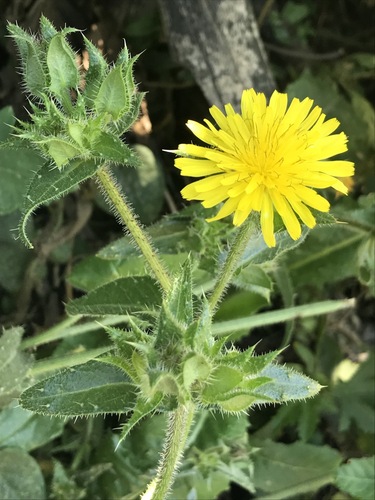
(c) mvz-juangonzalezromero, some rights reserved (CC BY-NC), uploaded by mvz-juangonzalezromero
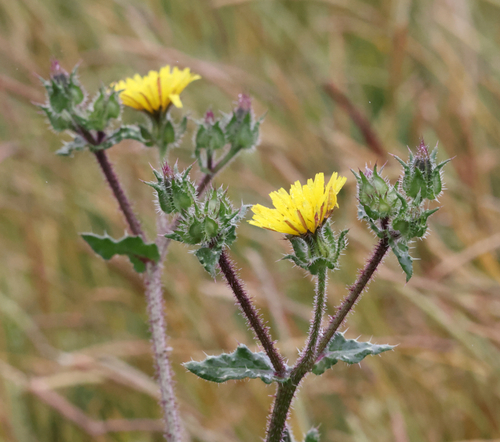
(c) Jerry Lanfear, some rights reserved (CC BY), uploaded by Jerry Lanfear
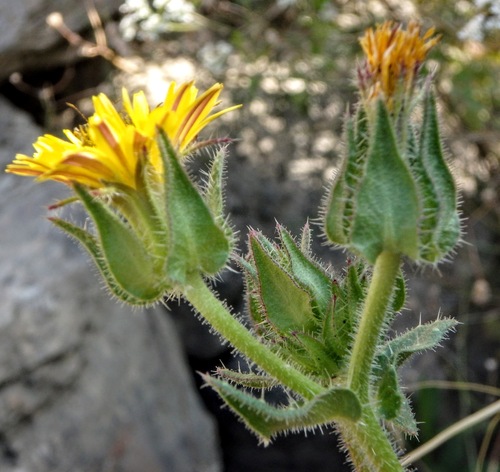
(c) Pedro Antonio Lázaro Molinero, some rights reserved (CC BY-NC), uploaded by Pedro Antonio Lázaro Molinero
What to Eat
Edible parts: Leaves, Root, Flowers
Young plants are used as a potherb, added to soups or eaten raw seasoned with oil and salt. The root has been eaten as a famine food.
Where to Find It
It is a Mediterranean plant. It grows in grassy and waste places. It can grow in brackish marshes. It can grow in arid places.
Africa, Argentina, Australia, Balkans, Bosnia, Britain, Chile, Crete, Croatia, Easter Island, Egypt, Europe*, France, Greece, Iran, Iraq, Ireland, Israel, Italy, Lebanon, Mediterranean*, Mexico, Middle East, New Zealand, North Africa, North America, Russia, Sicily, South Africa, Southern Africa, South America, Spain, Syria, Tasmania, Uruguay,
How to Identify
A herb which grows over 1 or 2 years. It has spreading stems and irregular branching. The plant is covered with bristly hairs. These are fattened at their bases. There are hooked prickles at the tips of the leaves. The lower leaves are sword shaped and can have a few teeth. They narrow into the leaf stalk. The upper leaves are smaller and do not have leaf stalks. They clasp the stem at the base. The flower heads often occur singly. The flowers are yellow.
Medicinal Uses
The leaves were formerly used as a pot herb, and were "esteemed good to relax the bowels". There are also various reports of it being used as an antihelminthic treatment, although this may be due to confusion about the meaning of its name. The English herbalist Nicholas Culpeper considered "Lang de Boeuf" to be a good cure for melancholy (when steeped in wine), and a general alexipharmic (antidote to unspecified toxins). Although it is not a popular culinary herb, some foragers like to use the flowers to flavour vinegar. Some pet owners feed the leaves to their tortoises, but many apparently do not like it.
Wikipedia
Source ↗Helminthotheca echioides, known as bristly (or prickly) oxtongue, is a sprawling annual or biennial herb native to Europe and North Africa. It was originally placed within the genus Picris but is often separated within the small genus Helminthotheca alongside a few other (mainly North African) plants which also have the distinctive outer row of bracts around the flowerheads. It is a ruderal plant, found on waste ground and agricultural soils around the world, and in some places it is considered a troublesome weed.
Notes
There are about 45 Picris species.
Names & Synonyms
Amerueghe, Asparedda, Buglosa, Carraja, Hoidomourida, Hrastej, Ilengua de bou, Krastavac, Pazija, Pega pega, Picris, Rastej, Remiendo, Siropica, Spurraine
References (33)
- Biscotti, N. & Pieroni, A., 2015, The hidden Mediterranean diet: wild vegetables traditionally gathered and consumed in the Gargano area, Apulia, SE Italy. Acta Societatis Botanicorum Poloniae 84 (3): 327-338
- Biscotti, N. et al, 2018, The traditional food use of wild vegetables in Apulia (Italy) in the light of Italian ethnobotanical literature. Italian Botanist 5:1-24
- Blamey, M and Grey-Wilson, C., 2005, Wild flowers of the Mediterranean. A & C Black London. p 462 (As Picris echioides)
- Crowe, A., 1997, A Field Guide to the Native Edible Plants of New Zealand. Penguin. p 94 (As Picris echioides)
- Curtis, W.M., 1963, The Students Flora of Tasmania Vol 2 p 383 (As Picris echioides)
- Dashorst, G.R.M., and Jessop, J.P., 1998, Plants of the Adelaide Plains & Hills. Botanic Gardens of Adelaide and State Herbarium. p 154 (As Picris echioides)
- Dolina, K. & Luczaj, L., 2014, Wild food plants used on the Dubrovnik coast (south-eastern Croatia) Acta Soc Bot Pol 83(3):175–181 (As Picris echioides)
- Dretakis, M. et al, 2012, Flora and Fauna Biodiversity in an ancient olive grove in Crete (Greece) in Calabrese G. (Ed.) Study on Biodiversity in Century-Old Olive Groves. CIHEAM - Mediterranean Agronomic Institute of Bari. p 94
- Facciola, S., 1998, Cornucopia 2: a Source Book of Edible Plants. Kampong Publications, p 41 (As Picris echioides)
- Fox, F. W. & Young, M. E. N., 1982, Food from the Veld. Delta Books. p 128 (As Picris echioides)
- Geraci, A., et al, 2018, The wild taxa utilized as vegetables in Sicily (Italy): a traditional component of the Mediterranean diet. Journal of Ethnobiology and Ethnomedicine (2018) 14:14
- Hadjichambis, A. C., et al, 2007, Wild and semi-domesticated food plant consumption in seven circum-Mediterranean areas. International Journal of Food Sciences and Nutrition. 2007, 1-32. (As Picris echioides)
- Hedrick, U.P., 1919, (Ed.), Sturtevant's edible plants of the world. p 495 (As Picris echioides)
- Irving, M., 2009, The Forager Handbook, A Guide to the Edible Plants of Britain. Ebury Press p 157 (As Picris echioides)
- Lamp, C & Collet F., 1989, Field Guide to Weeds in Australia. Inkata Press. p 216 (As Picris echioides)
- Lazarides, M. & Hince, B., 1993, Handbook of Economic Plants of Australia, CSIRO. p 189 (As Picris echioides)
- Lentini, F. and Venza, F., 2007, Wild food plants of popular use in Sicily. J Ethnobiol Ethnomedicine. 3: 15 (As Picris echioides)
- Licata, M., et al, 2016, A survey of wild plant species for food use in Sicily (Italy) – results of a 3-year study in four Regional Parks. Journal of Ethnobiology and Ethnomedicine 12:12
- Lim, T. K., 2015, Edible Medicinal and Non Medicinal Plants. Volume 9, Modified Stems, Roots, Bulbs. Springer p 65
- Low, T., 1992, Bush Tucker. Australia’s Wild Food Harvest. Angus & Robertson. p 156(As Picris echioides)
- Luczaj et al, 2013, Wild vegetable mixes sold in the markets of Dalmatia (southern Croatia). Journal of Ethnobiology and Ethnomedicine. 8:2 (As Picris echioides)
- Luczaj, L. et al, 2013, Wild food plants used in the villages of the Lake Vrana Nature Park (northern Dalmatia, Croatia). Acta Societatis Botanicorum Poloniae, 82(4): 275-281 (As Picris echioides)
- Luczaj, L. et al, 2014, Wild Food Plants of Dalmatia (Croatia). in A. Pieroni, C. L. Quave (eds.), Ethnobotany and Biocultural Diversities in the Balkans, p 142 (As Picris echioides)
- PARMENTIER (As Picris echioides)
- Pasta, S., et al, 2020, An Updated Checklist of the Sicilian Native Edible Plants: Preserving the Traditional Ecological Knowledge of Century-Old Agro-Pastoral Landscapes. Frontiers in Plant Science. Volume 11|Article 388
- Pieroni A, Nebel S, Santoro RF, Heinrich M., 2005, Food for two seasons: culinary uses of non-cultivated local vegetables and mushrooms in a south Italian village. Int J Food Sci Nutr. 56(4):245-72 (As Picris echioides)
- Plants for a Future database, The Field, Penpol, Lostwithiel, Cornwall, PL22 0NG, UK. http://www.scs.leeds.ac.uk/pfaf/ (As Picris echioides)
- Royal Botanic Gardens, Kew (1999). Survey of Economic Plants for Arid and Semi-Arid Lands (SEPASAL) database. Published on the Internet; http://www.rbgkew.org.uk/ceb/sepasal/internet [Accessed 11th April 2011] (As Picris echioides)
- Ruiters-Welcome, A. K., 2019, Food plants of southern Africa. Ph.D. thesis. Univ. of Johannesburg p 35
- Sp. pl. 2:792. 1753 (As Picris echioides)
- Tardio, J., et al, 2006, Ethnobotanical review of wild edible plants in Spain. Botanical J. Linnean Soc. 152, 27-71 (As Picris echioides)
- Welcome, A. K. & Van Wyk, B.-E., 2019, An inventory and analysis of the food plants of southern Africa. South African Journal of Botany 122 (2019) 136–179
- Zizka, G., 1991, Flowering Plants of Easter Island. Palmarum Hortus Francofurtensis