Pinus cembra
L.
Arolla pinetree, Swiss stone pine, Siberian cedar
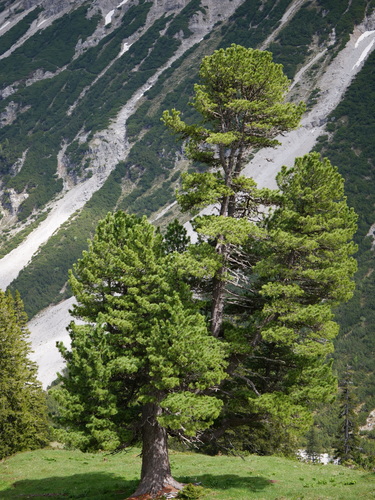
(c) Wolfgang Jauch, some rights reserved (CC BY), uploaded by Wolfgang Jauch
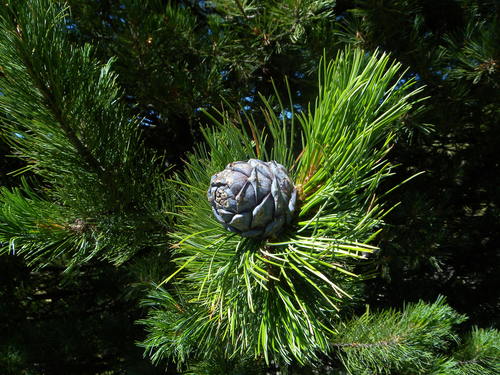
(c) Sébastien SANT, some rights reserved (CC BY-NC), uploaded by Sébastien SANT
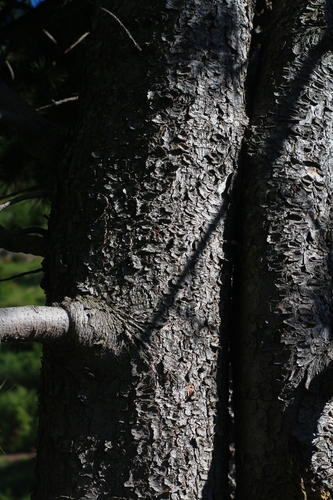
(c) CorentinD, some rights reserved (CC BY), uploaded by CorentinD
What to Eat
Edible parts: Seeds, Seeds - oil, Male flowers
The seed is eaten raw or cooked and is much prized — oil-rich with a delicious flavour, though carrying a slight taste of turpentine. It is a reasonable size at around 10mm x 8mm. An edible drying oil is also pressed from the seed. The pulpwood yields a vanillin flavouring as a by-product of resin processing.
Known Hazards
Where to Find It
It is a temperate plant. It is a very hardy tree. Trees need good drainage. They can grow on a range of soil types. It grows at 1,500-2,400 m altitude in the Alps. Heidelberg Victoria. It suits hardiness zones 4-7.
Australia, Austria, Britain, Czech, Europe*, France, Germany, Hungary, Italy, Mediterranean, Moldova, Poland, Romania, Russia, Slovakia, Switzerland, Ukraine, USA,
How to Identify
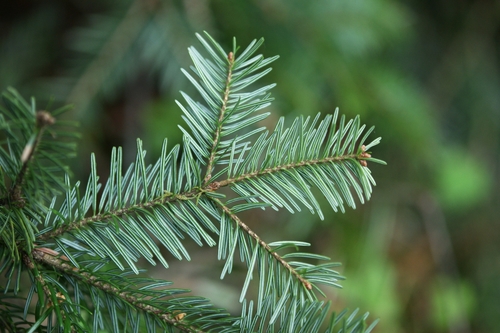
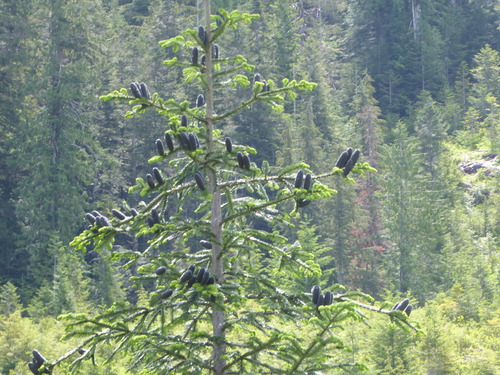
A medium sized tree. It grows 13-25 m tall. It is evergreen. The trunk is knotty. The branches are short and level branches. The young bark has resin blisters and later becomes scaly. The young leaves are soft and pale green. They become dense and stiff. They grow in groups of five. They are shiny green on top and whitish underneath. The shoots are hairy. The male flowers are yellow when ripe. They are in clusters at the base of new growth. The female flowers are red and at the tips. The cones are 10 cm long. They are small and erect and egg shaped. They ripen to red brown. The seeds are large. They are edible. The cones do not open naturally but cones rot on the ground.
How to Grow
Thrives in a light well-drained sandy or gravelly loam. Dislikes poorly drained moorland soils. Established plants tolerate drought. Succeeds in most situations, flourishing on N. facing slopes and in moist heavy clay soils. Grows best in the cooler wetter areas of Britain. A very hardy plant tolerating temperatures down to about -30°c. The edible seeds are collected in large numbers in Siberia and are often exported. (This report probably refers to the sub-species P. cembra sibirica.) This species does not appear to be long lived or to produce its cones freely in S. Britain. It does not produce cones until it is 30 years old. The cones take three years to ripen and then fall from the tree with the seeds still inside. The seed is often eaten by squirrels etc before it can fall to the ground. The cones do not open, seed is extracted by breaking up the soft scales of the cone. Plants are strongly outbreeding, self-fertilized seed usually grows poorly. They hybridize freely with other members of this genus. Slow growing in cultivation, plants usually make less than 30 cm increase in height per year even when young. Leaf secretions inhibit the germination of seeds, thereby inhibiting the growth of other plants below the tree. Plants in this genus are notably susceptible to honey fungus. An evergreen. Pine species are generally not self-fertile; they require cross-pollination between different trees to produce seeds effectively. Pine seeds are typically harvested in late summer to early autumn, usually from August to October (Northern Hemisphere), when cones begin to open and release seeds. Pine trees usually flower in spring, typically from March to June (Northern Hemisphere), depending on the species and climatic conditions. Growth rates vary significantly among pine species, but many can be considered fast-growing, reaching heights of 10 to 30 feet (3 to 9 meters) within 5 to 10 years, depending on species and environmental conditions.
Propagation: Sow seed in individual pots in a cold frame as soon as it is ripe, or in late winter. Cold stratification at 4°c for 6 weeks improves germination of stored seed. Transplant seedlings to permanent positions as soon as possible and protect them for the first winter or two. The root system is very sparse, so early placement is important. Plant trees when small — between 30 and 90cm, ideally around 5–10cm tall — with a thorough weed-excluding mulch. Larger trees establish poorly and may show little growth for several years, with lasting harm to root development and wind resistance. Cuttings are only viable from trees under 10 years old, using single leaf fascicles with the base of the short shoot. Disbudding a few weeks before taking cuttings can assist rooting, but cuttings are generally slow to establish.
Medicinal Uses
Turpentine from pine resin is antiseptic, diuretic, rubefacient, and vermifuge. Taken internally it treats kidney and bladder complaints; used both internally and as a rub or steam bath it addresses rheumatic conditions. It is also beneficial to the respiratory system, helping with mucous membrane diseases, coughs, colds, influenza, and TB. Externally it is applied via liniment plasters, poultices, steam baths, and inhalers for skin complaints, wounds, sores, burns, and boils.
Other Uses
The needles yield a tan or green dye and contain terpene, which is leached by rain and suppresses germination in some plants, including wheat. Turpentine is also obtained from the leaves. As with other pines, oleo-resins are present in the tissues but extraction is only economically worthwhile from certain trees, particularly those from warmer climates. Resins are obtained by tapping the trunk or through destructive distillation of the wood. Turpentine constitutes roughly 20% of the oleo-resin and is obtained by distillation; it is used as a solvent for waxes, in varnish-making, and medicinally. The residual rosin is used on violin bows and in sealing wax and varnish. Pitch from the resin is used for waterproofing and wood preservation. The wood is soft and easily worked, and is used for furniture and turnery.
Wikipedia
Source ↗Pinus cembra, also known as Swiss pine, Swiss stone pine, Arolla pine, Austrian stone pine, or just stone pine, is a species of pine tree in the subgenus Strobus.
Production
Trees are slow growing. They take many years before producing cones. Trees live up to 2000 years. The cones should be harvested slightly immature and dried to give the best quality nuts.
Notes
There are over 100 species of Pinus.
Names & Synonyms
Cirbolya, Moungnett, Pin
References (25)
- Abbet, C., et al, 2014, Ethnobotanical survey on wild alpine food plants in Lower and Central Valais (Switzerland). Journal of Ethnopharmacology 151 (2014) 624–634
- Christanell, A., et al, 2010, The Cultural Significance of Wild Gathered Plant Species in Kartitsch (Eastern Tyrol, Austria) and the Influence of Socioeconomic Changes on Local Gathering Practices. Chapter 3 in Ethnobotany in the New Europe. Berghahn Books.
- Ciesla, W.M., 1998, Non-wood forest products from conifers. Non-wood forest products 12, FAO, Rome, p 72
- Coombes, A.J., 2000, Trees. Dorling Kindersley Handbooks p 66
- Cundall, P., (ed.), 2004, Gardening Australia: flora: the gardener's bible. ABC Books. p 1047
- Denes, A., et al, 2012, Wild plants used for food by Hungarian ethnic groups living in the Carpathian Basin. Acta Societatis Botanicorum Poloniae 81 (4): 381-396
- Facciola, S., 1998, Cornucopia 2: a Source Book of Edible Plants. Kampong Publications, p 170
- Flowerdew, B., 2000, Complete Fruit Book. Kyle Cathie Ltd., London. p 187
- Glowinski, L., 1999, The Complete Book of Fruit Growing in Australia. Lothian. p 136
- Gouldstone, S., 1983, Growing your own Food-bearing Plants in Australia. Macmillan p 153
- Harris, E & J., 1983, Field Guide to the Trees and Shrubs of Britain. Reader's Digest. p 258
- Hibbert, M., 2002, The Aussie Plant Finder 2002, Florilegium. p 234
- Jackes, D. A., Edible Forest Gardens
- Łukasz Łuczaj and Wojciech M Szymański, 2007, Wild vascular plants gathered for consumption in the Polish countryside: a review. J Ethnobiol Ethnomedicine. 3: 17
- Lyle, S., 2006, Discovering fruit and nuts. Land Links. p 328
- Mattalia, G., et al, 2012, Traditional uses of wild food and medicinal plants among Brigasc, Kye ́, and Provenc ̧al communities on the Western Italian Alps. Genet Resour Crop Evol. Springer
- Pieroni, A.,& Giusti, M. E., 2009, Alpine Ethnobotany in Italy: Journal of Ethnobiology and Ethnomedicine. 5:32
- Plants for a Future database, The Field, Penpol, Lostwithiel, Cornwall, PL22 0NG, UK. http://www.scs.leeds.ac.uk/pfaf/
- Schuler, S., (Ed.), 1977, Simon & Schuster's Guide to Trees. Simon & Schuster. No. 29
- Sp. pl. 2:1000. 1753
- Uphof,
- van Wyk, B., 2005, Food Plants of the World. An illustrated guide. Timber press. p 297
- Wickens, G.E., 1995, Edible Nuts. FAO Non-wood forest products. FAO, Rome. p176
- Wiersema, J. H. & Leon, B., 2013, World Economic Plants. A Standard Reference CRC Press. 2nd Ed. p 530
- World Checklist of Useful Plant Species 2020. Royal Botanic Gardens, Kew