Pinus contorta
Douglas ex Loudon
Beach Pine, Lodge Pole Pine, Shore Pine
(c) Alison Northup, some rights reserved (CC BY), uploaded by Alison Northup

(c) Jim Morefield, some rights reserved (CC BY)

(c) S. Rae, some rights reserved (CC BY)
What to Eat
Edible parts: Seeds, Wood, Bark, Gum, Shoots, Leaves - tea
The inner bark is eaten raw or cooked, fresh or dried. It can be mashed into a pulp, formed into cakes, and baked. Harvested in early spring when male cones are releasing pollen, the flavour is not unpleasant at that stage but becomes strongly resinous as the season progresses. It is considered a famine food and used only when other options are exhausted. Sap is collected in spring and consumed as a drink. The seed is also eaten raw or cooked. Pitch collected from the trunk can be hardened and used as a chewing gum. The pulpwood yields a vanillin flavouring as a by-product of resin processing.
Known Hazards
Where to Find It
It is a temperate plant. It grows on a wide range of soils. It can grow in wet depressions. It regenerates after fire. Botanical Gardens Hobart. Melbourne Botanical Gardens. It suits hardiness zones 5-9.
Argentina, Australia, Britain, Canada, Europe, Falklands, Faroe Islands, North America, South America, Tasmania, USA,
How to Identify
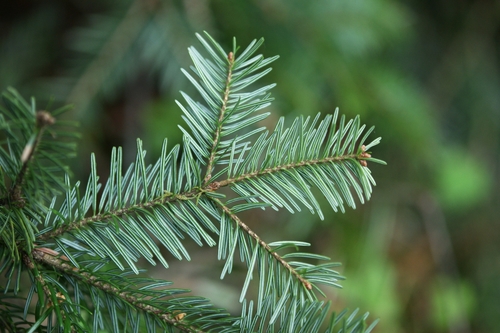
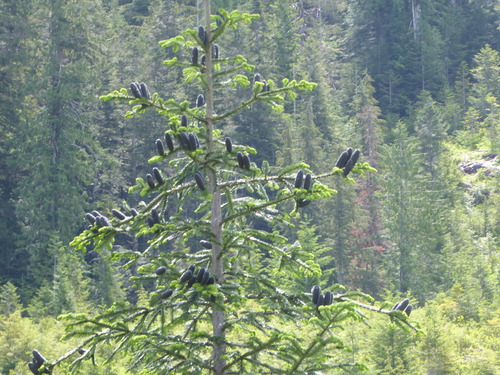
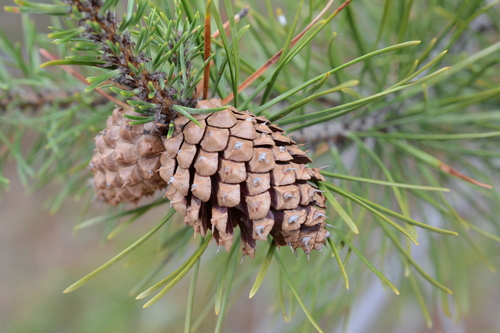
A medium sized tree. It grows to 30 m high and can be 100 cm across the trunk. The trunk is often straight with a little taper. The branches are slender and short. The needles are in bundles of 2. They are 3-7 cm long. They are usually twisted and stiff and have a very sharp point. They do not spread apart and the edges have sharp teeth. The twigs are orange-brown. The seed cones are oval and 3-6 cm long. They are purplish-brown. They are stalkless and at right angles to the branch. They may point slightly backwards. They occur in small clusters at the nodes. The remain on the tree for 10-20 years and remain closed. The scales are thickened at the tips. They have a prickle which curves backwards. The cones open when exposed to the heat from a fire. The seeds are brown and mottled. They have a ridge on one side. They are 3 mm long and with a wing.
How to Grow
Thrives in a light well-drained sandy or gravelly loam. Dislikes poorly drained moorland soils. Tolerates water-logged soils. Succeeds in exposed maritime positions. Established plants tolerate drought. The coastal form of this species is a very fast growing tree, especially when young, with new growth of 1 metre or more per year. The forms from coastal Washington and Oregon do best in Britain. The sub-species P. contorta latifolia is normally slower growing than the species type though it is sometimes faster in some inland sites at higher altitudes. New growth takes place from mid-April until early July. Trees are long-lived, with specimens 600 years old recorded. Extensively cultivated for timber in N. Europe, this is an aggressive colonizing species that can form huge pure stands following a forest fire or clear-felling an area for timber. Trees can be shrubby in habit when they are grown on poor sites. Leaf secretions inhibit the germination of seeds, thereby reducing the amount of plants that can grow below the tree. There are some named forms, selected for their ornamental value. Plants are strongly outbreeding, self-fertilized seed usually grows poorly. They hybridize freely with other members of this genus. This species hybridises in the wild with P. banksiana where their ranges overlap. Trees come into flower at an early age, usually between 6 and 10 years. Good seed crops are produced every 1 - 3 years. The cones are 2 - 5cm long, they open and shed their seed whilst still attached to the tree, though many of the cones will remain unopened on the tree, preserving the vitality of the seeds until they are stimulated to open by excessively hot weather or a forest fire. Plants in this genus are notably susceptible to honey fungus.
Propagation: Sow seed in individual pots in a cold frame as soon as it is ripe, or in late winter. Stratification at 4°c for 6 weeks can improve germination of stored seed. Transplant seedlings to permanent positions as early as possible, protecting them through the first winter or two. The root system is very sparse, so timely planting is important. Set trees out when small — between 30 and 90cm, ideally around 5–10cm tall — under a thorough weed-excluding mulch. Larger trees check badly and may make little growth for several years, with lasting harm to root development and wind resistance. Cuttings can only be taken from trees under 10 years old, using single leaf fascicles with the base of the short shoot. Disbudding a few weeks before taking cuttings can help; cuttings are generally slow to establish.
Medicinal Uses
Beach pine was widely used medicinally by several Native North American tribes, particularly for its antiseptic and wound-healing properties and its benefits to the chest and lungs, though it is little used in modern herbalism. Turpentine from pine resin is antiseptic, diuretic, rubefacient, vermifuge, and vulnerary. Internally it treats kidney and bladder complaints and rheumatic conditions; it also addresses mucous membrane diseases and respiratory complaints. Externally it is applied as liniment plasters and poultices for skin complaints, wounds, and boils. A decoction of young shoots has been used for stomach pains. Young buds have been chewed for sore throats. The inner bark has been eaten as a blood purifier, diuretic, and cathartic, and a decoction used as a tonic and to treat coughs, colds, consumption, and gonorrhoea.
Other Uses
The needles yield a tan or green dye and contain terpene, released by rain, which negatively affects germination in some plants including wheat. Roots were braided by Native North Americans to make rope. Pitch from the tree is used to waterproof canoes, baskets, and shoes and as a glue; it has also been used to preserve wood and baskets, though it is not a commercially significant crop. Oleo-resins occur in all pine tissues and are obtained by tapping the trunk or by destructive distillation of the wood; warmer-climate trees generally give higher yields. Turpentine accounts for roughly 20% of the oleo-resin and is used as a solvent for waxes, in varnish-making, and medicinally. Residual rosin is used on violin bows and in sealing wax and varnish. Pitch from the resin is used for waterproofing and wood preservation. The wood is straight but coarse-grained, light, hard, strong, and brittle, varying from light and soft to hard and heavy depending on the tree. It works easily and is used for general construction, posts, poles, and pulp. It makes good fuel, burning well even when green due to its high pitch content.
Wikipedia
Source ↗Pinus contorta, with the common names lodgepole pine, shore pine, twisted pine, and contorta pine, is an evergreen species of conifer tree. It is a common pine in western North America, found near the ocean shore and in dry montane forests to the subalpine, but is rare in lowland rain forests.
Production
Seed production begins after 5-10 years and good crops occur every 1-3 years. Trees can live for 200 years.
Notes
There are over 100 species of Pinus.
Names & Synonyms
References (18)
- Arbor. frutic. brit. 4:2292, figs. 2210-2211. 1838
- Brickell, C. (Ed.), 1999, The Royal Horticultural Society A-Z Encyclopedia of Garden Plants. Convent Garden Books. p 800
- Coombes, A.J., 2000, Trees. Dorling Kindersley Handbooks p 66
- Cundall, P., (ed.), 2004, Gardening Australia: flora: the gardener's bible. ABC Books. p 1047
- Esperanca, M. J., 1988. Surviving in the wild. A glance at the wild plants and their uses. Vol. 2. p 154
- Etkin, N.L. (Ed.), 1994, Eating on the Wild Side, Univ. of Arizona. p 72
- Farrar, J.L., 1995, Trees of the Northern United States and Canada. Iowa State University press/Ames p 60
- Harris, E & J., 1983, Field Guide to the Trees and Shrubs of Britain. Reader's Digest. p 248
- Hedrick, U.P., 1919, (Ed.), Sturtevant's edible plants of the world. p 497
- Kuhnlein, H. V. and Turner, N. J., 1991, Traditional Plant Foods of Canadian Indigenous Peoples. Food and Nutrition in History and Anthropology Volume 8. Gordon and Breach. p 39
- Lord, E.E., & Willis, J.H., 1999, Shrubs and Trees for Australian gardens. Lothian. p 86
- Moerman, D. F., 2010, Native American Ethnobotany. Timber Press. p 404
- Plants for a Future database, The Field, Penpol, Lostwithiel, Cornwall, PL22 0NG, UK. http://www.scs.leeds.ac.uk/pfaf/
- Porsild, A.E., 1974, Rocky Mountain Wild Flowers. Natural History Series No. 2 National Museums of Canada. p 38
- Stubbs, R. D., 1966, An investigation of the Edible and Medicinal Plants used by the Flathead Indians. MA thesis University of Montana. p 57
- Turner, N. J., 1988, Ethnobotany of Coniferous Tress in Thompson and Lillooet Interior Salish of British Colombia. Economic Botany 42(2) :177-194
- Turner, N., et al, 2011, "Up on the Mountain": Ethnobotanical Important of Montane Sites in Pacific Coastal North America. Journal of Ethnobiology 31(1): 4-43
- Upson, R., & Lewis R., 2014, Updated Vascular Plant Checklist and Atlas for the Falkland Islands. Falklands Conservation and Kew.