Pinus densiflora
Siebold & Zucc.
Japanese red pine, Japanese umbrella pine

(c) harum.koh, some rights reserved (CC BY-SA), uploaded by harum.koh

(c) harum.koh, some rights reserved (CC BY-SA), uploaded by harum.koh

(c) Kok Leng Yeo, some rights reserved (CC BY)
What to Eat
Edible parts: Fruit for drink, Seeds, Leaves - flavouring, Bark - flavouring
The seed is eaten raw or cooked and, while quite small at only 4mm long, is oil-rich with a slightly resinous flavour. Male catkins are also edible. The inner bark is dried, ground into a powder, and used as a thickener in soups or added to cereals when making bread — it is an emergency food used only when other sources fail. Immature female cones can be baked. The pulpwood yields a vanillin flavouring as a by-product of resin processing.
Known Hazards
Where to Find It
It is a temperate plant. It grows from coastal regions to hillsides from sea level to 900 m in N China. It suits hardiness zones 4-9. Arboretum Tasmania. Hobart Botanical Gardens.
Asia, Australia, China, Hawaii, Japan, Korea, Russia, Tasmania, USA,
How to Identify
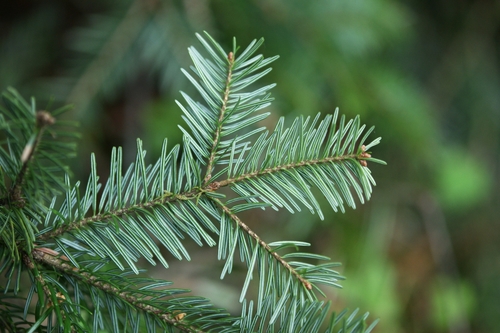
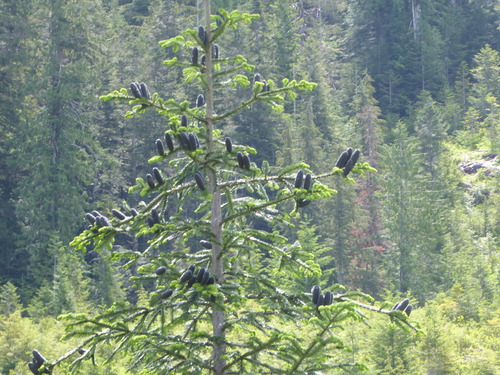
A tree. It is 30 m tall. The trunk is 1.5 m across. The bark is orange red. It is flaky and scaly. The crown is like an umbrella. The first year branches are yellow or red. There are 2 needles per bundle. They are half round in cross section. The seed cones can be erect or hang down. They have short stalks. They are dark yellowish-brown. The are oval or cone shaped and 3-5.5 cm long by 2.5-4.5 cm wide. The seed scales are usually thin. The seeds are oval and 3-7 mm long by 3 mm wide. The wings are 1-2 cm wide by 5-7 mm thick.
How to Grow
Thrives in a light well-drained sandy or gravelly loam. Dislikes poorly drained moorland soils. Established plants tolerate drought. Leaf secretions inhibit the germination of seeds, thereby reducing the amount of plants that can grow below the tree. The plant is quite fast growing when very young but this soon tails off and the tree is then quite slow growing. Cultivated for its wood in Japan, but it is unlikely to be a worthwhile timber tree in Britain. Plants are strongly outbreeding, self-fertilized seed usually grows poorly. They hybridize freely with other members of this genus. Hybridizes in the wild with P. thunbergii. There are many named forms of this species. Plants in this genus are notably susceptible to honey fungus.
Propagation: Sow seed in individual pots in a cold frame as soon as it is ripe, or in late winter. Stratification at 4°c for 6 weeks can improve germination of stored seed. Move seedlings to permanent positions as soon as possible, protecting them through the first winter or two. The root system is very sparse, so early planting is essential. Set trees out when small — between 30 and 90cm, ideally around 5–10cm tall — under a good weed-excluding mulch. Larger trees establish poorly and may show negligible growth for several years, with lasting damage to root development and wind resistance. Cuttings can only be taken from trees under 10 years old, using single leaf fascicles with the base of the short shoot. Disbudding a few weeks before taking cuttings can help, but cuttings are generally slow to establish.
Medicinal Uses
Turpentine from pine resin is antiseptic, diuretic, rubefacient, and vermifuge. Taken internally it is valuable for kidney and bladder complaints; used both internally and as a rub or steam bath it helps with rheumatic conditions. It is also beneficial to the respiratory system and useful for mucous membrane diseases, coughs, colds, influenza, and TB. Applied externally via liniment plasters, poultices, steam baths, and inhalers, it treats skin complaints, wounds, sores, burns, and boils.
Other Uses
The needles yield a tan or green dye and contain terpene, which is leached by rain and negatively affects germination in some plants including wheat. Oleo-resins are present in all pine tissues but are often not available in commercially viable quantities; they are obtained by tapping the trunk or through destructive distillation of the wood, with warmer-climate trees generally yielding more. Turpentine makes up roughly 20% of the oleo-resin and is separated by distillation; it is used as a solvent for waxes, in varnish-making, and medicinally. Residual rosin is used on violin bows and in sealing wax and varnish. Pitch from the resin is used for waterproofing and wood preservation. The wood is a useful timber in Japan, used for construction, poles, and furniture, though it is unlikely to be of much value in Britain.
Wikipedia
Source ↗Pinus densiflora, also called the Japanese red pine, the Japanese pine, or Korean red pine, is a species of pine tree native to East Asia and Siberia.
Production
Cones take 18 months to mature.
Notes
There are over 100 species of Pinus.
Names & Synonyms
Chi song, Sonamu
References (16)
- Coombes, A.J., 2000, Trees. Dorling Kindersley Handbooks p 68
- Cundall, P., (ed.), 2004, Gardening Australia: flora: the gardener's bible. ABC Books. p 1047
- Facciola, S., 1998, Cornucopia 2: a Source Book of Edible Plants. Kampong Publications, p 170
- Fl. jap. 2:22, t. 112. 1842
- Fu Liguo, Li Nan, Mill, R.R., Pinaceae. Flora of China.
- Hibbert, M., 2002, The Aussie Plant Finder 2002, Florilegium. p 234
- Hwang, H., et al, 2013, A Study on the Flora of 15 Islands in the Western Sea of Jeollanamdo Province, Korea. Journal of Asia-Pacific Biodiversity Vol. 6, No. 2 281-310
- Hwang, HS, et al, 2014, Distribution characteristics of plant in the Ungseokbong Mountain, Gyeongsangnam-do, Korea. Journal of Asia-Pacific Biodiversity. 7(2014) e164-e178
- Kim, H. & Song, M., 2013, Ethnobotanical analysis for traditional knowledge of wild edible plants in North Jeolla Province (Korea). Genetic. Resour. Crop Evol. (2013) 60:1571-1585
- Ong, H. G., et al, 2015, Ethnobotany of the wild edible plants gathered in Ulleung Island, South Korea. Genet Resourc Crop Evol. Springer
- Pemberton, R. W. & Lee, N. S., 1996, Wild Food Plants in South Korea: Market Presence, New Crops, and Exports to the United States. Economic Botany, Vol. 50, No. 1, pp. 57-70
- Plants for a Future database, The Field, Penpol, Lostwithiel, Cornwall, PL22 0NG, UK. http://www.scs.leeds.ac.uk/pfaf/
- Song, M., et al, 2013, Traditional knowledge of wild edible plants in Jeju Island, Korea. Indian Journal of Traditional Knowledge. 12(2) pp 177-194
- Staples, G.W. and Herbst, D.R., 2005, A tropical Garden Flora. Bishop Museum Press, Honolulu, Hawaii. p 70
- Tanaka,
- World Checklist of Useful Plant Species 2020. Royal Botanic Gardens, Kew