Pinus halepensis
Mill.
Aleppo Pine, Jerusalem pine
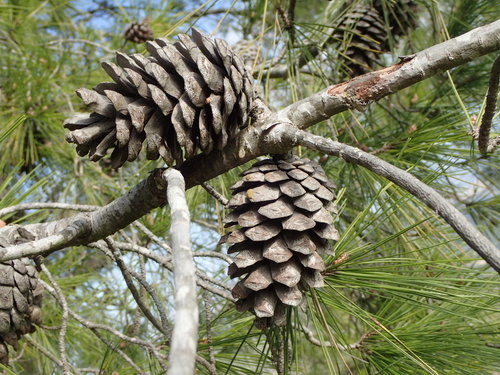
(c) Ron Vanderhoff, some rights reserved (CC BY-NC), uploaded by Ron Vanderhoff

(c) Damon Tighe, some rights reserved (CC BY-NC), uploaded by Damon Tighe
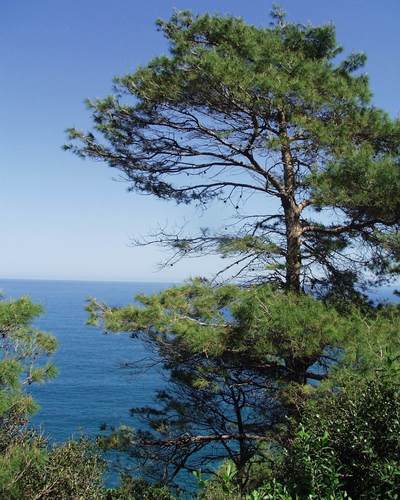
(c) Errol Véla, some rights reserved (CC BY-NC), uploaded by Errol Véla
What to Eat
Edible parts: Seeds, Sap, Shoots, Leaves, Male cones
Resin tapped from the trunk is used both as a chewing gum and as a flavouring for wine. A vanillin flavouring is also obtained as a by-product of resins released from the pulpwood.
Known Hazards
Where to Find It
A Mediterranean plant. A native of Syria. It will grow on most soils. It suits open sunny positions. It is resistant to frost and drought. Often it grows on limestone soils. It does well in drier regions. It suits areas with a rainfall between 350-700 mm a year. Hobart Government House. It suits hardiness zones 8-11. Arboretum Tasmania.
Africa, Algeria, Andorra, Argentina, Asia, Australia, Britain, Central America, Chile, East Africa, Europe, Guatemala, India, Indonesia, Israel, Italy, Jordan, Libya, Mediterranean*, Middle East, Morocco, New Zealand, North Africa, North America, Pakistan, Palestine, Portugal, Sahara, SE Asia, Slovenia, South Africa, Southern Africa, Spain, Syria, Tasmania, Tunisia, Zimbabwe,
How to Identify
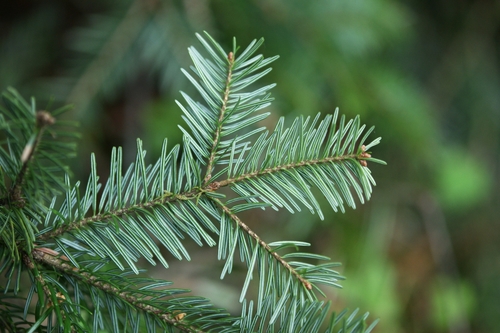
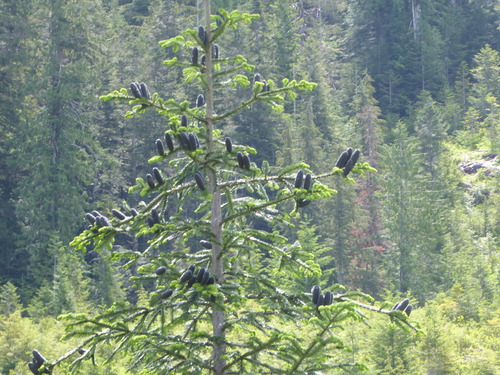
An evergreen tree. It grows to 12-20 m high and spreads to 4-6 m across. The stem is twisted and branching. The crown of the tree is like a cone but it becomes more rounded with age. The bark is ash grey. The bark becomes reddish with age. The leaves are like green needles. They are arranged in pairs and bright green. They are 6-11 cm long. The cones are oval. The female cones are 5-12 cm long.
How to Grow
Thrives in a light well-drained sandy or gravelly loam. Dislikes poorly drained moorland soils. Established plants are very tolerant of drought, they succeed in poor chalky soils and also in poor dry sandy soils. Fairly wind-resistant. Plants are not very successful in Britain. They are tender when young but are then fully hardy. Plants are strongly outbreeding, self-fertilized seed usually grows poorly. They hybridize freely with other members of this genus. Leaf secretions inhibit the germination of seeds, thereby reducing the amount of pants that can grow under the tree. Plants in this genus are notably susceptible to honey fungus.
Propagation: Sow seed in individual pots in a cold frame as soon as it is ripe, or in late winter if not. Stored seed benefits from a short stratification of 6 weeks at 4°c to improve germination. Seedlings should be planted into their permanent positions as soon as possible and protected for the first winter or two. Because the root system is very sparse, early transplanting is essential for good establishment. Plant trees when small, between 30 and 90cm — ideally at around 5–10cm tall. A thorough weed-excluding mulch greatly aids establishment. Larger transplants check badly and show little growth for several years, with poor root development and wind resistance as a result. Cuttings can be taken, but only from trees less than 10 years old. Use single leaf fascicles with the base of the short shoot. Disbudding the shoots several weeks before taking cuttings can help, though cuttings are generally slow to establish.
Medicinal Uses
Turpentine drawn from the resin of pine trees is antiseptic, diuretic, rubefacient, and vermifuge. Taken internally, it is a valuable remedy for kidney and bladder complaints, and is used both internally and as a rub or steam bath for rheumatic conditions. It benefits the respiratory system and is useful against mucous membrane diseases, coughs, colds, influenza, and TB. Externally, it treats skin complaints, wounds, sores, burns, and boils, applied via liniment plasters, poultices, herbal steam baths, and inhalers.
Other Uses
A tan or green dye can be obtained from the needles. The needles release a substance called terpene when washed by rain, which inhibits germination of some plants including wheat. The tree is fairly wind-tolerant and suitable for shelterbelt planting. 'Greek turpentine' is obtained from the stems. Oleo-resins occur in the tissues of all pines, obtained by tapping the trunk or by destructive distillation of the wood; trees from warmer regions generally yield more. Turpentine makes up an average of 20% of the oleo-resin and is separated by distillation, with uses including as a solvent for waxes, in varnish, and medicinally. The remaining rosin is used by violinists on their bows and in sealing wax and varnish. Pitch derived from the resin is used for waterproofing and as a wood preservative. The tree has an extensive root system and is planted on sand dunes for stabilisation. The wood is of mediocre quality and used for rough construction. Tannin is obtained from the bark.
Wikipedia
Source ↗Pinus halepensis, commonly known as the Aleppo pine, also known as the Jerusalem pine, is a pine native to the Mediterranean region. It was officially named by the botanist Philip Miller in his 1768 book The Gardener's Dictionary; he probably never went to Aleppo but mentions seeing large specimens at Goodwood in the garden of the Duke of Richmond, which were transplanted (perhaps sent by Alexander Russell from Syria) in 1739.
Production
Trees live for 150-200 years.
Other Information
It is cultivated.
Notes
There are over 100 species of Pinus.
Names & Synonyms
Alepski bor, Lizzab, Pino, Pinus pesisir, Snober halabi, Zgougou
References (31)
- Al-Qura'n, S. A., 2010, Ethnobotanical and Ecological Studies of Wild Edible Plants in Jordan. Libyan Agriculture Research Center Journal International 1(4):231-243
- Ambasta, S.P. (Ed.), 2000, The Useful Plants of India. CSIR India. p 457
- Blamey, M and Grey-Wilson, C., 2005, Wild flowers of the Mediterranean. A & C Black London. p 27
- Bodkin, F., 1991, Encyclopedia Botanica. Cornstalk publishing, p 800
- Brickell, C. (Ed.), 1999, The Royal Horticultural Society A-Z Encyclopedia of Garden Plants. Convent Garden Books. p 801
- Cundall, P., (ed.), 2004, Gardening Australia: flora: the gardener's bible. ABC Books. p 1048
- Dop, M. C., et al, 2019, Identification and frequency of consumption of wild edible plants over a year in central Tunisia: a mixed-methods approach. Public Health Nutrition: 23(5), 782–794
- Facciola, S., 1998, Cornucopia 2: a Source Book of Edible Plants. Kampong Publications, p 170
- Flora of Pakistan. www.eFloras.org
- Gard. dict. ed. 8: Pinus no. 8. 1768
- Glowinski, L., 1999, The Complete Book of Fruit Growing in Australia. Lothian. p 136
- Hall, N. et al, 1972, The Use of Trees and Shrubs in the Dry Country of Australia, AGPS, Canberra. p 397
- Hibbert, M., 2002, The Aussie Plant Finder 2002, Florilegium. p 234
- http://www.botanic-gardens-ljubljana.com/en/plants
- Hussey, B.M.J., Keighery, G.J., Cousens, R.D., Dodd, J., Lloyd, S.G., 1997, Western Weeds. A guide to the weeds of Western Australia. Plant Protection Society of Western Australia. p 14
- Jardin, C., 1970, List of Foods Used In Africa, FAO Nutrition Information Document Series No 2.p 46
- Lazarides, M. & Hince, B., 1993, Handbook of Economic Plants of Australia, CSIRO. p 191
- Lord, E.E., & Willis, J.H., 1999, Shrubs and Trees for Australian gardens. Lothian. p 87
- Mahklouf, M. H., 2019, Ethnobotanical Study of Edible Wild Plants in Libya. European Journal of Ecology. 5(2): 30-40
- Morley, B.D., & Toelken, H.R., (Eds), 1983, Flowering Plants in Australia. Rigby. p 30
- Oran, S. A. S., 2015, Selected Wild Aromatic Plants in Jordan. International Journal of Medicinal Plants. Photon 108 (2015) 686-699
- Paczkowska, G. & Chapman, A.R., 2000, The Western Australian Flora. A Descriptive Calatogue. Western Australian Herbarium. p 28
- Ryan, S., 2008, Dicksonia. Rare Plants Manual. Hyland House. p 69
- Schiller, G., et al, 2014, Therapeutic Use of Aleppo Pine (Pinus halepensis Mill.), in Z. Yaniv, N. Dudai (eds.), Medicinal and Aromatic Plants of the Middle-East, Springer
- Schuler, S., (Ed.), 1977, Simon & Schuster's Guide to Trees. Simon & Schuster. No. 31
- Sfikas, G., 1984, Trees and shrubs of Greece. Efstathiadis Group. Athens. p 40
- Sukarya, D. G., (Ed.) 2013, 3,500 Plant Species of the Botanic Gardens of Indonesia. LIPI p 449
- Tardio, J., et al, Ethnobotanical review of wild edible plants in Spain. Botanical J. Linnean Soc. 152 (2006), 27-71
- van Wyk, B, van Wyk, P, and van Wyk B., 2000, Photographic guide to Trees of Southern Africa. Briza. p 233
- Wiersema, J. H. & Leon, B., 2013, World Economic Plants. A Standard Reference CRC Press. 2nd Ed. p 531
- World Checklist of Useful Plant Species 2020. Royal Botanic Gardens, Kew