Pinus jeffreyi
Balf.
Jeffrey pine, Yellow pine

(c) Christopher J. Earle, some rights reserved (CC BY-NC), uploaded by Christopher J. Earle

(c) Jay Pruett, some rights reserved (CC BY-NC), uploaded by Jay Pruett
(c) Skyler K, some rights reserved (CC BY), uploaded by Skyler K
What to Eat
Edible parts: Seeds, Nuts
The oil-rich seeds can be eaten raw or cooked and have a resinous flavour; they measure about 10–12mm long. Crystallised sap has traditionally been collected and eaten like candy. A vanillin flavouring is also obtained as a by-product of resins released from the pulpwood.
Known Hazards
Where to Find It
It is a temperate plant. It grows naturally on dry slopes on high mountains in the western United States. Melbourne Botanical Gardens (Hopetoun lawn). It suits hardiness zones 6-9. Arboretum Tasmania.
Australia, Britain, Europe, Mexico, North America, Tasmania, USA,
How to Identify
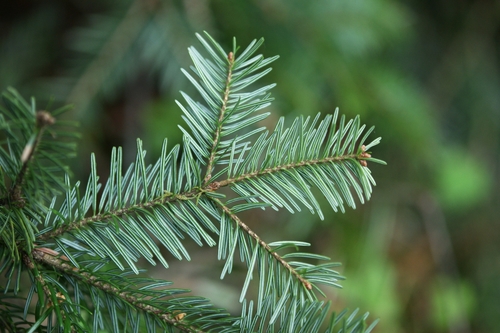
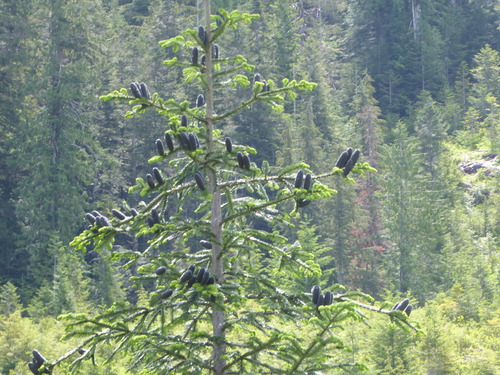
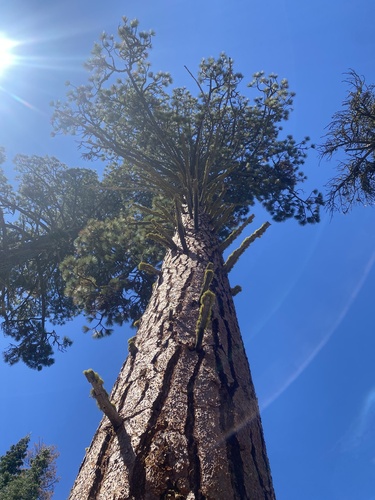
A tree like Pinus ponderosa but the needles are shorter and stiffer and the cones are much larger. It is an evergreen tree which is broadly cone shaped and grows to 40 m high. The leaves are needle like and rigid. They are 25 cm long and occur in clusters of three. They are blue-green and on stout shoots.
How to Grow
Succeeds in most soils, but prefers a light well-drained sandy or gravelly loam. Dislikes poorly drained moorland soils. Established plants tolerate drought. This species is not hardy in the colder areas of the country, it tolerates temperatures down to between -5 and -10°c. A very ornamental plant. It is often short-lived in Britain but is moderately fast growing with some trees reaching a height of 15 metres in 29 years. A long-lived tree in the wild, specimens 500 years old are known. It commences bearing seeds when about 10 - 15 years old, though good production does not commence until twice that age. Leaf secretions inhibit the germination of seeds, thereby inhibiting the growth of other plants below the tree. Plants are strongly outbreeding, self-fertilized seed usually grows poorly. They hybridize freely with other members of this genus. Closely related to P. ponderosa, and hybridizes with it in the wild. Some of the earlier plantings under this name in Britain have turned out to be P. ponderosa. The cones are 12 - 35cm long, they open and shed their seed whilst still attached to the tree. The resin from broken shoots has a very strong lemon scent. Plants in this genus are notably susceptible to honey fungus. An evergreen.
Propagation: Sow seed in individual pots in a cold frame as soon as it is ripe, or in late winter if not. Stored seed benefits from a short stratification of 6 weeks at 4°c to improve germination. Seedlings should be planted into their permanent positions as soon as possible and protected for the first winter or two. Because the root system is very sparse, early transplanting is essential for good establishment. Plant trees when small, between 30 and 90cm — ideally at around 5–10cm tall. A thorough weed-excluding mulch greatly aids establishment. Larger transplants check badly and show little growth for several years, with poor root development and wind resistance as a result. Cuttings can be taken, but only from trees less than 10 years old. Use single leaf fascicles with the base of the short shoot. Disbudding the shoots several weeks before taking cuttings can help, though cuttings are generally slow to establish.
Medicinal Uses
Turpentine drawn from the resin of pine trees is antiseptic, diuretic, rubefacient, and vermifuge. Taken internally, it is a valuable remedy for kidney and bladder complaints, and is used both internally and as a rub or steam bath for rheumatic conditions. It benefits the respiratory system and is useful against mucous membrane diseases, coughs, colds, influenza, and TB. Externally, it treats skin complaints, wounds, sores, burns, and boils, applied via liniment plasters, poultices, herbal steam baths, and inhalers.
Other Uses
A tan or green dye can be obtained from the needles. The needles release a substance called terpene when washed by rain, which inhibits germination of some plants including wheat. Oleo-resins occur in the tissues of all pines, obtained by tapping the trunk or by destructive distillation of the wood; trees from warmer regions generally yield more. Turpentine makes up an average of 20% of the oleo-resin and is separated by distillation, with uses including as a solvent for waxes, in varnish, and medicinally. The remaining rosin is used by violinists on their bows and in sealing wax and varnish. Pitch derived from the resin is used for waterproofing and as a wood preservative. The resin of this species is particularly notable for containing the hydrocarbon n-heptane in an unusually pure form, unmixed with other heptane isomers, produced through a complex and poorly understood biochemical process. This purity led to its use as the zero-point in the octane rating scale for petrol. The wood is light, strong, and fine-grained, ranging from soft to hard, and is used for furniture, boxes, and toys.
Wikipedia
Source ↗Pinus jeffreyi, also known as Jeffrey pine, Jeffrey's pine, yellow pine and black pine, is a North American pine tree. It is mainly found in California, but also in the westernmost part of Nevada, southwestern Oregon, and northern Baja California. It is named in honor of its botanist documenter John Jeffrey.
Notes
There are over 100 species of Pinus.
Names & Synonyms
Pino amarillo, Pino colorado, Pino negro
References (8)
- Andr. Murray, Bot. Exped. Oregon 8:2. 1853
- Coombes, A.J., 2000, Trees. Dorling Kindersley Handbooks p 68
- Cundall, P., (ed.), 2004, Gardening Australia: flora: the gardener's bible. ABC Books. p 1048
- Harris, E & J., 1983, Field Guide to the Trees and Shrubs of Britain. Reader's Digest. p 252
- Jackes, D. A., Edible Forest Gardens
- Kermath, B. M., et al, 2014, Food Plants in the Americas: A survey of the domesticated, cultivated and wild plants used for Human food in North, Central and South America and the Caribbean. On line draft. p 660
- Moerman, D. F., 2010, Native American Ethnobotany. Timber Press. p 408
- Plants for a Future database, The Field, Penpol, Lostwithiel, Cornwall, PL22 0NG, UK. http://www.scs.leeds.ac.uk/pfaf/