Pinus parviflora
Siebold & Zucc.
Japanese white pine

(c) evabeekeeper, some rights reserved (CC BY-NC)

(c) Marco Mussita, some rights reserved (CC BY), uploaded by Marco Mussita

(c) harum.koh, some rights reserved (CC BY-SA), uploaded by harum.koh
What to Eat
Edible parts: Seeds, Nuts
The seeds can be eaten raw or cooked. They are oil-rich with a resinous flavour and are about 10mm long. A vanillin flavouring is also obtained as a by-product of resins released from the pulpwood.
Known Hazards
Where to Find It
It is a warm temperate plant. It grows naturally on stony soils in mountains in Japan. It is frost hardy. It suits hardiness zones 4-9. Sunshine Victoria.
Asia, Australia, Britain, China, Europe, Indonesia, Japan, Korea, SE Asia, Tasmania,
How to Identify
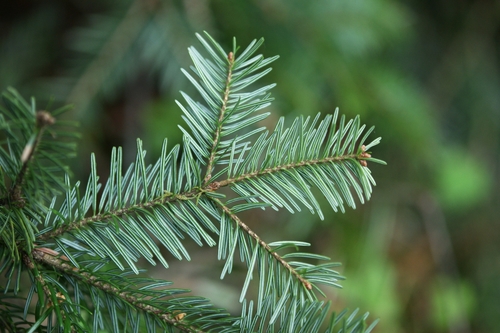
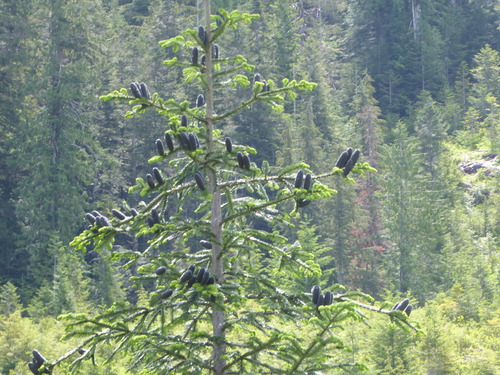
An evergreen tree. It grows 9-22 m tall and spreads 6-7.5 m wide. The trunk can be 1 m across. The crown is cone shaped but develops a flat top when mature. The bark is purple-brown and smooth. The branches often occur in layers. The leaves are needle-like and occur in groups of five. They are soft and bluish. They are slightly curved and have a blue-white stripe on the underside. The female flowers are pink or purple at the ends of the shoots. The male flowers are yellow or brown. They are clustered around the shoot. The cones are blue-green and oval. They are 4-7.5 cm long by 3.5-4.5 cm wide. The seeds are nearly brown and mottled with black. They are 8-10 mm long by 7 mm wide.
Nutrition Score: 68/100
| Part | Moisture | kJ | kcal | Protein | Vit A | Vit C | Iron | Zinc |
|---|---|---|---|---|---|---|---|---|
| Nuts | 1.9 | 2887 | 690 | 14.6 | — | — | 6.2 | 6 |
How to Grow
Thrives in a light well-drained sandy or gravelly loam. Dislikes poorly drained moorland soils. Established plants tolerate drought. Leaf secretions inhibit the germination of seeds, thereby reducing the amount of plants that can grow under the trees. This species sometimes self-sows in British gardens. Plants are strongly outbreeding, self-fertilized seed usually grows poorly. They hybridize freely with other members of this genus. There are two main forms of this species in cultivation in Britain. A low growing form (which is probably a Japanese semi-dwarf cultivar) is of slow growth whilst a taller growing form (probably the wild species) is more rapid. There are many named forms selected for their ornamental value, most of them are dwarf forms. This species is also commonly used for bonsai. Plants in this genus are notably susceptible to honey fungus.
Propagation: Sow seed in individual pots in a cold frame as soon as it is ripe, or in late winter if not. Stored seed benefits from 6 weeks of cold stratification at 4°c to improve germination. Move seedlings to their permanent positions as soon as possible and protect them for the first winter or two. The root system is very sparse, so early planting is essential for good establishment. Plant trees when small — between 30 and 90cm, ideally around 5–10cm tall — with a thorough weed-excluding mulch. Larger transplants check badly, barely growing for several years, with poor root development and wind resistance. Cuttings are only viable from trees under 10 years old, using single leaf fascicles with the base of the short shoot. Disbudding a few weeks before taking cuttings can help, though cuttings are typically slow to establish.
Medicinal Uses
Turpentine from pine resin is antiseptic, diuretic, rubefacient, and vermifuge. Taken internally, it treats kidney and bladder complaints, and is used both internally and as a rub or steam bath for rheumatic conditions. It benefits the respiratory system and is useful for mucous membrane diseases, coughs, colds, influenza, and TB. Externally it treats skin complaints, wounds, sores, burns, and boils, applied as liniment plasters, poultices, herbal steam baths, and inhalers.
Other Uses
A tan or green dye comes from the needles. The needles release terpene when rained on, which negatively affects germination of some plants including wheat. Oleo-resins are extracted by tapping the trunk or by destructive distillation of the wood; warmer-region trees tend to yield more. Turpentine makes up around 20% of the oleo-resin, separated by distillation, and used as a solvent for waxes, in varnish-making, and medicinally. Rosin, the residue after turpentine removal, is used on violin bows and in sealing wax and varnish. Pitch from the resin is used for waterproofing and as a wood preservative.
Wikipedia
Source ↗Pinus parviflora, also known as Japanese white pine, is a pine in the white pine group, Pinus subgenus Strobus, native to Japan.
Production
It is slow growing.
Notes
There are over 100 species of Pinus. It is used for bonsai.
Names & Synonyms
Pohon jepang putih, Ri ben wu zhen song
References (9)
- Coombes, A.J., 2000, Trees. Dorling Kindersley Handbooks. p 71
- Cundall, P., (ed.), 2004, Gardening Australia: flora: the gardener's bible. ABC Books. p 1050
- Fl. jap. 2:27, t. 115. 1842
- Harris, E & J., 1983, Field Guide to the Trees and Shrubs of Britain. Reader's Digest. p 255
- Hibbert, M., 2002, The Aussie Plant Finder 2002, Florilegium. p 234
- Joyce, D., 1998, The Garden Plant Selector. Ryland, Peters and Small. p 172
- Plants for a Future database, The Field, Penpol, Lostwithiel, Cornwall, PL22 0NG, UK. http://www.scs.leeds.ac.uk/pfaf/
- Sukarya, D. G., (Ed.) 2013, 3,500 Plant Species of the Botanic Gardens of Indonesia. LIPI p 451
- Valder, P., 1999, The Garden Plants of China. Florilegium. p 85