Pinus roxburghii
Sarg.
Chir Pine, Long-leaved Indian Pine
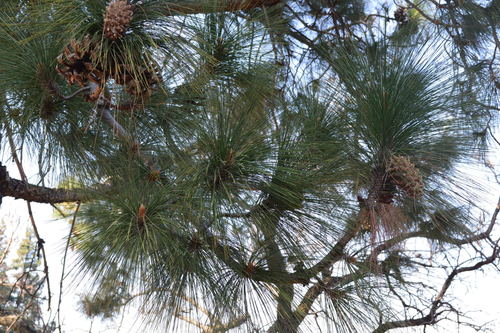
(c) Hildegard Klein, some rights reserved (CC BY), uploaded by Hildegard Klein
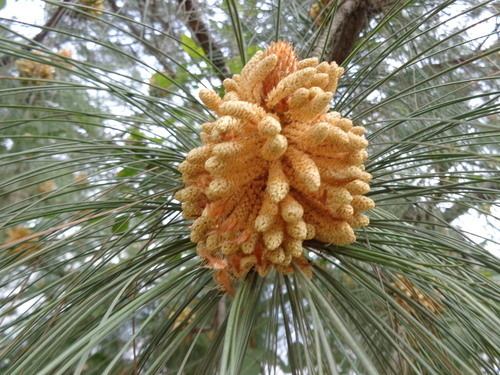
(c) Phuentsho, some rights reserved (CC BY-NC), uploaded by Phuentsho
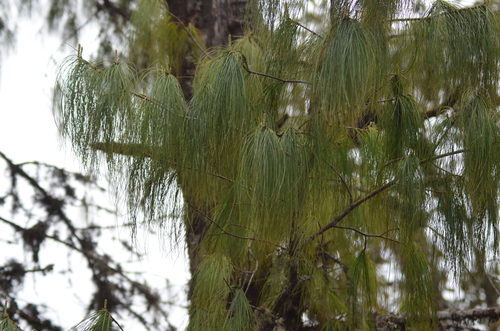
(c) Brian Johnson, some rights reserved (CC BY-NC), uploaded by Brian Johnson
What to Eat
Edible parts: Seeds, Manna
The seeds can be eaten raw or cooked, though they are not particularly palatable — their strong turpentine flavour means they are generally reserved as an emergency food. They are a reasonable size at up to 11mm long. A sweet, edible manna, which is actually a gum, exudes from the bark and twigs. A vanillin flavouring is obtained as a by-product of resins released from the pulpwood.
Known Hazards
Where to Find It
It is a temperate plant. It grows in Nepal between 800-1400 m altitude. It grows on dry slopes. In China it grows in the mountains between 2100-2200 m altitude in Xixang. In Uttar Pradesh in India it grows between 600-2800 m altitude. Hobart Botanical gardens, Melbourne Botanical Gardens. It suits hardiness zones 6-11. Arboretum Tasmania.
Afghanistan, Africa, Asia, Australia, Bhutan, Canada, China, East Africa, Himalayas, India, Kashmir, Mozambique, Nepal, North America, Northeastern India, NW India, Pakistan, Sikkim, Tasmania, Zimbabwe,
How to Identify
An evergreen pine. It is a tree. It can be 55 m tall. The trunk is over 1 m across. The bark is dark red-brown and thick. It is deeply cracked along its length and scaly. The leaves occur in bundles of 3. They are 10-20 cm long by 1.5 mm wide. They are like threads. They are pointed. There is a persistent sheath on 2-3 cm of the base. The male cones are cylindrical and yellow. The female cones are brown. They are 10-20 cm long by 6-9 cm wide. The seed scales are oblong, thick and stiff. The seeds are nearly 1 cm long. They have wings about 2.5 cm wide.
How to Grow
Thrives in a light well-drained sandy or gravelly loam. Succeeds on calcareous soils. Dislikes poorly drained moorland soils. Dislikes shade. Established plants tolerate drought. The chir pine is not very hardy in Britain, succeeding outdoors only in the mildest areas of the country. In the driest parts of its native range the leaves are shed after 10 - 11 months, making it deciduous. Trees are extensively tapped for their resin in India and are the main source of resin in that region. Plants are strongly outbreeding, self-fertilized seed usually grows poorly. They hybridize freely with other members of this genus. This species is closely related to P. canariensis. Leaf secretions inhibit the germination of seeds, thereby reducing the amount of plants that can grow under the trees. Plants in this genus are notably susceptible to honey fungus.
Propagation: Sow seed in individual pots in a cold frame as soon as it is ripe, or in late winter if necessary. A short stratification of 6 weeks at 4°C can improve germination of stored seed. Plant seedlings into their permanent positions as soon as possible and protect them through their first winter or two. Because plants have a very sparse root system, early transplanting is important for good establishment. Trees should be moved to their final positions when small — between 30 and 90cm — though in practice planting out at around 5–10cm tall works well, provided a thorough weed-excluding mulch is used. Larger transplants establish poorly, putting on little growth for several years, which also compromises root development and wind resistance. Cuttings can be taken, but this method only works on trees less than 10 years old. Use single leaf fascicles with the base of the short shoot attached. Disbudding the shoots a few weeks before taking cuttings can improve success. Cuttings are generally slow to grow away.
Medicinal Uses
The turpentine derived from pine resin is antiseptic, diuretic, rubefacient, and vermifuge. Taken internally, it is a valuable remedy for kidney and bladder complaints, and is used both internally and as a rub or steam bath for rheumatic conditions. It also benefits the respiratory system, making it useful against diseases of the mucous membranes and complaints such as coughs, colds, influenza, and TB. Externally, it treats skin complaints, wounds, sores, burns, and boils, and is applied as liniment plasters, poultices, herbal steam baths, or inhalers. The wood is diaphoretic and stimulant, and is considered useful in treating burning sensations in the body, cough, fainting, and ulcers.
Other Uses
A tan or green dye is obtained from the needles. The needles contain terpene, which is released by rain and negatively affects the germination of some plants, including wheat. Resin is obtained from the sapwood; trees are tapped for three years and then rested for three years, with yields of up to 5.5 kilos per tree. Oleo-resins are present in all pine species but are often insufficient for economical extraction; they are obtained by tapping the trunk or by destructive distillation of the wood, with warmer-region trees giving higher yields. Turpentine makes up an average of 20% of the oleo-resin and is separated by distillation for use as a solvent, in varnish-making, and medicinally. The remaining rosin is used on violin bows and in sealing wax and varnish. Pitch from the resin is used for waterproofing and wood preservation. The very resinous wood can be splintered and used as a torch. A charcoal made from the leaves, mixed with rice water, is used as an ink. The wood is moderately hard and is used for construction, shingles, and boxes; it performs well in cold climates but is not resistant to white ants.
Wikipedia
Source ↗Pinus roxburghii, commonly known as chir pine or longleaf Indian pine, is a species of pine tree native to the Himalayas. It was named after William Roxburgh. It used to have a larger distribution reaching as far Gujarat.
Production
It is fast growing. The cones open after 25 months from fertilization.
Other Information
The seeds are used as a famine food.
Notes
There are over 100 species of Pinus.
Names & Synonyms
Aule salla, Cheeltu, Cheer, Chil, Chir, Emodi pine, Himalayan long-leaved pine, Khote sallo, Koluin, Kulain, Matichapatak, Nakhtar, Rani salla, Salla, Sallo, Sallo khote, Sallu, Sarala, Sirali, Xu mi chang ye song
References (30)
- Agarwal, R. & Chandra, V., 2019, Diversity of wild edible plants in the Mandal-Chopta forest, Uttarakhand. Journal of Medicinal Plants Studies 2019; 7(1): 89-92
- Ambasta, S.P. (Ed.), 2000, The Useful Plants of India. CSIR India. p 458
- Aryal, K. P., et al, 2018, Diversity and use of wild and non-cultivated edible plants in the Western Himalaya. Journal of Ethnobiology and Ethnomedicine (2018) 14:10
- Barkatullah, et al, 2009, Ethnobotanical studies of plants of Charkotli Hills, Batkhela District, Malakand, Pakistan. Front. Biol. China 2009, 4(4): 539–548
- Bodkin, F., 1991, Encyclopedia Botanica. Cornstalk publishing, p 803
- Ciesla, W.M., 1998, Non-wood forest products from conifers. Non-wood forest products 12, FAO, Rome, p 72
- Cundall, P., (ed.), 2004, Gardening Australia: flora: the gardener's bible. ABC Books. p 1050
- Dangol, D. R. et al, 2017, Wild Edible Plants in Nepal. Proceedings of 2nd National Workshop on CUAOGR, 2017.
- Facciola, S., 1998, Cornucopia 2: a Source Book of Edible Plants. Kampong Publications, p 170
- Fu Liguo, Li Nan, Mill, R.R., Pinaceae. Flora of China.
- Gangwar, A. K. & Ramakrishnan, P. S., 1990, Ethnobotanical Notes on Some Tribes of Arunachal Pradesh, Northeastern India. Economic Botany, Vol. 44, No. 1 pp. 94-105
- Gautam, R. S., et al, 2020, Wild Edible Fruits of Nepal. Int. J. Appl. Sci. Biotechnol. Vol 8(3): 289-304
- GUPTA,
- Hamayun, M., Ethnobotanical Studies of some Useful Shrubs and Trees of District Buner, NWFP, Pakistan
- Hedrick, U.P., 1919, (Ed.), Sturtevant's edible plants of the world. p 498 (As Pinus longifolia)
- Hibbert, M., 2002, The Aussie Plant Finder 2002, Florilegium. p 235
- Khan, M. & Hussain, S., 2014, Diversity of wild edible plants and flowering phenology of district Poonch (J & K) in the northwest Himalaya. Indian Journal of Sci, Res. 9(1): 032-038
- Krishen P., 2006, Trees of Delhi, A Field Guide. DK Books. p 169
- Manandhar, N.P., 2002, Plants and People of Nepal. Timber Press. Portland, Oregon. p 365
- Masoodi, H. U. R. & Sundriyal, R. C., 2020, Richness of non-timber forest products in Himalayan communities—diversity, distribution, use pattern and conservation status. Journal of Ethnobiology and Ethnomedicine 16:56
- Negi, K.S., 1988, Some little known wild edible plants of U.P. Hills. J. Econ. Tax. Bot. Vol. 12 No. 2 pp 345-360
- Plants for a Future database, The Field, Penpol, Lostwithiel, Cornwall, PL22 0NG, UK. http://www.scs.leeds.ac.uk/pfaf/
- Radha, B., et al, 2013, Wild Edible Plant Resources of the Lohba Range of Kedarnath Forest Division (KFD), Garhwal Himalaya, India. Int. Res J. Biological Sci. Vol. 2 (11), 65-73
- Recher, P, 2001, Fruit Spirit Botanical Gardens Plant Index. www.nrg.com.au/~recher/ seedlist.html p 7
- Sahni, K.C., 2000, The Book of Indian Trees. Bombay Natural History Society. Oxford. p 195
- Silva 11:9. 1897
- Tanaka,
- Thakur, D., et al, 2017, Why they eat, what they eat: patterns of wild edible plants consumption in a tribal area of Western Himalaya. Journal of Ethnobiology and Ethnomedicine (2017) 13:70
- Thapa, L. B., et al, 2014, Wild Edible Plants used by endangered and Indigenous Raji Tribe in Western Nepal. International Journal of Applied Sciences and Biotechnology. Vol 2(3):243-252
- Wickens, G.E., 1995, Edible Nuts. FAO Non-wood forest products. FAO, Rome. p176