Pinus strobus
L.
White Pine, Eastern White Pine
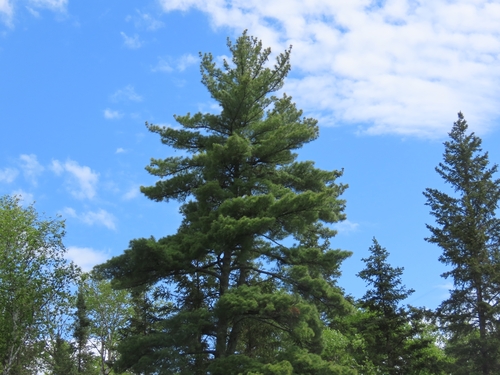
no rights reserved, uploaded by Carter Dorscht
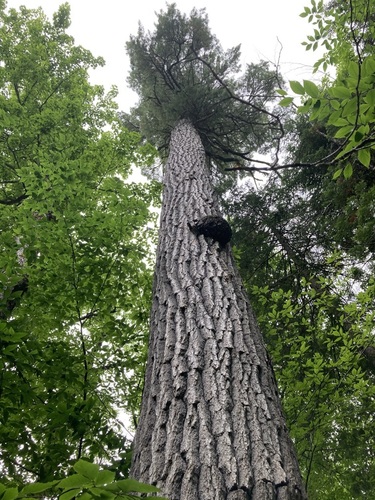
(c) Fen Levy-O'Malley, some rights reserved (CC BY-NC), uploaded by Fen Levy-O'Malley

(c) Douglas Goldman, some rights reserved (CC BY-SA), uploaded by Douglas Goldman
What to Eat
Edible parts: Seeds, Bark, Leaves - tea, Cones, Shoots
The small seeds, around 6mm long, can be eaten raw or cooked and are mainly used as a flavouring in cooking. Fresh needles can be brewed into an aromatic tea rich in vitamins A and C, and the leaves also make a refreshing drink on their own. Tender new shoots boiled in syrup produce an acceptable candy, and the sticky amber sap can be chewed like gum. Firm, unexpanded male cones can be boiled and used as a flavouring — they have a pleasant sweet taste. The inner bark has a sweet flavour and can be eaten raw or cooked; it is often dried, ground into a powder, and used as a thickener in soups or added to cereals when making bread. A vanillin flavouring is also obtained as a by-product of resins released from the pulpwood.
Known Hazards
Where to Find It
It is a temperate plant. It grows naturally in woods at low altitude in North America. It is cultivated in N China. They can tolerate frost. It grows on light moist soils. It suits hardiness zones 3-9. Hobart Botanical Gardens.
Australia, Britain, Canada, Central America, China, Europe, Guatemala, Korea, Mexico, North America, Norway, Papua New Guinea, PNG, Scandinavia, Slovenia, Sweden, Tasmania, USA,
How to Identify
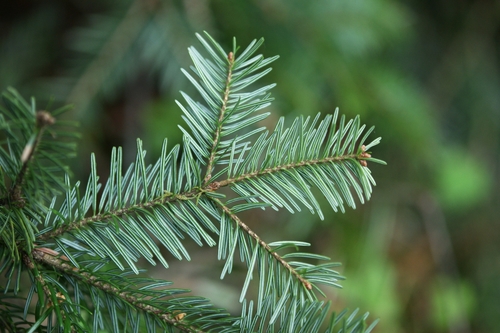
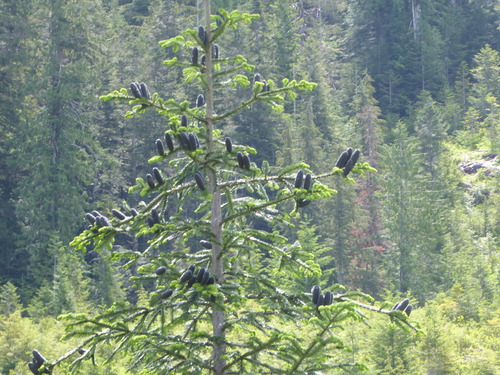
A tree. It grows to 65 m tall. The trunk is 1.8 m across. The bark is dark brown and deeply furrowed. It has irregular oblong, long scaly plates. The crown is cone shaped but becomes rounded or flattened. There are 5 needles per bundle. They do not hang down and are deep green. They are slightly twisted and 6-14 cm long by 0.7-1 mm wide. They are not stiff. The seed cones are clustered and have a stalk. It is 2-3 cm long. The cones are grey brown with purple tints. They are 7-20 cm long. They take 2 years to mature then shed their seeds and fall. The seeds are red-brown with black mottle. They are broadly oval and 5-6 mm across. The wing is pale brown and 1.8-2.5 cm wide.
How to Grow
Thrives in a light well-drained sandy or gravelly loam. Dislikes poorly drained moorland soils. Established plants tolerate drought. Intolerant of atmospheric pollution. The white pine is a very important timber crop in its native range, the huge stands that existed before the Europeans went to N. America have been largely cut down. It is a fast-growing and fairly long-lived tree that is often cultivated as a timber tree, especially in central Europe. Young trees grow very vigorously with new shoots of up to 1 metre common. Growth slows and almost ceases by the time the tree is 20 metres tall. Trees can produce cones when 5 - 10 years old, but reliable seed production takes another 10 years. Good crops are produced every 3 - 5 years in the wild, with little seed in the intervening years. The cones are 10 - 20cm long and take 2 years to mature, they open and shed their seed in late summer whilst still attached to the tree. Plants often self-sow in Britain. Plants are strongly outbreeding, self-fertilized seed usually grows poorly. They hybridize freely with other members of this genus. Trees have a very thin bark, which makes them particularly susceptible to forest fires. This species is very susceptible to white pine blister rust, it should not be grown near any gooseberries or currants (Ribes species) since these plants can act as vectors for the disease. Plants are also subject to aphid damage. Plants in this genus are notably susceptible to honey fungus. Leaf secretions inhibit the germination of seeds, thereby reducing the amount of plants that can grow under the trees.
Propagation: Sow seed in individual pots in a cold frame as soon as it is ripe, or in late winter if not. A short stratification of 6 weeks at 4°C can improve germination of stored seed. Plant seedlings into their permanent positions as soon as possible and protect them for their first winter or two. Because plants have a very sparse root system, early planting is important for good establishment. Trees should be planted out when quite small — between 30 and 90cm — though we typically plant them at around 5–10cm tall. A thorough weed-excluding mulch aids establishment well. Larger trees check badly and may put on little growth for several years, which also harms root development and wind resistance. Cuttings work only when taken from trees less than 10 years old. Use single leaf fascicles with the base of the short shoot; disbudding the shoots a few weeks before taking cuttings can help. Cuttings are normally slow to grow away.
Medicinal Uses
White pine was used medicinally by several Native North American Indian tribes, who valued it especially for its antiseptic and vulnerary qualities, applying it extensively to skin complaints, wounds, burns, boils, and similar conditions. It was also used to treat coughs, colds, and influenza due to its benefit to the respiratory system. The turpentine obtained from the resin is antiseptic, diuretic, rubefacient, and vermifuge. Taken internally, it treats kidney and bladder complaints; used as a rub or steam bath, it addresses rheumatic conditions. It is also effective against diseases of the mucous membranes and respiratory complaints including coughs, colds, influenza, and TB. Externally, it treats skin complaints, wounds, sores, burns, and boils, and is applied as liniment plasters, poultices, herbal steam baths, and inhalers. A pitch poultice can draw out toxins from boils and reduce pain. The dried inner bark is demulcent, diuretic, and expectorant, and an infusion of it is used to treat colds; it remains an ingredient in commercial cough syrups to promote expulsion of phlegm. A poultice of pounded inner bark treats cuts, sores, and wounds, and the wetted inner bark can be laid on the chest to treat severe colds. The dried inner bark contains 10% tannin, some mucilage, an oleoresin, a glycoside, and a volatile oil. A tea made from young needles treats sore throats and, being rich in vitamin C, is effective against scurvy. An infusion of young twigs has been used for kidney disorders and pulmonary complaints. Powdered wood has been used as a dressing on babies' chafed skin, sores, and improperly healed navels.
Other Uses
A tan or green dye is obtained from the needles. The needles release a substance called terpene when washed by rain, which negatively affects the germination of some plants, including wheat. Oleo-resins are present in all pine tissues but are often not extracted unless yields are commercially worthwhile; they are obtained by tapping the trunk or by destructive distillation of the wood, with trees from warmer regions generally yielding more. Turpentine makes up an average of 20% of the oleo-resin and is separated by distillation; it has wide uses including as a solvent for waxes, in varnish-making, and medicinally. The remaining rosin is used by violinists on their bows and in sealing wax and varnish. Pitch obtained from the resin is used for waterproofing canoes and containers and as a wood preservative. The wood is straight and close-grained, light, soft, not strong, and works easily, taking an excellent natural or painted finish; it weighs 24lb per cubic foot. It is a valuable timber, especially suited for ship masts, and is also used for lumber, cheap furniture, house interiors, and general construction.
Wikipedia
Source ↗Pinus strobus, commonly called the eastern white pine, northern white pine, white pine, Weymouth pine (British), and soft pine is a large pine native to eastern North America. It occurs from Newfoundland, Canada, west through the Great Lakes region to southeastern Manitoba and Minnesota, United States, and south along the Appalachian Mountains and upper Piedmont to northernmost Georgia and very rare in some of the higher elevations in northeastern Alabama. It is considered rare in Indiana. The Haudenosaunee maintain the tree as the central symbol of their multinational confederation, calling it the "Tree of Peace", where the Seneca use the name o'sóä' and the Mohawk people call it onerahtase'ko:wa. Within the Wabanaki Confederacy, the Mi'kmaq use the term guow to name the tree, both the Wolastoqewiyik and Peskotomuhkatiyik call it kuw or kuwes, and the Abenaki use the term kowa. It is known as the "Weymouth pine" in the United Kingdom, after Captain George Weymouth of the British Royal Navy, who brought its seeds to England from Maine in 1605.
Production
Trees grow rapidly. Trees can live 100-200 years. Cones take 2 years to mature.
Notes
There are over 100 species of Pinus. The tea is rich in Vitamins A and C.
Names & Synonyms
Bei mei qiao song, Gladki bor, Weymouth pine
References (23)
- Beckstrom-Sternberg, Stephen M., and James A. Duke. "The Foodplant Database." http://probe.nalusda.gov:8300/cgi-bin/browse/foodplantdb.(ACEDB version 4.0 - data version July 1994)
- Bodkin, F., 1991, Encyclopedia Botanica. Cornstalk publishing, p 803
- BRIGGS & SIMONOVITCH,
- Coombes, A.J., 2000, Trees. Dorling Kindersley Handbooks. p 73
- Cundall, P., (ed.), 2004, Gardening Australia: flora: the gardener's bible. ABC Books. p 1050
- DILLINGHAM,
- Facciola, S., 1998, Cornucopia 2: a Source Book of Edible Plants. Kampong Publications, p 171
- Farrar, J.L., 1995, Trees of the Northern United States and Canada. Iowa State University press/Ames p 44
- Fu Liguo, Li Nan, Mill, R.R., Pinaceae. Flora of China.
- Harris, E & J., 1983, Field Guide to the Trees and Shrubs of Britain. Reader's Digest. p 256
- Hibbert, M., 2002, The Aussie Plant Finder 2002, Florilegium. p 235
- http://www.botanic-gardens-ljubljana.com/en/plants
- Kermath, B. M., et al, 2014, Food Plants in the Americas: A survey of the domesticated, cultivated and wild plants used for Human food in North, Central and South America and the Caribbean. On line draft. p 663
- Kiple, K.F. & Ornelas, K.C., (eds), 2000, The Cambridge World History of Food. CUP p 1878
- Kuhnlein, H. V. and Turner, N. J., 1991, Traditional Plant Foods of Canadian Indigenous Peoples. Food and Nutrition in History and Anthropology Volume 8. Gordon and Breach. p 41
- Little, E.L., 1980, National Audubon Society Field Guide to North American Trees. Alfred A. Knopf. p 296
- Lord, E.E., & Willis, J.H., 1999, Shrubs and Trees for Australian gardens. Lothian. p 87
- MacKinnon, A., et al, 2009, Edible & Medicinal Plants of Canada. Lone Pine. p 33
- Moerman, D. F., 2010, Native American Ethnobotany. Timber Press. p 413
- Plants for a Future database, The Field, Penpol, Lostwithiel, Cornwall, PL22 0NG, UK. http://www.scs.leeds.ac.uk/pfaf/
- Schuler, S., (Ed.), 1977, Simon & Schuster's Guide to Trees. Simon & Schuster. No. 35
- Sp. pl. 2:1001. 1753
- Toupal, R. S. & Hollenback, K., 2009, An Ethnobotany of Indiana Dunes National Lakeshore: Plant Uses of the Ojibwa People. Bureau of Applied Research in Anthropology. University of Arizona