Pluchea indica
(L.) Less
Indian sage, Indian camphorweed
no rights reserved, uploaded by 葉子

(c) Cheng-Tao Lin, some rights reserved (CC BY), uploaded by Cheng-Tao Lin
no rights reserved, uploaded by 葉子
What to Eat
Edible parts: Leaves as condiment, Spice, Flowers, Vegetable
The plant contains the compounds β-sitosterol and stigmasterol, which have antidiabetic properties. The β-sitosterol isolated from the root extract can also neutralize the venom of Russell's viper (Daboia russelii) and the monocled cobra (Naja kaouthia).
Where to Find It
A tropical plant. It often grows in salty locations. It grows around the coast. It is often near sea level and in mangroves. It grows in wetlands. It can be on hard, stony ground. In Java it grows up to 1,000 m above sea level.
Asia, Australia, Cambodia, China, East Timor, Hawaii, India, Indochina, Indonesia, Japan, Kiribati, Laos, Malaysia, Myanmar, Pacific, Pakistan, Papua New Guinea, PNG, Philippines, SE Asia, Singapore, Taiwan, Thailand, Timor-Leste, Tuvalu, USA, Vietnam,
How to Identify
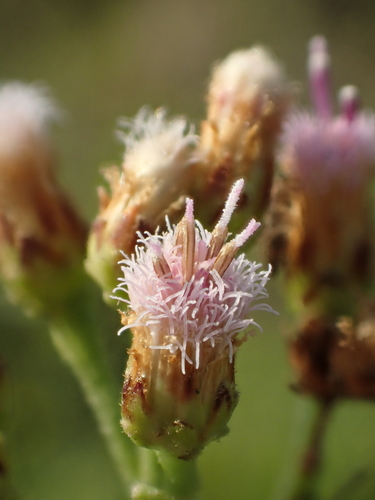
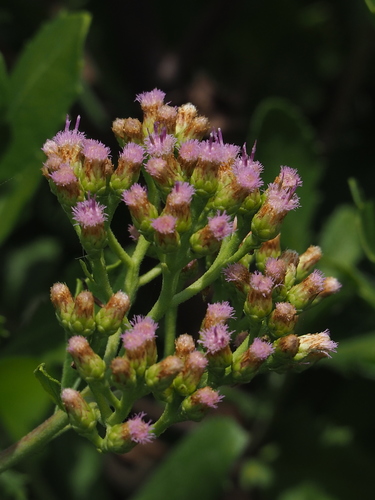
A small shrub. It grows 1-3 m high. It has many branches from the base. The leaves are alternate and simple. They are 1-2.5 cm long by 6-8 mm wide. The flowers occur in a panicle of heads at the ends of branches. The flower heads are 3 mm across. They are mauve. The fruit is a brown nut about 1 mm across.
Nutrition Score: 27/100
| Part | Moisture | kJ | kcal | Protein | Vit A | Vit C | Iron | Zinc |
|---|---|---|---|---|---|---|---|---|
| Leaves | 86 | 176 | 42 | 1.8 | — | — | 5.6 | — |
How to Grow
Plants can be grown from seeds. It can be grown using cuttings. It can be used for hedges.
Propagation: Seed - Cuttings.
Medicinal Uses
Indian sage is commonly used within its native range to treat a wide range of disorders. Considerable research has been carried out into the plant and a range of medically active compounds have been demonstrated. The leaves and aerial parts of the plant contain terpenoids, flavonoids and an essential oil. The main components of the oil are camphor, 'ALFA'-pinene, benzyl alcohol, benzyl acetate, eugenol, linalool and 'DELTA'-cadinol. The essential oil has demonstrated antimicrobial activity under laboratory conditions on the growth of the bacteria Staphylococcus aureus and Escherichia coli, the pathogenic fungi Microsporium gypseum and Candida albicans, as well as of the non-pathogenic Pithium ultimum and Xanthomonas campestris. The plant extract displays a dose-related diuretic effect, with no detectable pathological changes even after high doses. The roots contain pterocaptriol, plucheoside C, D1, D2 and D3 and E, plucheol A and B, hop-17(21)-en-3'BETA'-yl acetate and boehmeryl acetate. A methanol extract of the roots was tested in various models of inflammations and ulcers in vivo. It demonstrated significant anti-inflammatory action, and also a protective action against ulcers. This extract also showed significant hepatoprotective activity against experimentally induced liver damage. The methanol extract of the roots was also screened for activity against the venom of the snake Vipera russellii, where it was found to significantly reduce venom-induced lethality and haemorrhagic activity. Venom-induced coagulant and anticoagulant activity was also antagonized. In traditional medicine, the leaves are considered to be antitussive, diaphoretic, febrifuge, galactagogue and stomachic. An infusion is used to stimulate perspiration in a fever. An infusion of the leaves as a tea, or the leaves and young shoots crushed in alcohol, are used for treating lumbago. The crushed leaves, raw or steamed, are eaten to correct foul breath and offensive perspiration odour. A decoction of the leaves and stem is drunk to ease asthma and other pulmonary problems. A decoction of the fresh leaves is used in an inhalant to cure colds. Externally the leaves are used to relieve skin diseases, whilst the fresh leaves are applied to cure haemorrhoids. The powdered leaves, mixed with beeswax and castor oil, are applied in bandaging closed fractures. The juice from the crushed leaves, mixed with the juice of other plants, is used as a remedy for dysentery. An infusion of the leaves, usually in combination with other ingredients, is given as a treatment against leucorrhoea. Indian sage is used externally, in special baths as an aromatic and stimulant, and also in nerve-strengthening fomentations. It is mixed with other ingredients into a poultice which is an effective embrocation against weakness after diarrhoea, and against ulcers and sores. In Thailand all parts of the plant are used as a diuretic and antidiabetic. A decoction of the roots or leaves is recommended for treating fever, headache, rheumatism, sprains, dysentery and dyspepsia. It is used in baths to treat scabies. The roots, mixed with other ingredients, are applied as a poultice for rheumatic pains.
Other Uses
Plants are grown as an intercrop in teak forests Cultivated as a hedge at lower elevations, sometimes up to elevations of 1,000 metres.
Wikipedia
Source ↗Pluchea indica is a species of flowering plant in the aster family, Asteraceae. Its common names include Indian camphorweed, Indian fleabane, and Indian pluchea. It is native to parts of Asia and Australia, and it is widespread in the Pacific Islands as an introduced and often invasive species. The species hybridizes with Pluchea carolinensis when the two plants grow together, yielding a hybrid that has been named Pluchea × fosbergii.
Other Information
It is sold in local markets in China. It is cultivated.
Notes
There are about 50 Pluchea species. It is used in medicine.
Names & Synonyms
Baluntas, Beluntas, Beluntas paya, Indian fleabane, Khayu, Khlu, Kukronda, Lontas, Luntas, Mili, Munjhu, Rukha, Wabalu, Xie la
References (26)
- Ali M. S. M., 2008, Analysis of Phenolics and Other Phytochemicals in Selected Malaysian Traditional Vegetables and Their Activities In Vitro. PhD thesis University of Glasgow.
- Ambasta, S.P. (Ed.), 2000, The Useful Plants of India. CSIR India. p 470
- Andarwulan, N., et al, 2010, Flavonoid content and antioxidant activity of vegetables from Indonesia. Food Chemistry 121: 1231-1235
- Arora, R. K., 2014, Diversity in Underutilized Plant Species - An Asia-Pacific Perspective. Bioversity International. p 108
- Burkill, I.H., 1966, A Dictionary of the Economic Products of the Malay Peninsula. Ministry of Agriculture and Cooperatives, Kuala Lumpur, Malaysia. Vol 2 (I-Z) p 1804
- Cooper, W. and Cooper, W., 2004, Fruits of the Australian Tropical Rainforest. Nokomis Editions, Victoria, Australia. p 83
- Cowie, I, 2006, A Survey of Flora and vegetation of the proposed Jaco-Tutuala-Lore National Park. Timor-Lests (East Timor) www.territorystories.nt/gov.au p 45
- Cribb, A.B. & J.W., 1976, Wild Food in Australia, Fontana. p 136
- Facciola, S., 1998, Cornucopia 2: a Source Book of Edible Plants. Kampong Publications, p 41
- Food Composition Tables for use in East Asia FAO http://www.fao.org/infoods/directory No. 667
- Lembogi Biologi Nasional, 1980, Sayur-sayuran. Balai Pustaka, Jakarta. p 80
- Li, D. et al, 2017, Ethnobotanical survey of herbal tea plants from the traditional markets in Chaoshan, China. Journal of Ethnopharmacology. 205 (2017) 195-206
- Lim, T. K., Edible Medicinal and Non-Medicinal Plants Volume 7 Flowers
- Linnaea 6:150. 1831
- MARDI Malaysia
- Martin, F.W. & Ruberte, R.M., 1979, Edible Leaves of the Tropics. Antillian College Press, Mayaguez, Puerto Rico. p 99, 185
- Ochse, J.J. et al, 1931, Vegetables of the Dutch East Indies. Asher reprint. p 138
- Oomen, H.A.P.C., & Grubben, G.J.H., 1978, Tropical Leaf Vegetables in Human Nutrition, Communication 69, Department of Agricultural research, RTI Amsterdam, p 97, 120
- Sukarya, D. G., (Ed.) 2013, 3,500 Plant Species of the Botanic Gardens of Indonesia. LIPI p 689
- Terra, G.J.A., 1973, Tropical Vegetables. Communication 54e Royal Tropical Institute, Amsterdam, p 68
- Thaman, R. R., 1987, Plants of Kiribati: A listing and analysis of vernacular names. Atoll Research Bulletin No. 296
- Thaman, R. R, 2016, The flora of Tuvalu. Atoll Research Bulletin No. 611. Smithsonian Institute p 68
- Tindall, H.D., & Williams, J.T., 1977, Tropical Vegetables and their Genetic Resources, International Board for Plant Genetic Resources, Rome, p 109
- World Checklist of Useful Plant Species 2020. Royal Botanic Gardens, Kew
- Zeven, A. C. & de West, J. M. J., 1982, Dictionary of cultivated plants and their regions of diversity. Wageningen. p 51
- Zhang, Y., et al, 2014, Diversity of wetland plants used traditionally in China: a literature review. Journal of Ethnobiology and Ethnomedicine. 10:72