Podolepis jaceoides
(Sims) Voss
Showy Podolepis, Showy Copper-wire Daisy

(c) Karen Retra, some rights reserved (CC BY-NC), uploaded by Karen Retra

(c) Karen Retra, some rights reserved (CC BY-NC), uploaded by Karen Retra

(c) Lise Kool, some rights reserved (CC BY-NC), uploaded by Lise Kool
What to Eat
Edible parts: Root
The root is edible, though no further details on preparation or use are recorded.
Where to Find It
A temperate plant. It grows in grasslands and open forests. It often grows in moderately rich soil. It suits semi-arid regions. It can grow from sea level to alpine grassland. It needs a well drained moist soil. Tasmania Herbarium.
Australia*, Britain, Europe, Tasmania*,
How to Identify
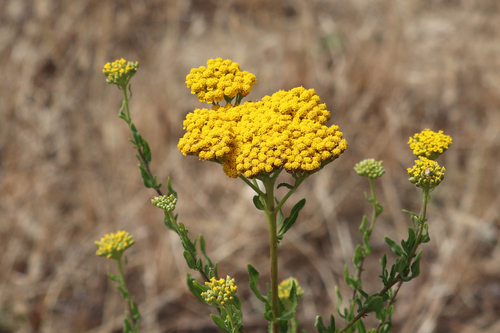
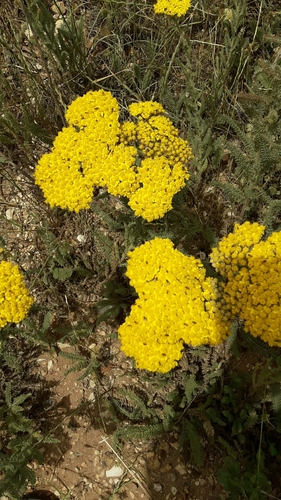
A daisy. It is showy and has a ragged look. It grows 30-80 cm high and spreads 30-70 cm wide. It can re-grow from its rootstock. There can be several stems from one rootstock. The leaves are crowded in tufts near the base. They are sword shaped but vary in hairiness. The leaves near the base are 10-20 cm long by 1-2 cm wide. There are only a few leaves on the stems. They are 1-5 cm long by 0.2-1 cm wide. The flowering stems are 40 cm high. They contain single large flowers. The flowers are golden yellow and have deeply split ray florets. The flower heads have papery bracts around them. The flower buds are large and bend over.
How to Grow
Plants can be grown from seed or by division of the rootstock.
Propagation: Sow seed in a greenhouse from early to mid spring. Once seedlings are large enough to handle, prick them out into individual pots and plant into permanent positions in late spring or early summer, after the last expected frosts. Where seed is plentiful, a direct outdoor sowing in situ in late spring is worth attempting. The plant can also be propagated by division in spring.
Medicinal Uses
None known.
Other Uses
None known.
Wikipedia
Source ↗Podolepis jaceoides is a hardy perennial reaching 0.6 m height, suitable for UK zone 9. Flowers appear from July through August. The plant is hermaphroditic and attracts insect pollinators. It thrives in light sandy and medium loamy soils with excellent drainage, tolerating mildly acidic, neutral, and mildly alkaline pH levels, including saline conditions. The plant requires full sun exposure and prefers moist soil, making it unsuitable for shaded locations.
Production
Plants only a live a short time in cultivation.
Other Information
The roots of Alpine podolepis (Podolepis robusta) and Long podolepis (Podolepis hieracioides) were probably also eaten.
Notes
There are 20 Podolepis species. They grow in Australia.
Names & Synonyms
References (17)
- Blomberry, A.M., 1979, Australian Native Plants. Angus and Robertson p 102
- Cameron, M., (Ed.) 1981, A Guide to Flowers & Plants of Tasmania. Reed p 36
- Cherikoff V. & Isaacs, J., The Bush Food Handbook. How to gather, grow, process and cook Australian Wild Foods. Ti Tree Press, Australia p 196
- Cribb, A.B. & J.W., 1976, Wild Food in Australia, Fontana. p 153
- Cronin, L., 1989, The Concise Australian Flora. Reed. p 56
- Curtis, W.M., 1963, The Students Flora of Tasmania Vol 2 p 348
- Elliot, W.R., & Jones, D.L., 1997, Encyclopedia of Australian Plants suitable for cultivation. Vol 7. Lothian. p 399 (Photo)
- Gilfedder, L et al, 2003, The Nature of the Midlands. Midlands Bushweb. PO Box 156 Longford, Tasmania. p 78
- Hastings Advance Community College, 2017, Uses for Native Plants of the Mornington Peninsula. 86pp. p 62
- Hibbert, M., 2002, The Aussie Plant Finder 2002, Florilegium. p 237
- Lazarides, M. & Hince, B., 1993, Handbook of Economic Plants of Australia, CSIRO. p 193
- Lim, T. K., 2015, Edible Medicinal and Non Medicinal Plants. Volume 9, Modified Stems, Roots, Bulbs. Springer p 66
- Plants for a Future database, The Field, Penpol, Lostwithiel, Cornwall, PL22 0NG, UK. http://www.scs.leeds.ac.uk/pfaf/
- Tasmanian Herbarium Vascular Plants list p 12
- Vilm. Blumengaurtn. ed. 3, 1:537. 1894 "jaceodes"
- Whiting, J. et al, 2004, Tasmania's Natural Flora. Tasmania's Natural Flora Editorial Committee PO Box 194, Ulverstone, Tasmania, Australia 7315 p 47
- www.fsd.monash.edu.au/files/bethgottpamphley_po.pdf