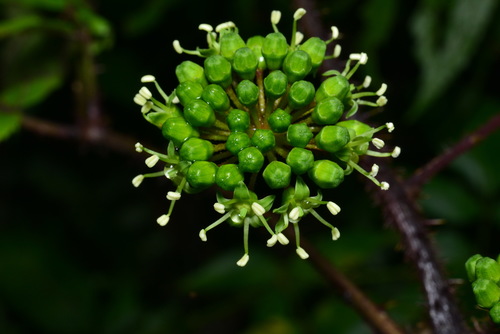
Polyscias scutellaria
(Burm. f.) Fosberg
Saucer leaf, Cup leaf papua, Hedge panax
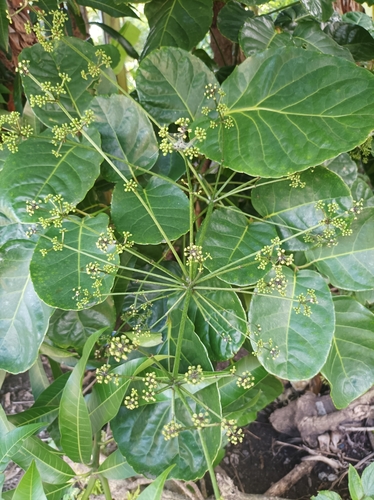
(c) Dominik Maximilián Ramík, some rights reserved (CC BY), uploaded by Dominik Maximilián Ramík
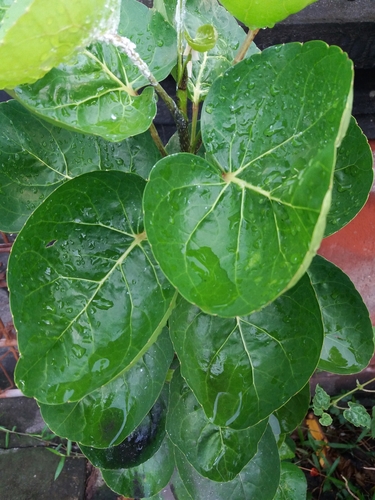
(c) cucfin_jumiati_nevi, some rights reserved (CC BY-NC)
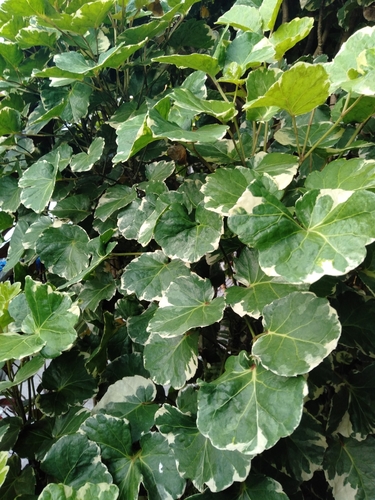
(c) ndionson, some rights reserved (CC BY-NC), uploaded by ndionson
What to Eat
Edible parts: Leaves, Vegetable
Ancient native Indonesians have used shield aralia leaf as a bowl substitute due to its bowl-like shape and tear-resistant properties. In modern Indonesian cuisine shield aralia can be used as fancy food packaging. Shredded shield aralia has aromatic properties that can be mixed with meat or fish to conceal the odor.
Where to Find It
A tropical plant. It occurs in the lower altitude regions. It needs well drained soils. It often grows at low altitudes and up to 800 m altitude. It is often grown as a hedge. In XTBG Yunnan.
Asia, Australia, China, Chuuk, Cook Islands, Fiji, FSM, Guam, Hawaii, India, Indochina, Indonesia, Kiribati, Malaysia, Marquesas, Nauru, Pacific*, Palau, Papua New Guinea, PNG, Philippines, Rotuma, Samoa, SE Asia, Solomon Islands, Sri Lanka, Tokelau, Tuvalu, USA, Vanuatu, Vietnam,
How to Identify
A shrub which forms many branches from the base. It is 1-6 m high and spreads 1.5-3 m wide. The stems are bronze-green and there are distinct scars where the leaves fall off. The leaves have long leaf stalks and they can be simple or have 1-5 leaflets. The leaves are often cup shaped or saucer shaped. The leaf is elongated along the leaf stalk for about a quarter of its length. The leaves have teethed and are smooth on both sides. They are dark green on top and lighter green beneath. The leaf blade is 8-25 across and almost round or kidney shaped. The leaf stalk is 6-28 cm long. The flowers are 0.5 cm across. They are white or yellow. The fruit is 0.7 cm across and purplish-black. It is round and fleshy.
Nutrition Score: 50/100
| Part | Moisture | kJ | kcal | Protein | Vit A | Vit C | Iron | Zinc |
|---|---|---|---|---|---|---|---|---|
| Leaves | 82 | 227 | 54 | 3.7 | — | 85 | 4 | — |
How to Grow
The shrub is often planted and pruned to form a hedge. It is grown from cuttings.
Propagation: Seed - Cuttings.
Medicinal Uses
The leaves and the roots, combined with parsley, are used as a diuretic. The juice of the leaves has been used to relieve stomach aches and facilitate childbirth.
Other Uses
The leaves are used as plates. The plant responds well to pruning and can be grown as a hedge.
Wikipedia
Source ↗Polyscias scutellaria, the shield aralia, or plum aralia, is a tropical shrub or small tree reaching 2–6 meters in height. A native of eastern Malesia and southwest Pacific islands, it is commonly grown in gardens. The leaves and root can be used as an antiseptic and deodorant.
Notes
There are about 100 Polyscias species.
Names & Synonyms
Bei, Belahess, Daun belangkas, Daun mangkok, Godong mangkokan, Lala, Mamanukan, Mangkokan, Ndanindani, Platito, Semangkok, Shield aralia, Te toara
References (31)
- Andarwulan, N., et al, 2010, Flavonoid content and antioxidant activity of vegetables from Indonesia. Food Chemistry 121: 1231-1235 (As Nothopanax scutellarium)
- Bradacs, G., 2008, Ethnobotanical Survey and Biological Screening of Medicinal Plants from Vanuatu. PhD thesis Frankurt University. p 100
- Burkill, I.H., 1966, A Dictionary of the Economic Products of the Malay Peninsula. Ministry of Agriculture and Cooperatives, Kuala Lumpur, Malaysia. Vol 2 (I-Z) p 1589 (As Nothopanax scutellarium)
- Cabalion, P. and Morat, P., 1983, Introduction le vegetation, la flore et aux noms vernaculaires de l'ile de Pentcoste (Vanuatu), In: Journal d'agriculture traditionnelle et de botanique appliquee JATBA Vol. 30, 3-4
- Clarke, W.C. & Thaman, R.R., 1993, Agroforestry in the Pacific Islands: Systems for sustainability. United Nations University Press. New York. p 255
- Conn, B.J., (Ed.) 1995, Handbooks of the Flora of Papua New Guinea. Vol 3. Melbourne University Press. p 34
- Elliot, W.R., & Jones, D.L., 1997, Encyclopedia of Australian Plants suitable for cultivation. Vol 7. Lothian. p 421
- Food Composition Tables for use in East Asia FAO http://www.fao.org/infoods/directory No. 499
- French, B.R., 2010, Food Plants of Solomon Islands. A Compendium. Food Plants International Inc. p 93
- Gillaumin, R., 1954, Les Plantes utiles des Nouvelles-Hebrides (fin et complement) In: Journal d'agriculture tropicale et de botanique appliquee Vol. 1, No. 10-12 pp 453-460 (As 'lala')
- Henderson, C.P. and I.R.Hancock, 1988, A Guide to the Useful Plants of the Solomon Islands. Res. Dept. Min of Ag. & Lands. Honiara, Solomon Islands. p 111
- Hibbert, M., 2002, The Aussie Plant Finder 2002, Florilegium. p 238
- Lebot, V. & Sam, C., Green desert or ‘all you can eat’? How diverse and edible was the flora of Vanuatu before human introductions?. Terra australis 52 p 410
- Lugod, G.C. and de Padua L.S., 1979, Wild Food Plants in the Philippines. Vol. 1. Univ. of Philippines Los Banos. p 18 (As Polyscias cochleatum)
- Lyons, G., et al, 2020, Macro- and Micronutrients from Traditional Food Plants Could Improve Nutrition and Reduce Non-Communicable Diseases of Islanders on Atolls in the South Pacific. Plants 2020, 9, 942
- Martin, F.W. & Ruberte, R.M., 1979, Edible Leaves of the Tropics. Antillian College Press, Mayaguez, Puerto Rico. p 177
- McClatchey, W. C., 2012, Wild food plants of Remote Oceania. Acta Societatis Botanicorum Poloniae 81(4) 371-380
- Occas. Pap. Univ. Hawaii 46:9. 1948
- Ochse, J.J. et al, 1931, Vegetables of the Dutch East Indies. Asher reprint. p 67
- Oomen, H.A.P.C., & Grubben, G.J.H., 1978, Tropical Leaf Vegetables in Human Nutrition, Communication 69, Department of Agricultural research, RTI Amsterdam, p 36, 97
- Owen, S., 1993, Indonesian Food and Cookery, INDIRA reprints. p 53
- Peekel, P.G., 1984, (Translation E.E.Henty), Flora of the Bismarck Archipelago for Naturalists, Division of Botany, Lae, PNG. p 424, 423
- Samy, J., Sugumaran, M., Lee, K. L. W., 2009, Herbs of Malaysia, Marshall Cavendish. p 201
- Smith, A.C., 1985, Flora Vitiensis Nova, Lawaii, Kuai, Hawaii, Volume 3 p 638
- Sukarya, D. G., (Ed.) 2013, 3,500 Plant Species of the Botanic Gardens of Indonesia. LIPI p 692
- Staples, G.W. and Herbst, D.R., 2005, A tropical Garden Flora. Bishop Museum Press, Honolulu, Hawaii. p 136 (Drawing)
- Terra, G.J.A., 1973, Tropical Vegetables. Communication 54e Royal Tropical Institute, Amsterdam, p 63
- Thaman, R. R, 2016, The flora of Tuvalu. Atoll Research Bulletin No. 611. Smithsonian Institute p 66
- Walter, A. & Lebot, V., 2007, Gardens of Oceania. ACIAR Monograph No. 122. p 171
- Whistler, W. A., 1988, Ethnobotany of Tokelau: The Plants, Their Tokelau Names, and Their Uses. Economic Botany 42(2): 155-176
- World Checklist of Useful Plant Species 2020. Royal Botanic Gardens, Kew