Proboscidea fragrans
(Lindl.) Decne
Fragrant Devil’s Claw
(c) Pedro Nájera Quezada, some rights reserved (CC BY-NC)

(c) Barry Sullender, some rights reserved (CC BY-NC)

(c) Barry Sullender, some rights reserved (CC BY-NC)
What to Eat
Edible parts: Leaves, Seeds, Seedspod
Leaves are cooked as a potherb with beans. The half-ripe seedpods, which are 8–10cm long, are cooked and eaten as a vegetable. The seeds can be boiled and eaten; soft immature seeds can also be eaten raw, roasted, or ground into a paste.
Where to Find It
It is a subtropical plant.
Australia, Central America, Mexico, North America, USA,
How to Identify
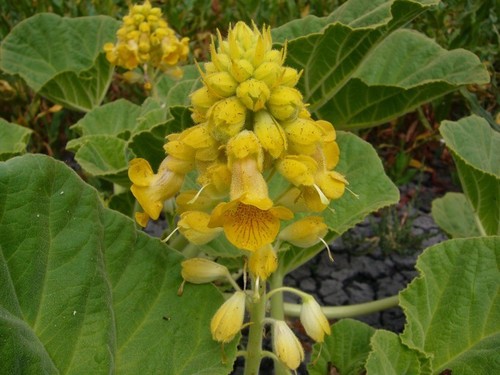
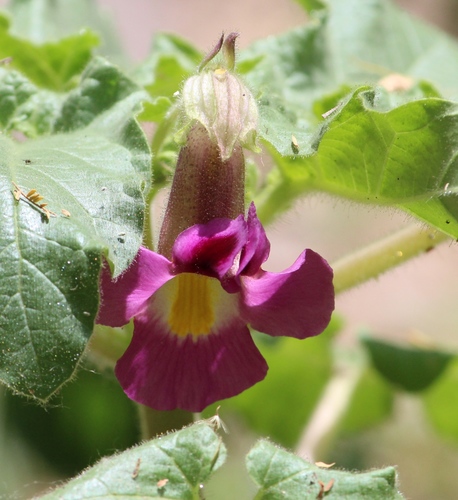
Proboscidea fragrans is a frost-tender annual reaching 0.6 m tall and 0.3 m wide, hardy to UK zone 10. It flowers July to September. The plant is hermaphroditic and requires full sun. It tolerates light sandy, medium loamy, and heavy clay soils with good drainage, adapting to mildly acid, neutral, and basic pH levels. It prefers moist soil.
How to Grow
Propagation: Seed should be sown in spring in a warm greenhouse. When large enough to handle, prick seedlings into individual pots and plant out after the last expected frosts.
Medicinal Uses
None known
Other Uses
The ripe seedpods are used as ornaments on willow baskets. The pods are softened with lye and water, then split, bent and used as sewing withes in coiled basketry.
Wikipedia
Source ↗Proboscidea fragrans is a frost-tender annual reaching 0.6 m tall and 0.3 m wide, hardy to UK zone 10. It flowers July to September. The plant is hermaphroditic and requires full sun. It tolerates light sandy, medium loamy, and heavy clay soils with good drainage, adapting to mildly acid, neutral, and basic pH levels. It prefers moist soil.
Notes
There are 9 Proboscidea species.
Names & Synonyms
Chihuahuan devil's claw, Cuernitos
References (12)
- Ann. Sci. Nat. Bot. ser. 5, 3:326. 1865
- Beckstrom-Sternberg, Stephen M., and James A. Duke. "The Foodplant Database." http://probe.nalusda.gov:8300/cgi-bin/browse/foodplantdb.(ACEDB version 4.0 - data version July 1994) (As Martynia fragrans)
- Facciola, S., 1998, Cornucopia 2: a Source Book of Edible Plants. Kampong Publications, p 148 (As Proboscidea lousianica ssp. fragrans)
- Hedrick, U.P., 1919, (Ed.), Sturtevant's edible plants of the world. p 404 (As Martynia fragrans)
- Heywood, V.H., Brummitt, R.K., Culham, A., and Seberg, O. 2007, Flowering Plant Families of the World. Royal Botanical Gardens, Kew. p 203
- Kermath, B. M., et al, 2014, Food Plants in the Americas: A survey of the domesticated, cultivated and wild plants used for Human food in North, Central and South America and the Caribbean. On line draft. p 702
- Kiple, K.F. & Ornelas, K.C., (eds), 2000, The Cambridge World History of Food. CUP p 1874
- Lazarides, M. & Hince, B., 1993, Handbook of Economic Plants of Australia, CSIRO. p 198
- Moerman, D. F., 2010, Native American Ethnobotany. Timber Press. p 436
- Plants for a Future database, The Field, Penpol, Lostwithiel, Cornwall, PL22 0NG, UK. http://www.scs.leeds.ac.uk/pfaf/
- Southw. Naturalist 28:448. 1983 (As Proboscidea lousianica ssp. fragrans)
- Terra, G.J.A., 1973, Tropical Vegetables. Communication 54e Royal Tropical Institute, Amsterdam, p 68