Proboscidea louisianica
(Miller) Thellung
Common Devil’s claw

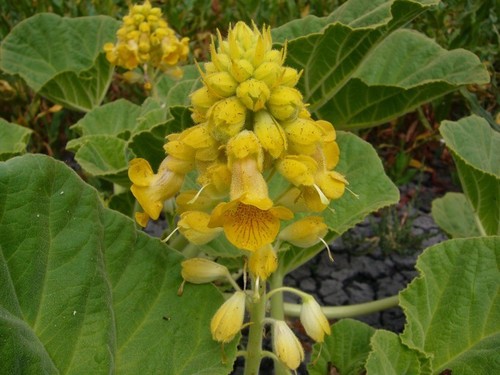
(c) J. Fernando Pío León, some rights reserved (CC BY-NC), uploaded by J. Fernando Pío León

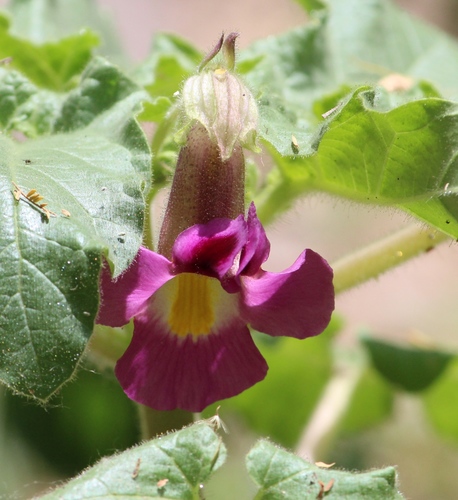
(c) duckswim2, some rights reserved (CC BY-NC), uploaded by duckswim2

(c) lonnyholmes, some rights reserved (CC BY-NC), uploaded by lonnyholmes
What to Eat
Edible parts: Seeds, Pods, Leaves, Fruit
Young fruits, harvested while still tender enough to be pierced with a fork, can be sliced and added to soups as a thickening agent, parboiled and eaten as a vegetable, or pickled in vinegar. The fruit is about 4–6mm long. Seeds can be eaten raw or cooked and are high in protein and oil; an edible oil is also extracted from them. The root is edible, though no preparation details are recorded.
Where to Find It
It needs warmth and sun. It can grow in warm temperate and tropical places.
Australia, Britain, Central America, Europe, Hawaii, Mexico, North America, Pacific, Slovenia, South America, USA,
How to Identify
An annual herb. It is a soft stemmed plant. It grows 30-90 cm high. It branches to spread over a metre across. The leaves are like pumpkin leaves. The leaves are large and 30 cm long by 12 cm across. They are covered with glandular nectar. The plant produces a slimy exudate. The flowers are tube shaped and purplish with yellow mottling inside. They are 3-6 cm long. They often have green, purple or violet spots. The plant has a bad scent. The fruit is a tear shaped capsule. It has a green outer husk. The fruit are fleshy at first. Later the inner woody shell remains and it has a long curved beak. These capsule turn yellow to black at maturity. The capsules have rough grooves at the base. They are 10-17 cm long. The beak eventually splits open and the shell opens.
How to Grow
Plants are grown from seed.
Propagation: Sow seed in spring in a warm greenhouse. Once seedlings are large enough to handle, prick them out into individual pots and plant them out after the last expected frosts.
Medicinal Uses
None known
Other Uses
A black dye can be obtained from the seedpods. The long, pointed seed capsule horns are used as the black pattern material in coiled basketry. The plant is noted for its scent.
Wikipedia
Source ↗Proboscidea louisianica is a species of flowering plant in the family Martyniaceae. Its true native range is unclear, but probably includes parts of the southwestern United States and Mexico in North America. It occurs in other areas, including other regions in North America, Europe, Australia, and South Africa, as an introduced species. It is the most widely distributed species in its family. Common names it shares with other Proboscidea species include devil's claw and unicorn-plant. Names more specific to the species include common devil's claw, ram's horn, aphid trap, Louisiana unicorn-plant, purple-flowered devil's-claw, goat's head, elephant tusks, and martinoe (or martina).
Names & Synonyms
Cuerno de toro, Louisianska samorogovka, Purple flowered Devil’s Claw, Ram’s horn, Unicorn plant
References (22)
- Beckstrom-Sternberg, Stephen M., and James A. Duke. "The Foodplant Database." http://probe.nalusda.gov:8300/cgi-bin/browse/foodplantdb.(ACEDB version 4.0 - data version July 1994) (As Martynia louisianica)
- Brickell, C. (Ed.), 1999, The Royal Horticultural Society A-Z Encyclopedia of Garden Plants. Convent Garden Books. p 834
- Facciola, S., 1998, Cornucopia 2: a Source Book of Edible Plants. Kampong Publications, p 148
- Hedrick, U.P., 1919, (Ed.), Sturtevant's edible plants of the world. p 405 (As Martynia proboscidea)
- Heywood, V.H., Brummitt, R.K., Culham, A., and Seberg, O. 2007, Flowering Plant Families of the World. Royal Botanical Gardens, Kew. p 204
- http://www.botanic-gardens-ljubljana.com/en/plants
- Illustrated Flora of Central Texas p 880
- Jordan, J., et al, 2006, Vascular Plants Utilized by the Plains Apache in Southwestern Oklahoma, Publications of the Oklahoma Biological Survey. 2nd Series. Volume 7: 24-33, 2006
- Kermath, B. M., et al, 2014, Food Plants in the Americas: A survey of the domesticated, cultivated and wild plants used for Human food in North, Central and South America and the Caribbean. On line draft. p 702
- Kiple, K.F. & Ornelas, K.C., (eds), 2000, The Cambridge World History of Food. CUP p 1874
- Lamp, C & Collet F., 1989, Field Guide to Weeds in Australia. Inkata Press. p 229
- Lazarides, M. & Hince, B., 1993, Handbook of Economic Plants of Australia, CSIRO. p 198
- Loughmiller, C & L., 1985, Texas Wildflowers. A Field Guide. University of Texas, Austin. p 164 (As Martynia louisianica)
- Mem. Soc. Sci. Nat. Cherbourg ser. 4, 38:480. 1911-1912
- Moerman, D. F., 2010, Native American Ethnobotany. Timber Press. p 436
- Morley, B. & Everard, B., 1970, Wild Flowers of the World. Ebury press. Plate 162
- Paczkowska, G. & Chapman, A.R., 2000, The Western Australian Flora. A Descriptive Catalogue. Western Australian Herbarium. p 294
- Plants for a Future database, The Field, Penpol, Lostwithiel, Cornwall, PL22 0NG, UK. http://www.scs.leeds.ac.uk/pfaf/
- Rangel-Landa, S., et al, 2017, Sociocultural and ecological factors influencing management of edible and non-edible plants: the case of Ixcatlan, Mexico. Journal of Ethnobiology and Ethnomedicine. 13:59
- Smith, N., Mori, S.A., et al, 2004, Flowering Plants of the Neotropics. Princeton. p 238
- Staples, G.W. and Herbst, D.R., 2005, A tropical Garden Flora. Bishop Museum Press, Honolulu, Hawaii. p 452
- Terra, G.J.A., 1973, Tropical Vegetables. Communication 54e Royal Tropical Institute, Amsterdam, p 68 (As Proboscidea jussieui)