Proboscidea parviflora
(Wooton) Wooton & Standl.
Double claw

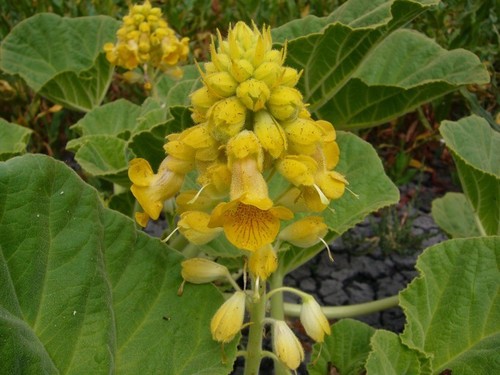
(c) KB, some rights reserved (CC BY-NC), uploaded by KB

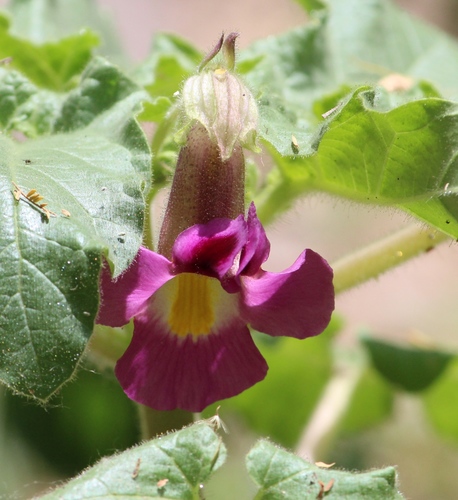
(c) kibuyu, some rights reserved (CC BY-NC-SA)

(c) Peter L. Warren, some rights reserved (CC BY-NC), uploaded by Peter L. Warren
What to Eat
Edible parts: Seeds
The young seeds are eaten fresh, the young tender fruit can be cooked and eaten, and the seeds may yield an edible oil.
Where to Find It
It is a tropical plant.
Mexico, North America, USA,
How to Identify
An annual herb. It grows 1 m tall. The flowers are purple. The fruit are 15 cm long by 5 cm wide. It has a logn beak that splits into a curved claw.
Wikipedia
Source ↗Proboscidea parviflora is a species of flowering plant in the family Martyniaceae known by the common names doubleclaw and red devil's-claw. It is native to the desert southwest of the United States and northern Mexico, where it grows in sandy, dry, and disturbed habitat and blooms during the hot summer. This is an annual herb growing from a taproot and producing sprawling, spreading stems. The leaves have rounded, oval, or roughly triangular blades up to 15 centimetres (6 in) long which have smooth edges or faint lobes or teeth. The inflorescence is an array of several showy bell-shaped flowers with five lobes flaring several centimeters wide. The flower is white to pink or purple, sometimes with mottling or lines of spots in the throat, and often a purple blotch on the upper lip. A yellow nectar guide extends along the lower lip. The fruit is a large seed pod many centimeters long, a cylindrical body tapering into a very long, thin, curving tail. As the fruit dries the tail cracks open and splits into two hooked, claw-like halves. The young fruits and seeds were used for food and the dark-colored hardened dry fruits were used in basketry by local Native Americans.
Names & Synonyms
Devil’s claw, Una de gato
References (9)
- Contr. U.S. Natl. Herb. 19:602. 1915
- Facciola, S., 1998, Cornucopia 2: a Source Book of Edible Plants. Kampong Publications, p 148
- Felger, R.S., Ancient Crops for the Twenty first century, in Rickie, G.A., (ed), 1979, New Agricultural Crops, AAAS Selected Symposium 38. Westview Press, Colarado. p 9
- Hermandez Bermejo, J.E., and Leon, J. (Eds.), 1994, Neglected Crops. 1492 from a different perspective. FAO Plant Production and Protection Series No 26. FAO, Rome. p 12
- Kermath, B. M., et al, 2014, Food Plants in the Americas: A survey of the domesticated, cultivated and wild plants used for Human food in North, Central and South America and the Caribbean. On line draft. p 702
- Kiple, K.F. & Ornelas, K.C., (eds), 2000, The Cambridge World History of Food. CUP p 1874
- Moerman, D. F., 2010, Native American Ethnobotany. Timber Press. p 436
- World Checklist of Useful Plant Species 2020. Royal Botanic Gardens, Kew
- Yetman, D., 2002, The Guarijios of the Sierra Madre: Hidden People of Northwestern Mexico. University of New Mexico Press. p 209