Antidesma bunius
(L.) Sprengel
Chinese laurel, Bignay, Currant Tree, Buni
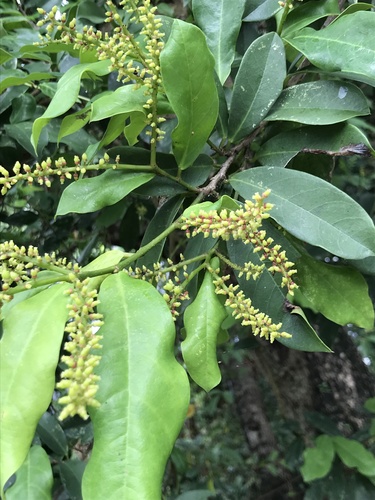
(c) biobank-lantauhk, some rights reserved (CC BY-NC), uploaded by biobank-lantauhk
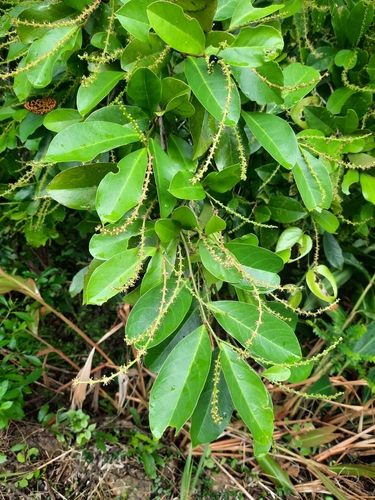
(c) johnallcock, some rights reserved (CC BY-NC)

(c) Chen Shu, some rights reserved (CC BY-NC), uploaded by Chen Shu
What to Eat
Edible parts: Fruit, Leaves, Spice
Edible Parts: Fruit Leaves Edible Uses: Edible portion: Fruit, Leaves, Spice/flavoring. The fruit can be eaten raw or cooked and used in jellies, preserves etc. When fully ripe, the thin but tough-skinned fruit is juicy and slightly sweet. The fruit is likened by some people to cranberries and is eaten mainly by children. The round fruit is up to 8mm in diameter with a relatively large seed, it is used mainly for jams and jellies, though it needs extra pectin added for it to jell properly. The fruit is carried in redcurrant-like clusters of 20 - 40 near the shoot tips. Some tasters detect a bitter or unpleasant aftertaste, unnoticeable to others. If the extracted bignay juice is kept under refrigeration for a day or so, there is settling of a somewhat astringent sediment, which can be discarded, thus improving the flavour. Young leaves can be eaten raw in salads or steamed and used as a side dish with rice. A slightly sour flavour, the leaves turn brown when cooked but retain their texture well. They can be cooked with other foods in order to impart their sour flavour.
Known Hazards
Where to Find It
A tropical plant. It can probably grow up to 1000 m altitude in the tropics. In Indonesia it grows between 50-1,400 m above sea level. It can stand light frost. They can grow on a variety of soils. They are common and widely distributed in open places and secondary forest throughout the Philippines. It can tolerate salt. It suits the humid tropical lowlands. It suits hardiness zones 10-12. In XTBG Yunnan.
Andamans, Asia, Australia, Bangladesh, Bhutan, Brazil, Cambodia, China, Colombia, Cuba, Hawaii, Himalayas, India, Indochina, Indonesia*, Laos, Malaysia, Myanmar, Nepal, Northeastern India, Pacific, Papua New Guinea, PNG, Philippines, SE Asia, Sikkim, Singapore, Solomon Islands, South America, Sri Lanka, Thailand, Tibet, USA, Vietnam, West Indies,
How to Identify
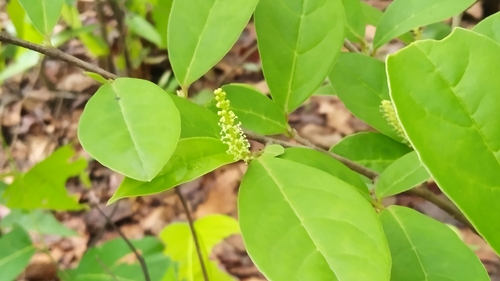
A small bushy tree. It is often 3-6 m tall. It can be up to 15-30 metres high. The leaves tend to be long and narrow and shiny. They are dark green. They are pointed at the tip and more rounded at the base. The leaves are 10-15 cm long by 5-7 cm wide. The male and female flowers are separate, on separate trees. Female flowers producing fruit are on the ends of branches. A spike of dark reddish black berries is produced. The berries are about 1 cm across and have one seed inside. They hang in a large cluster. There are 20-50 in a cluster.
Nutrition Score: 38/100
| Part | Moisture | kJ | kcal | Protein | Vit A | Vit C | Iron | Zinc |
|---|---|---|---|---|---|---|---|---|
| Fruit | 81.7 | 281 | 67 | 0.7 | 31 | 69 | 0.9 | — |
| Leaves | — | — | — | — | — | — | — | — |
How to Grow
It grows from seeds. These can be planted, but trees also grow naturally from seed. Trees can be produced by budding, grafting or from cuttings. Aerial layering can also be used. Spacing should be about 12 to 14 metres between trees. Some male trees need to be present for cross pollination. When female trees produce fruit without male trees, the seed from these fruit normally will not germinate.
Propagation: Seed - Whenever the seeds are used, they need about one month of after-ripening and can then be sown under shade without pre-treatment. Fresh seeds need pre-treatment with sulphuric acid for 15 min followed by soaking in water for 24 hours. The viability is about 3 - 70%. Depulped and dried fruits of A.bunius may be stored for 2 - 5 years in airtight containers without a serious decrease in seed viability. Vegetative propagation is preferred because seedlings are of uncertain sex and they do not commence cropping for a number of years. Greenwood cuttings. Air layering. Plants can begin producing when three years old. Grafting.
Medicinal Uses
Tonic The leaves are sudorific and employed in treating snakebite in Asia. The leaves and roots are used as medicine for traumatic injury.
Other Uses
Fibre Paper Pioneer Shelterbelt String Wood Other uses rating: Medium (3/5). Screening, Windbreaks, Public Open Space, Small Street Tree, Backyard Tree. Agroforestry Uses: A natural pioneer species, often common in the early stages of secondary forest succession and also invading marginal grassland. The tree has occasionally been employed in reforestation projects. This species seems to be an excellent choice as a pioneer for establishing a woodland, preferably used within its native range because of its tendency to invade habitats. Other Uses The bark yields a strong fibre for rope and cordage. The timber has been experimentally pulped for making cardboard. The timber is reddish and hard. If soaked in water, it becomes heavy and hard. Valued for general building, even though it is not very durable in contact with the soil and is also subject to attacks from termites. Special Uses Food Forest
Wikipedia
Source ↗Antidesma bunius is a species of fruit tree in the family Phyllanthaceae. It is native to South Asia, Southeast Asia, Melanesia, and northern Australia. It is commonly known as bignay, after its native name in the Philippines, where the fruits are commonly used for making bignay wine and jams. It is also known more ambiguously as Chinese laurel, Queensland cherry, salamander tree, wild cherry, and currant tree.
Production
Seedling trees fruit 4-5 years after planting. The fruiting season lasts a couple of months. In India plants flower and fruit April to August.
Other Information
It is a cultivated food plant. The fruit are sold in markets. This in only a minor edible fruit of lowland tropical areas. It is important in Indonesia and occasional in Papua New Guinea. The fruit are especially eaten by children.
Notes
There are about 100-170 Antidesma species.
Names & Synonyms
Amati, Anepu, Ariyaporiyan, Banshial buka, Bashial buka, Bignai, Bol-aborak, Bor-heloch, Bugnay, Buneh, Dieng-soh-silli, Herbert River cherry, Himalchari, Himalcheri, Huni, Karanda, Kantjer, Karawala keballa, Karikoomma, Kinbalin, Kunchur-kung, Kywe-pyisin, Malung renu, Malunga, Nayikoote, Nolaiali, Noolitali, Pani heloch, Pohon buni, Salamander tree, Somkongasing, Sonkong esing, Wuni
References (108)
- REFERENCES Antidesma bunius
- Airy Shaw, 1972, Kew Bulletin 26(2) p 353
- Alegado, A. M. & De Guzman, R. B., 2014, Indigenous food crops of the Aetas tribe in the Philippines and their traditional methods of food preparation. in Promotion of Underutilized Indigenous Food Resources for Food Security and Nutrition in Asia and Pacific. FAO. Bangkok p 160
- Ambasta S.P. (Ed.), 2000, The Useful Plants of India. CSIR India. p 45
- Anon , 1921, Philipp. Agric Rev. 14 p 243
- Arora, R. K., 2014, Diversity in Underutilized Plant Species - An Asia-Pacific Perspective. Bioversity International. p 57
- Ashton, M. S., et al 1997, A Field Guide to the Common Trees and Shrubs of Sri Lanka. WHT Publications Ltd. p 193
- Bailey, F M., 1902, Rep British New Guinea p 3
- Bajpai, O., et al, 2015, Tree species of the Himalayan Terai region of Uttar Pradesh, India: a checklist. Check List 11(4): 1718
- BARC, 2016, State of Biodiversity for Food and Agriculture in Bangladesh. Bangladesh Agricultural Research Council.
- Barcelo, R., 2015, Phytochemical Screening and Antioxidant Activity of Edible Wild Fruits in Benguet, Cordillera Administrative Region, Philippines. Electronic Journal of Biology, 2015, Vol.11(3): 80-89
- Barwick, M., 2004, Tropical and Subtropical Trees. A Worldwide Encyclopedic Guide. Thames and Hudson p 28
- Bircher, A. G. & Bircher, W. H., 2000, Encyclopedia of Fruit Trees and Edible Flowering Plants in Egypt and the Subtropics. AUC Press. p 34
- Black, A A 1870, Treasures Botany 1:75
- Blench, R., 2004, Fruits and Arboriculture in the Indo-Pacific Region. Indo-Pacific Prehistory Association Bulletin 24. (Taipei Papers Volume 2) p 34
- Bodner, C. C. and Gereau, R. E., 1988, A Contribution to Bontoc Ethnobotany. Economic Botany, 43(2): 307-369
- Brown, W.H., 1920, Wild Food Plants of the Philippines. Bureau of Forestry Bulletin No. 21 Manila. p 80
- Brown, 1951, Useful Plants of the Philippines p 296
- 1977, Buah Buahan, Lembaga Biologi Nasional p 26
- Burkill, I H, 1935, A Dictionary of the Economic Products of the Malay Peninsula p 185
- Carig, Elizabeth T., 2020, Guidebook on Native Trees within the Quirino Forest Landscape. Plaridel, Bulacan, St. Andrew Publishing House. p 39
- Chakraborty, S. & Chaturbedi, H. P., 2014, Some Wild Edible Fruits of Tripura- A Survey. Indian Journal of Applied research. (4) 9
- Cherikoff V. & Isaacs, J., The Bush Food Handbook. How to gather, grow, process and cook Australian Wild Foods. Ti Tree Press, Australia p 144, 198
- Chua-Barcelo, R. T., 2014, Ethnobotanical survey of edible wild fruits in Benguet, Cordillera administrative region, the Philippines. Asian Pac. J. Trop. Biomed. 4(Suppl. 1):S525-S538
- Cook, A A., 1975, Diseases of Tropical; and Subtropical fruits and nuts. Hafner
- Cooper W & Cooper W T, 1994, Fruits of the Rain Forest. RD Press p 34
- Cooper, W. and Cooper, W., 2004, Fruits of the Australian Tropical Rainforest. Nokomis Editions, Victoria, Australia. p 172
- Corner, Wayside Trees of Malaya p 231
- Coronel, R.E., 1982, Fruit Collections in the Philippines. IBPGR Newsletter p 6
- Cribb, A.B. & J.W., 1976, Wild Food in Australia, Fontana. p 22
- Cundall, P., (ed.), 2004, Gardening Australia: flora: the gardener's bible. ABC Books. p 161
- Darley, J.J., 1993, Know and Enjoy Tropical Fruit. P & S Publishers. p 119
- Delang, C. O., 2007, Ecological Succession of Usable Plants in an Eleven-Year Fallow Cycle in North Lao P.D.R., Ethnobotany Research and Applications. Vol. 5:331-350
- Dobriyal, M. J. R. & Dobriyal, R., 2014, Non Wood Forest Produce an Option for Ethnic Food and Nutritional Security in India. Int. J. of Usuf. Mngt. 15(1):17-37
- Elliot, W.R., & Jones, D.L., 1982, Encyclopedia of Australian Plants suitable for cultivation. Vol 2. Lothian. p 208
- Facciola, S., 1998, Cornucopia 2: a Source Book of Edible Plants. Kampong Publications, p 240
- Flora of China. www.eFloras.org
- French, B., 1986, Food Plants of Papua New Guinea, Asia Pacific Science Foundation p 290
- Hardwick, G., 2001, Economically Useful Plants for Northern Australia: Master Species List. Crusader eBooks.
- Hazarika, T. K., et al, 2012, Studies on wild fruits of Mizoram, India used as ethno-medicines. Genetic Resources and Crop Evolution. Published on line 03 February, 2012
- Hedricks U.P. (ed) 1919, Sturtevant’s Edible Plants of the World. Dover p 60
- Heyne, K., 1927, Nutt. Plant. Ned. Ind. p 915
- Hibbert, M., 2002, The Aussie Plant Finder 2002, Florilegium. p 30
- Hill, M. & Hallam, D., (eds), 1997, Na Hang Nature Reserve, Tat Ke Sector. Site description and conservation evaluation. Hanoi. p 77
- Hooker, Flora of British India Vol V p 357
- Hu, Shiu-ying, 2005, Food Plants of China. The Chinese University Press. p 509
- INFOODS:FAO/INFOODS Databases
- Jackes, B.R., 2001, Plants of the Tropics. Rainforest to Heath. An Identification Guide. James Cook University. p 51
- Jeeva, S., 2009, Horticultural potential of wild edible fruits used by the Khasi tribes of Meghalaya. Journal or Horticulture and Forestry Vol. 1(9) pp. 182-192
- Jose, D. T. & Sasidharan, N., 2016, Checklist of wild edible plants of Aralam Wildlife sanctuary, Kerala, India. South Indian Journal Of Biological Sciences 2016; 2(1); 141‐144
- Jones D, L, 1986, Ornamental Rainforest Plants in Australia, Reed Books, p 180, 340
- Kalshoven, L.G.E., 1951, De Plagen van de Cultuur Gewassen in Indonesie. p 1026
- Kiple, K.F. & Ornelas, K.C., (eds), 2000, The Cambridge World History of Food. CUP p 1732
- Lazarides, M. & Hince, B., 1993, Handbook of Economic Plants of Australia, CSIRO. p 22
- Lembaga Biologi Nasional, 1977, Buah-Buahan, Balai Pustaka, Jakarta. p 26
- Leon, J. 1968, Fundamentos Botanicos de los Cultiuvos Tropicales. p 350
- Llamas, K.A., 2003, Tropical Flowering Plants. Timber Press. p 187
- Lorenzi, H., Bacher, L., Lacerda, M. & Sartori, S., 2006, Brazilian Fruits & Cultivated Exotics. Sao Paulo, Instituto Plantarum de Estuados da Flora Ltda. p 410
- Macmillan, H.F. (Revised Barlow, H.S., et al) 1991, Tropical Planting and Gardening. Sixth edition. Malayan Nature Society. Kuala Lumpur. p 291
- Majumdar, K., & Datta, B. K., 2009, Traditional wild edible fruits for the forest dwellers of Tripura, India. Pleione 3(2): 167 - 178
- Maranon, J., 1935, Nutritive mineral value of Philippine food plants. Philipp. J Sci. 53:317-358.
- Martin, F.W. & Ruberte, R.M., 1979, Edible Leaves of the Tropics. Antillian College Press, Mayaguez, Puerto Rico. p 55, 179, 191
- Martin, F. W., et al, 1987, Perennial Edible Fruits of the Tropics. USDA Handbook 642 p 25
- Monsalud, M.R., Tongacan, A.L., Lopez, F.R., & Lagrimas, M.Q., 1966, Edible Wild Plants in Philippine Forests. Philippine Journal of Science. p 465
- Morton, J. F., 1987, Fruits of Warm Climates. Wipf & Stock Publishers p 210
- Neal, C.M., 1965, In Gardens of Hawaii. Bishop Museum Press.
- Nicholson, N & H., 1994, Australian Rainforest Plants 4, Terania Rainforest Publishing. NSW. p 9
- Nurfadilah, S., et al, 2017, Species richness, conservation status, and potential uses of plants in Segara Anakan Area of Sempu Island, East Java, Indonesia. BIODIVERSITAS. Volume 18, Number 4
- Ochse, J.J. et al, 1931, Vegetables of the Dutch East Indies. Asher reprint. p 262
- Ochse,J.J., Dijkman,M.J., Soule, M.J.& Wehlburg,C., 1961, Tropical and Subtropical Agriculture. P 599
- Pasha, M. K. & Uddin, S. B., 2019, Minor Edible Fruits of Bangladesh. Bangladesh J. Plant Taxon. 26(2): 299–313
- Patiri, B. & Borah, A., 2007, Wild Edible Plants of Assam. Geethaki Publishers. p 124
- Pegu, R., et al, 2013, Ethnobotanical study of Wild Edible Plants in Poba Reserved Forest, Assam, India. Research Journal of Agriculture and Forestry Sciences 1(3):1-10
- Polinag, M. A., 2003, Food from the Wilderness. Department of Environment and Natural Resources. Laguna.
- PROSEA (Plant Resources of South East Asia) handbook, Volume 2, 1991, Edible fruits and nut. p 78
- PROSEA handbook Volume 13 Spices. p 274
- Purseglove, J.W., 1968, Tropical Crops Dicotyledons, Longmans. p 139
- Queensland Forest Service, 1991, Trees and Shrubs. Department of Primary Industries. p 62
- Rajapaksha, U., 1998, Traditional Food Plants in Sri Lanka. HARTI, Sri Lanka. p 206
- Ramakrishnan, T.S., & Sundaram, N.V., 1952, A new rust on Antidesma in India. Trans. Brit. Mycol. Soc. 35:26-28
- Recher, P, 2001, Fruit Spirit Botanical Gardens Plant Index. www.nrg.com.au/~recher/ seedlist.html p 1
- Roa, J. A. G. & Boada, D. S. G., 2018, Fundación para el Fortalecimiento de la Fruticultura y Plantas Alimenticias no Convencionales en Colombia.
- Rumf. 17, Herbarium Amboinense 3, 170, p 204.
- Sarma, H., et al, 2010, Updated Estimates of Wild Edible and Threatened Plants of Assam: A Meta-analysis. International Journal of Botany 6(4): 414-423
- Savita, et al, 2006, Studies on wild edible plants of ethnic people in east Sikkim. Asian J. of Bio Sci. (2006) Vol. 1 No. 2 : 117-125
- Sawian, J. T., et al, 2007, Wild edible plants of Meghalaya, North-east India. Natural Product Radiance Vol. 6(5): p 413
- Seidemann J., 2005, World Spice Plants. Economic Usage, Botany, Taxonomy. Springer. p 45
- Singh, H.B., Arora R.K.,1978, Wild edible Plants of India. Indian Council of Agricultural Research, New Delhi. p17, 49
- Sosef, M. S. M., Hong, L. T., & Prawirohatmodjo, S., (Eds.), 1998, Timber tree: Lesser-known timbers. Plant Resources of South-East Asia, 5(3), p 74
- Sukarya, D. G., (Ed.) 2013, 3,500 Plant Species of the Botanic Gardens of Indonesia. LIPI p 128
- Syst. veg. 1:826. 1824
- Tanaka,T., 1976, Tanaka's Cyclopedia of Edible Plants of the World. Keigaku Publishing, Tokyo. p 50
- Tate, D., 1999, Tropical Fruit. Archipelago Press. Singapore. p 24
- Terra, G.J.A., 1973, Tropical Vegetables. Communication 54e Royal Tropical Institute, Amsterdam, p 25
- Townsend, K., 1994, Across the Top. Gardening with Australian Plants in the tropics. Society for Growing Australian Plants, Townsville Branch Inc. p 83
- USDA, ARS, National Genetic Resources Program. Germplasm Resources Information Network - (GRIN). [Online Database] National Germplasm Resources Laboratory, Beltsville, Maryland. Available: www.ars-grin.gov/cgi-bin/npgs/html/econ.pl (10 April 2000)
- Uphof, J.C.Th.,1968, Dictionary of Economic Plants 591pp Cramer p
- Walter, A. & Sam C., 2002, Fruits of Oceania. ACIAR Monograph No. 85. Canberra. p 278
- 1948 Wealth of India p 84
- Wiersema, J. H. & Leon, B., 2013, World Economic Plants. A Standard Reference CRC Press. 2nd Ed. p 59
- Wight, R., 1963, Icones Plantarum Indiae Orientalis Vol 3 Pl 819.
- Wild edible plants of Himachal Pradesh
- Williams, K.A.W., 1999, Native Plants of Queensland Volume 4. Keith A.W. Williams North Ipswich, Australia. p 54
- www.worldagroforestrycentre.org/treedb/
- Flora of Thailand. www.nationalherbarium.nl/thaueuph/
- World Checklist of Useful Plant Species 2020. Royal Botanic Gardens, Kew
- www.pngplants.org
- Zeven, A. C. & de West, J. M. J., 1982, Dictionary of cultivated plants and their regions of diversity. Wageningen. p 64