Antidesma dallachyanum
Baill.
Herbert River cherry

Florida Museum of Natural History Herbarium - University of Florida

Fairchild Tropical Botanical Garden Herbarium (FTG)

Fairchild Tropical Botanical Garden Herbarium (FTG)
What to Eat
Edible parts: Fruit
The fruit are eaten fresh and used to make jelly, juice, and wine. The fruit are high in Vitamin C.
Where to Find It
It is a tropical plant. It grows beside streams. It likes deep well-drained soil. It needs a warm, sheltered, frost free site. It is damaged by drought and frost.
Australia*, North America, USA,
How to Identify
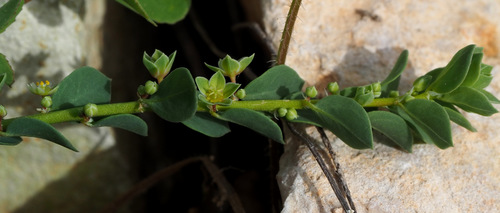
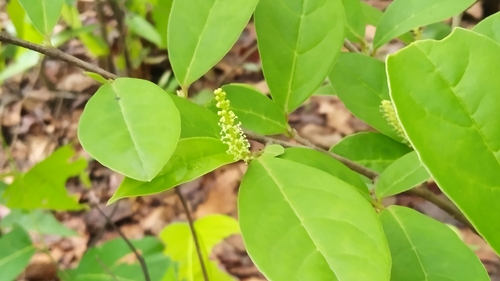
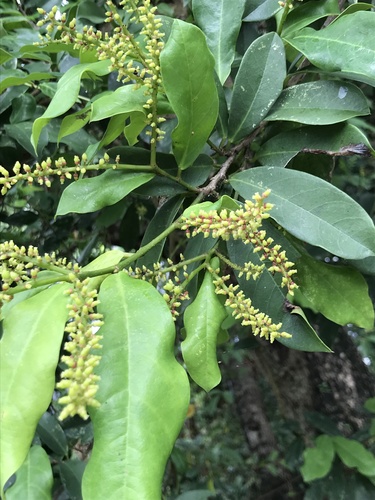
A small to medium sized tree. It grows to 6-8 m tall. It spreads 2-4 m wide. Leaves are dark green and glossy. They are 5-10 cm long by 2-3 cm wide. They are oval or sword shaped. The leaf stalks are 4-8 mm long. Male and female trees are separate. Female trees on their own can bear a small amount of fruit. The fruit occur in long currant like clusters. There are 10-30 fruit in a cluster. They are larger than bignay and black or dark purple. Fruit are 2.5 cm across.
How to Grow
Plants can be grown from seed or cuttings. They can be grafted.
Production
Plants produce fruit in its sixth year. Fruit matures in 90-150 days.
Notes
There are about 100-170 Antidesma species. The fruit are high in Vitamin C.
Names & Synonyms
Currant Tree, Wild Cherry, Woolmi
References (16)
- Adansonia 6:337. 1865
- Bircher, A. G. & Bircher, W. H., 2000, Encyclopedia of Fruit Trees and Edible Flowering Plants in Egypt and the Subtropics. AUC Press. p 34
- Bodkin, F., 1991, Encyclopedia Botanica. Cornstalk publishing, p 90
- Cherikoff V. & Isaacs, J., The Bush Food Handbook. How to gather, grow, process and cook Australian Wild Foods. Ti Tree Press, Australia p 144, 198
- Cribb, A.B. & J.W., 1976, Wild Food in Australia, Fontana. p 22
- Elliot, W.R., & Jones, D.L., 1982, Encyclopedia of Australian Plants suitable for cultivation. Vol 2. Lothian. p 208
- Facciola, S., 1998, Cornucopia 2: a Source Book of Edible Plants. Kampong Publications, p 240
- Gouldstone, S., 1983, Growing your own Food-bearing Plants in Australia. Macmillan p 132
- John, L., & Stevenson, V., 1979, The Complete Book of Fruit. Angus & Robertson p 292
- Lazarides, M. & Hince, B., 1993, Handbook of Economic Plants of Australia, CSIRO. p 22
- Leiper, G & Houser, J., Mutooroo. Plant Use by Australian Aboriginal People. Assembly press, Queensland.
- Martin, F. W., et al, 1987, Perennial Edible Fruits of the Tropics. USDA Handbook 642 p 25
- Morton, J. F., 1987, Fruits of Warm Climates. Wipf & Stock Publishers p 211
- Price, S.H. & J.L., Wild Food, Medicine and useful plants of the Wet tropics. Kwik Kopy, Cairns. p 5
- Townsend, K., 1994, Across the Top. Gardening with Australian Plants in the tropics. Society for Growing Australian Plants, Townsville Branch Inc. p 82
- World Checklist of Useful Plant Species 2020. Royal Botanic Gardens, Kew