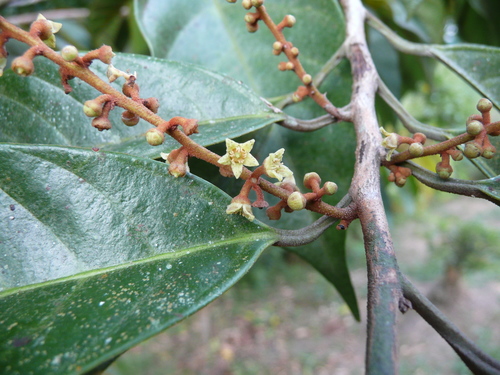
Scorodocarpus borneensis
(Baill.) Becc.
Woodland onion, Wild garlic tree

(c) Albert Freeman, some rights reserved (CC BY-NC-SA)
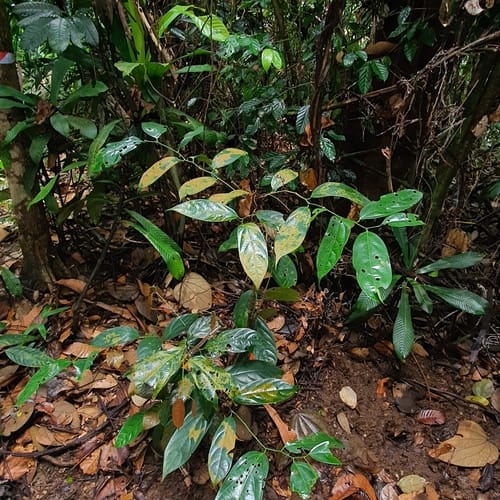
(c) pbsg, some rights reserved (CC BY)

(c) pbsg, some rights reserved (CC BY)
What to Eat
Edible parts: Leaves, Seeds, Spice, Flowers, Fruit
The fruit, seeds, young leaves, and flowers are eaten. The bark and fruit are used as seasoning to flavor food, with the fruit notably prized for their very strong garlic flavor.
Where to Find It
A tropical plant. It grows in lowland forests and up to 600 m altitude. It needs well drained soils for good growth.
Asia, Brunei, Indochina, Indonesia, Malaysia, SE Asia, Thailand,
How to Identify
A tall tree. It grows 40 m tall. The branches start at five meters above ground. The trunk is 36 cm across. The bark is cracked and brown. There is a red colour under the bark. The bark has a distinct garlic odour. The leaves are leathery and shiny green. They are 10-22 cm long by 4-9 cm wide. They are rounded at the base and taper to the tip. The flowers are white and 1.5 cm long. They can occur singly of in groups of 2-3. The fruit are round and green. They are 5 cm across. They have a hard case and a thin fleshy pulp. The fruit are edible. Young leaves are eaten as vegetables.
Nutrition Score: 44/100
| Part | Moisture | kJ | kcal | Protein | Vit A | Vit C | Iron | Zinc |
|---|---|---|---|---|---|---|---|---|
| Leaves | 66.5 | 414 | 99 | 3.7 | — | 3.5 | 0 | 10 |
How to Grow
Plants can be grown from seeds and from stumps.
Propagation: The seeds show about 70% germination in 11 - 32 months, the fruits have about 40% germination in 9 - 16 months. Before storage, seeds should be sun-dried for about 10 days.
Medicinal Uses
The fruits, and also an infusion of the bark, are sometimes used as an antidote for antiaris (Antiaris toxicaria) poisoning. An extract from the fruits has shown antimicrobial activity.
Other Uses
The heartwood is dark red brown to purple brown; the sapwood light yellow, sometimes with a transitional red-brown zone. The texture is moderately fine; the grain shallowly to deeply interlocked; lustre low. The wood is moderately durable with some resistance to termite attack, it has a strong smell of garlic when freshly cut. The wood is moderately easy to saw; it dresses and bores smoothly if the grain is not deeply interlocked. It is used for medium to heavy construction under cover (beams, joists, posts, door and window frames, flooring, rafters), bridge building, salt-water piling (with bark on), boat keels, mine props, transmission posts, agricultural implements and sleepers in temporary railway lines.
Production
It grows slowly. Fruiting is seasonal.
Other Information
The fruit are commonly used. They have a very strong garlic flavour.
Names & Synonyms
Bawang hutan, Dali-dali, Ja'oi, Kalip, Kayu hindu, Kesidu, Kesindu, Kisinduh, Kulim, Mencorug, Pohon bawang putih hutan, Pohon kesuna hutan, Sagad-berauh, Sagan-berauh, Sindok, Sindu, Troduh
References (18)
- Altschul, S.V.R., 1973, Drugs and Foods from Little-known Plants. Notes in Harvard University Herbaria. Harvard Univ. Press. Massachusetts. no. 797
- Burkill, I.H., 1966, A Dictionary of the Economic Products of the Malay Peninsula. Ministry of Agriculture and Cooperatives, Kuala Lumpur, Malaysia. Vol 2 (I-Z) p 2020
- Chai, P. P. K. (Ed), et al, 2000, A checklist of Flora, Fauna, Food and Medicinal Plants. Lanjak Entimau Wildlife Sanctuary, Sarawak. Forestry Malaysia & ITTO. p 161
- Facciola, S., 1998, Cornucopia 2: a Source Book of Edible Plants. Kampong Publications, p 162
- Flora Malesiana Vol 10 p 15
- Hoe, V. B. & Siong, K. H., 1999, The nutritional value of indigenous fruit and vegetables in Sarawak. Asia Pacific J. Clin. Nutr. 8(1):24-31
- Martin, F.W. & Ruberte, R.M., 1979, Edible Leaves of the Tropics. Antillian College Press, Mayaguez, Puerto Rico. p 208
- Menninger, E.A., 1977, Edible Nuts of the World. Horticultural Books. Florida p 9
- Milow, P., et al, 2013, Malaysian species of plants with edible fruits or seeds and their evaluation. International Journal of Fruit Science. 14:1, 1-27
- PROSEA handbook Volume 13 Spices. p 279
- Siong, K. H., 2003, Indigenous Fruits of Sarawak. Forest Department Sarawak. p 119
- Sleumer, H., 1984, Olacaceae, Flora Malesiana Series 1 Vol 10(1) p15
- Slik, F., www.asianplant.net
- Soepadmo, E. and Wong, K. M., 1995, Tree Flora of Sabah and Sarawak. Forestry Malaysia. Volume One. p 281
- Sukarya, D. G., (Ed.) 2013, 3,500 Plant Species of the Botanic Gardens of Indonesia. LIPI p 502
- Wickens, G.E., 1995, Edible Nuts. FAO Non-wood forest products. FAO, Rome. p145
- World Checklist of Useful Plant Species 2020. Royal Botanic Gardens, Kew
- Zawiah, N. & Othaman, H., 2012, 99 Spesies Buah di FRIM. Institut Penyelidikan Perhutanan Malaysia. p 216