Solanum caripense
Dunal
Tzimbalo, Pepino lloron

(c) Hinko Talsma, some rights reserved (CC BY-NC), uploaded by Hinko Talsma

no rights reserved

(c) Ana Mireya Guerrero G., some rights reserved (CC BY-NC-SA), uploaded by Ana Mireya Guerrero G.
What to Eat
Edible parts: Fruit
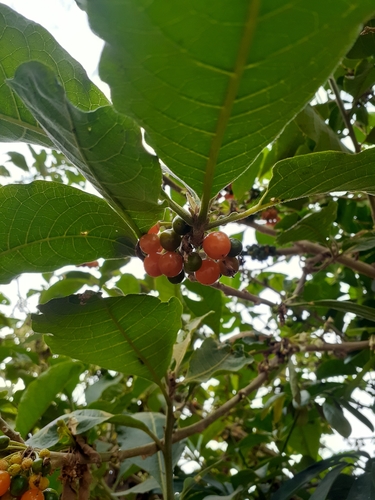
Fruit. The fruit, which is hardly larger than a cherry, is eagerly eaten by local people. It has a sweetish flavour, which makes it palatable despite having little flesh and numerous seeds. A juicy fruit that is thirst-quenching. The yellow-green, globose fruit has violet-colorued longitudinal stripes; it is up to 40mm in diameter.
Known Hazards
Where to Find It
A tropical plant. It grows on wooded slopes and along streams. It grows between 800-3,800 m above sea level. It can tolerate light frosts.
America, Andes*, Central America, Chile, Colombia, Costa Rica, Ecuador, Peru, South America*, Venezuela,
How to Identify
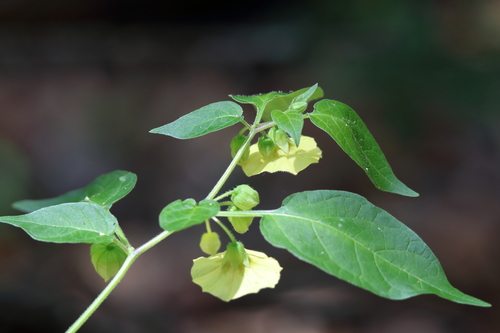
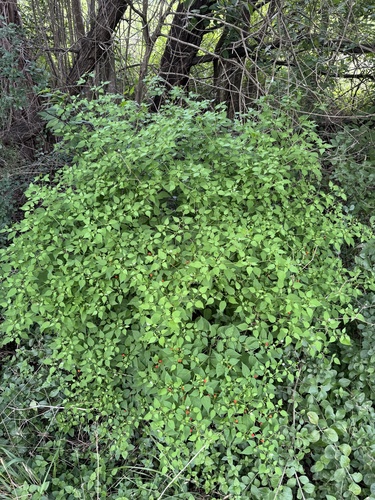
A climbing or sprawling plant. It grows 2 m long. The fruit is round and 3 cm across. They are like pepino.
How to Grow
Plants can be grown from seeds.
Propagation: Seed - sow in trays in a nursery. Prick out the seedlings into individual pots when they are large enough to handle and grow them on fast. Plant them out when 10cm or more tall. Cuttings of half-ripe wood. Very easy, the cuttings root within a couple of weeks.
Medicinal Uses
The tuber is halucinogenic.
Other Uses
The plant is used in breeding programmes to improve the pepino (Solanum muricatum).
Wikipedia
Source ↗Solanum caripense is a species of evergreen shrub native to South America and grown for its edible fruit. Rare in cultivation, it is known as tzimbalo. The fruit closely resembles the related pepino (Solanum muricatum), and it has been speculated that Solanum caripense may be the wild ancestor of the pepino. Like the pepino, the tzimbalo is a relative of other nightshades cultivated for their edible fruit, including the tomato (S. lycopersicum), the naranjilla (S. quitoense) and the eggplant (S. melongena). Solanum caripense is part of the Basarthrum clade within the broader Potato clade. The fruit is infrequently cultivated in its native range of Colombia, Ecuador, Bolivia, Peru and Chile but has been rediscovered on a small scale by heirloom gardeners elsewhere in the world.
Production
Plants produce fruit within 1-2 years from seed.
Other Information
The fruit are popular. They are cultivated.
Notes
There are about 1400 Solanum species. It will form hybrids with the pepino Solanum muricatum.
Names & Synonyms
Berriadores, Chinpalu yuyu, Cimbalo, Clavique, Durunsoga, Llorones, Simbailo
References (16)
- Facciola, S., 1998, Cornucopia 2: a Source Book of Edible Plants. Kampong Publications, p 236
- Fern, K., 2012, Tropical Species Database http://theferns.info/tropical/
- Kermath, B. M., et al, 2014, Food Plants in the Americas: A survey of the domesticated, cultivated and wild plants used for Human food in North, Central and South America and the Caribbean. On line draft. p 815
- Lopez-Diago, D. & Garcia, N., 2021, Wild edible fruits of Colombia. Biota ColomBiana 22 (2) p 52
- Martin, F.W., C.W. Campbell and R.M. Ruberté, 1987, Perennial edible fruits of the tropics - An inventory. United States Department of Agriculture, Agricultural Research Service, Agriculture Handbook No. 642. Washington, D.C., USA.
- National Research Council, 1989, Lost crops of the Incas: little-known plants of the Andes with promise for worldwide cultivation. National Academy Press, Washington DC, U.S.A.
- NYBG Herbarium "edible"
- Roa, J. A. G. & Boada, D. S. G., 2018, Fundación para el Fortalecimiento de la Fruticultura y Plantas Alimenticias no Convencionales en Colombia.
- Samuels, J., 2015, Biodiversity of Food Species of the Solanaceae Family: A Preliminary Taxonomic Inventory of Subfamily Solanoideae. Resources 2015, 4. 277-322
- Solan. syn. 8. 1816
- Torre, de la, L., et al, 2008, Enciclopedia de las Plantas Útiles del Ecuador. Herbario QCA. Pontificia Universidad Católica del Ecuador. p 590
- Van den Eynden, V., et al, 2003, Wild Foods from South Ecuador. Economic Botany 57(4): 576-603
- Van den Eynden, V., 2004, Use and management of edible non-crop plants in southern Ecuador, Ph D dissertation. p 108
- Van den Eynden, V., et al, 2004, Regional and ecological variations of wild edible plants in southern Ecuador. Lyonia. 7(2)
- Van den Eynden, V., & Cueva, E., 2008, Las plantas en la alimentacion. Enciclopedia de las Plantas Utiles del Ecuador. Herbario QCA & Herbario AAU. Quito & Aarhus. 2008: 62–66
- Wikipedia