Solanum centrale
J. Black
Desert raisin, Bush tomato

(c) Tony Bean, some rights reserved (CC BY-NC), uploaded by Tony Bean
(c) Dr Manfred Jusaitis, some rights reserved (CC BY-NC)
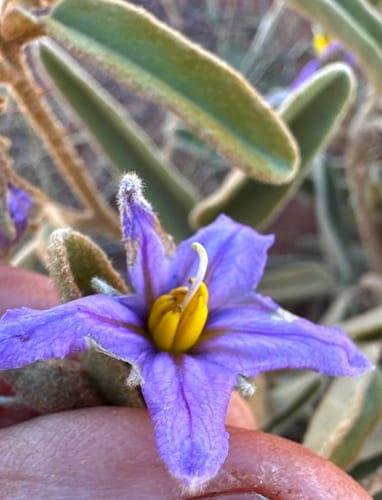
(c) Dr Manfred Jusaitis, some rights reserved (CC BY-NC)
What to Eat
Edible parts: Fruit, Spice
The ripe fruit can be eaten dried or ground into a powder and used as a spice in sauces, chutneys, relishes, jams, and as a topping for focaccia. The fruit can also be preserved in oil. The plant is high in Vitamin C.
Known Hazards
Where to Find It
A tropical plant. They thrive after bush fires. It can grow in arid places.
Australia*,
How to Identify
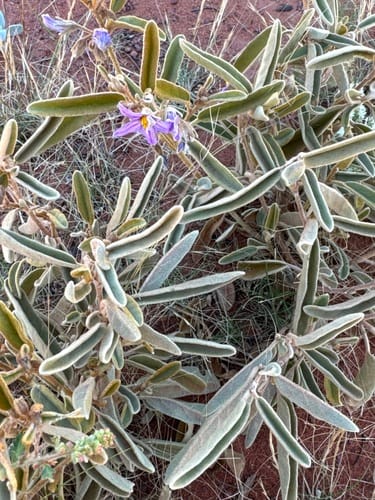
A plant which keeps growing from year to year. It has woody stems. There are long sharp thorns at intervals of 5-8 cm. The leaves are soft and greyish-green and covered with down. The young leaves are rust coloured. The flowers are violet and the shape of a five pointed star. The fruit are 2 cm across. They are purplish-green when young and pale yellow when ripe. The fruit are sticky.
Nutrition Score: 63/100
| Part | Moisture | kJ | kcal | Protein | Vit A | Vit C | Iron | Zinc |
|---|---|---|---|---|---|---|---|---|
| Fruit dried | 12.5 | 1174 | 281 | 8.5 | — | 17 | 11 | 1.4 |
| Fruit | 61.9 | 570 | 136 | 3.8 | — | 19 | 2.9 | 0.1 |
How to Grow
Plants are grown from seed.
Propagation: Seed - sow in trays in a nursery. Prick out the seedlings into individual pots when they are large enough to handle and grow them on fast. Plant them out when 10cm or more tall. Division of the stems..
Other Uses
An extract of the fruit is used as an ingredient in commercial cosmetic preparations as a skin conditioner.
Wikipedia
Source ↗Solanum centrale, the kutjera, or Australian desert raisin, is a plant native to the more arid parts of Australia. Like other "bush tomatoes", it has been used as a food source by Central Australia and Aboriginal groups for millennia. Solanum centrale was first described by J.M. Black in 1934. Like many plants of the genus Solanum, desert raisin is a small bush and has a thorny aspect. It is a fast-growing shrub that fruits prolifically the year after fire or good rains. It can also grow back after being dormant as root stock for years after drought years. The fruit are 1–3 cm in diameter, yellow in color when fully ripe, vitamin C-rich and possibly a source of vitamin D. These fruits dry on the bush, look like raisins and have a strong, pungent taste of tamarillo and caramel that makes them popular for use in sauces and condiments. They can be obtained either whole or ground, with the ground product (sold as "kutjera powder") easily added to bread mixes, salads, sauces, cheese dishes, chutneys, stews or mixed into butter. Martu people would skewer bush tomatoes and dry them so the food was readily transportable.
Production
The ripe fruit are dried and darken to chocolate brown. They can be powdered. The dried, powdered fruit can be stored for long periods. The drying is important to reduce the levels of alkaloids.
Notes
There are about 1400 Solanum species. It is high in Vitamin C.
References (29)
- Alice, L. & O'Quinn, T., Australian Bush Superfoods. Explore Australia p 82
- Bindon, P., 1996, Useful Bush Plants. Western Australian Museum. p 230
- Bonney, N., 1997, Economic Native Trees and Shrubs for South Australia. Greening Australia (SA) inc. Campbelltown SA 5074 p 161
- Bonney, N., 2012, Edible Wild Native Plants for Southern Australia. p 76
- Cancilla, D., 2018, Ethnobotanical and Ethnozoological Values Desktop Assessment - Eliwana Project. p 15
- Cherikoff V. & Isaacs, J., The Bush Food Handbook. How to gather, grow, process and cook Australian Wild Foods. Ti Tree Press, Australia p 191
- Facciola, S., 1998, Cornucopia 2: a Source Book of Edible Plants. Kampong Publications, p 236
- Hardwick, G., 2001, Economically Useful Plants for Northern Australia: Master Species List. Crusader eBooks.
- Hemphill, I, 2002, Spice Notes. Macmillan. p 88
- INFOODS:FAO/INFOODS Databases (As Solanum central)
- Isaacs, J., 1987, Bush Food, Aboriginal Food and Herbal Medicine. Weldons. p 66
- Lang, P. J., et al, 1986, Anangu Pitjantjatjara Lands Biological Survey. p 42
- Latz, P.K., 1996, Bushfires and Bushtucker: Aboriginal plant use in Central Australia. IAD Press Alice Springs p 269
- Latz, P & Wightman, G., 1995, Desert Bush Tucker Identikit. Common Native Food Plants of Central Australia. Parks & Wild Commission Northern territory. p 36
- Lazarides, M. & Hince, B., 1993, Handbook of Economic Plants of Australia, CSIRO. p 221
- Low, T., 1991, Wild Food Plants of Australia. Australian Nature FieldGuide, Angus & Robertson. p 166
- Low, T., 1992, Bush Tucker. Australia’s Wild Food Harvest. Angus & Robertson. p 66
- Miers, G., 2004, Cultivation and sustainable wild harvest of Bushfoods by Aboriginal Communities in Central Australia. RIRDC report W03/124 p 20
- NTBG herbarium "edible"
- Paczkowska, G . & Chapman, A.R., 2000, The Western Australian Flora. A Descriptive Calatogue. Western Australian Herbarium. p 537
- Pascoe, B., 2018, Dark Emu. 2018, Aboriginal Australia and the birth of Agriculture. Magabala books, p 31
- Recher, P, 2001, Fruit Spirit Botanical Gardens Plant Index. www.nrg.com.au/~recher/ seedlist.html p 3
- Robins, J., 1996, Wild Lime. Cooking from the Bush food garden. Allen & Unwin p 2
- Samuels, J., 2015, Biodiversity of Food Species of the Solanaceae Family: A Preliminary Taxonomic Inventory of Subfamily Solanoideae. Resources 2015, 4. 277-322
- Self, M., 199, Phoenix Seeds catalogue. p 15
- Smith, K & I., 1999, Grow your own bushfoods. New Holland. Australia. p 65
- Smith, N. M., 1991, Ethnobotanical Field Notes from the Northern Territory, Australia, J. Adelaide Bot. Gard. 14(1): 1-65
- Urban, A., 1990, Wildflowers of Inland Australia. Portside editions. p 169
- Wheeler, J.R.(ed.), 1992, Flora of the Kimberley Region. CALM, Western Australian Herbarium, p 726