Solanum echinatum
R.Br.
Spiny tomato
iNaturalist · cc-by-nc
(c) awkastrait, some rights reserved (CC BY-NC)
(c) awkastrait, some rights reserved (CC BY-NC)
iNaturalist · cc-by-nc
(c) Chris Martine, some rights reserved (CC BY-NC)
(c) Chris Martine, some rights reserved (CC BY-NC)
What to Eat
Edible parts: Fruit
The fruit is eaten.
Where to Find It
A tropical plant. Plants grow naturally in sandstone country.
Australia*,
Countries: Australia
How to Identify
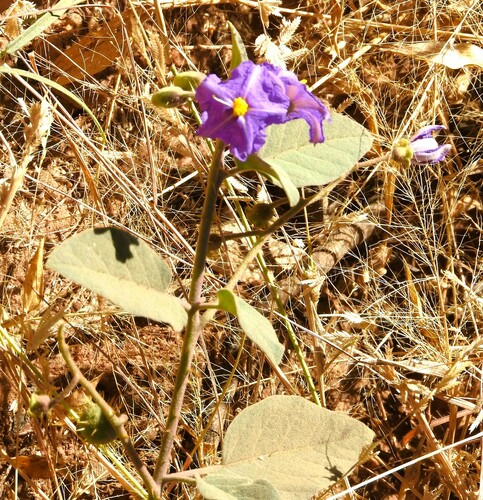
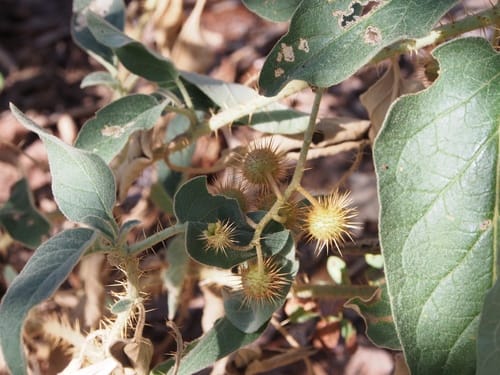
A shrub. It can be upright or lay over. It is 0.5 m high. Most parts of the plant are hairy. The leaves are very hairy. The leaves are oval and vary in size. The blade can be 3-6 cm long by 2-3 cm wide. They are grey-green. The flowers are purple with yellow centres. They are 1.5-2 cm across. Several flowers occur together in the axils of the leaves. The fruit is nearly round. It is a fleshy berry. They are 1-1.5 cm across. They have a thorny calyx around them. The fruit are pale green when ripe. There are many seeds inside.
Nutrition Score: 38/100
| Part | Moisture | kJ | kcal | Protein | Vit A | Vit C | Iron | Zinc |
|---|---|---|---|---|---|---|---|---|
| Fruit | 71.8 | 302 | 72 | 2 | — | — | 5.9 | 1.2 |
Notes
There are about 1400 Solanum species.
References (7)
- Brock, J., 1993, Native Plants of Northern Australia, Reed. p 300
- Cherikoff V. & Isaacs, J., The Bush Food Handbook. How to gather, grow, process and cook Australian Wild Foods. Ti Tree Press, Australia p 120, 201
- Hiddins, L., 1999, Explore Wild Australia with the Bush Tucker Man. Penguin Books/ABC Books. p 168
- Paczkowska, G . & Chapman, A.R., 2000, The Western Australian Flora. A Descriptive Calatogue. Western Australian Herbarium. p 537
- Townsend, K., 1994, Across the Top. Gardening with Australian Plants in the tropics. Society for Growing Australian Plants, Townsville Branch Inc. p 336
- Vigilante, T., et al, 2013, Island country: Aboriginal connections, values and knowledge of the Western Kimberley islands in the context of an island biological survey. Records of the Western Australian Museum Supplement 81: 145-182
- Wheeler, J.R.(ed.), 1992, Flora of the Kimberley Region. CALM, Western Australian Herbarium, p 730